
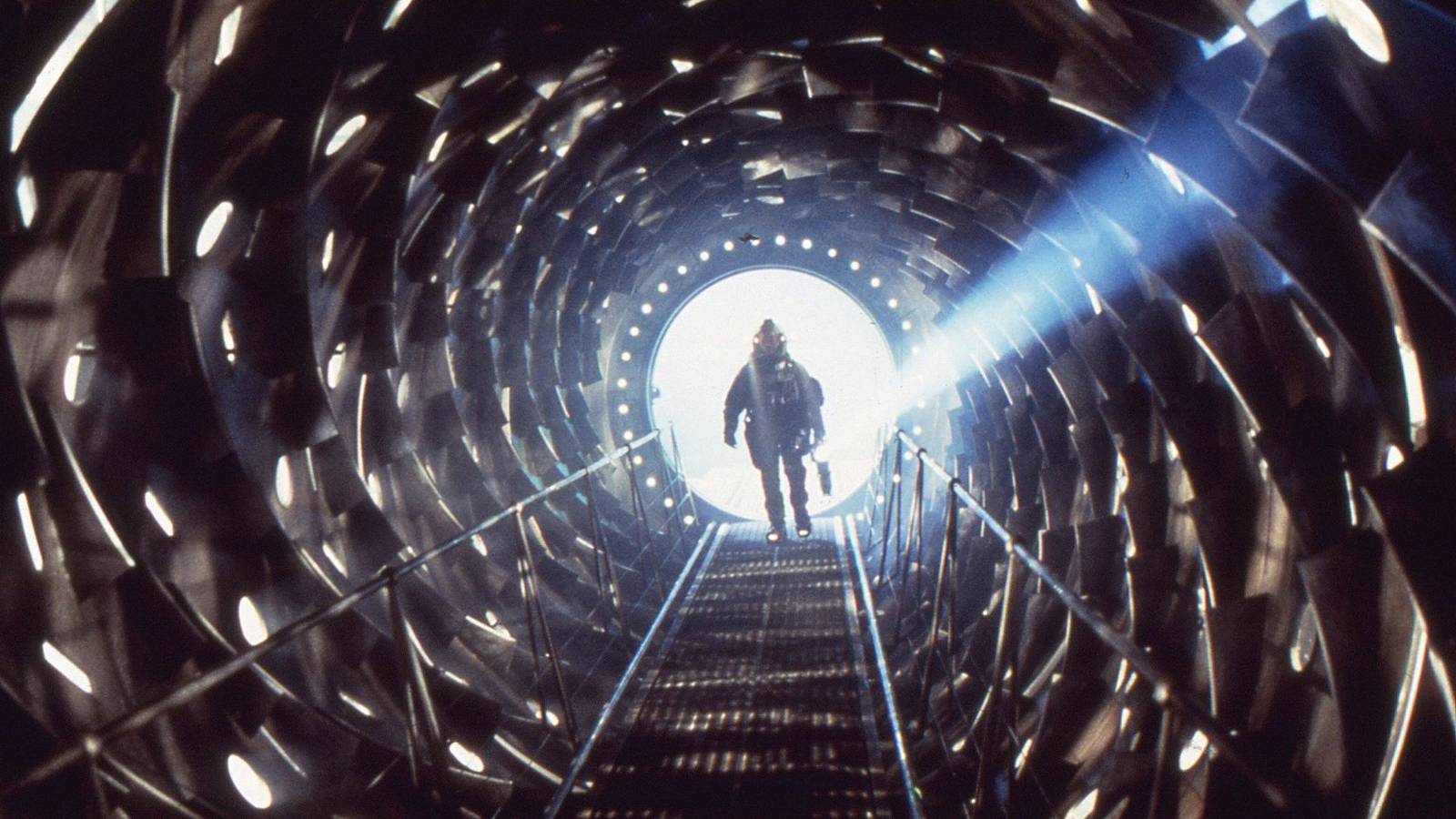
The master H.P. Lovecraft's fingerprints are all over modern sci-fi and horror, but there are surprisingly few direct adaptations of the master's work, aside from cult favorites like Stuart Gordon's Reanimator and Richard Stanley's unhinged Color Out of Space. Filmmakers have, somewhat understandably, struggled to translate his stories off the page. The very essence of what makes something Lovecraftian in the first place is exactly what makes adapting his stories into conventional movies complex. Hollywood has usually gone in the other direction, typically showing the monster, whether in horror movies or sci-fi. This is possibly because there is comfort in even the most hidden threat being revealed and conquered by the end. That means they tend not to lean into the same sort of existential dread that sits at the heart of Lovecraft. Fortunately, though, some of the greatest sci-fi movies ever made do capture that Lovecraftian spirit, so fans of his original works can appreciate some of that dark magic. First, a rule to clarify: these aren't movies based on the works of Lovecraft directly; rather, these nine sci-fi movies have the qualities of Lovecraft's creative philosophy and his vision of cosmic horror. 9 Event Horizon (1997) Completely savaged by critics and a legitimate box office bomb when it was released in 1997, Paul W.S. Anderson's Event Horizon has gone on to become a huge cult gem over the past almost three decades. The notoriously haunting horror movie follows the crew of a rescue ship investigating the titular starship, which vanished into a black hole and then mysteriously reappeared, and it features some of the most genuinely disquieting horror sci-fi scenes ever committed to screen. Blending hard sci-fi with pure cosmic nightmare fuel, Event Horizon ignored the allure of alien enemies to instead introduce the idea of an experimental gravity drive that opened a doorway to a chaotic dimension that is essentially just hell. The ship itself feels like a living creature, haunted and corrupted by its experience in that unfathomable realm, which causes the crew to self-mutilate and fall to raving madness. Even when studio interference mandated cuts to remove some of its infamous gore, Event Horizon still nails the Lovecraftian terror of humanity experiencing horrors beyond our normal comprehension. 8 Underwater (2020) William Eubanks' terribly underrated Underwater is strong evidence that the sci-fi genre has not plumbed the depths of the oceans as much as it probably should have. Released in the notorious dead zone of January 2020 and starring Kristen Stewart as a mechanical engineer trapped in a drilling station in the Mariana Trench, the film is a relentless exercise in dread and atmosphere. It deserves a lot more love than it actually got. It starts as a sort of alien-like deep-sea survival thriller, but then gradually reveals the truth as something far older and more sinister lurks in the dark depths. Underwater ingeniously mines the same sense of dread that other open-water horrors, even Jaws, used so well to remove the audience's sense of comfort. In this case, the idea of ocean isolation is far more Lovecraftian, as the author showed an obsession with sunken cities and ancient marine gods. When the tentacled monster finally reveals itself in the climax to be Cthulhu himself, Underwater confirms itself to be the closest thing to a big-budget Mythos blockbuster ever made. 7 The Mist (2007) Image courtesy of MovieStillsDb In 2007, Frank Darabont adapted Stephen King's novella. Again, while it was a moderate box office success, audiences were somewhat divided, mostly because of its notoriously bleak ending. Critics, on the other hand, loved it. It tells the tale of a strange, thick fog that takes over a small Maine town after a severe storm, and the bizarre spider-like predators hidden within it that attack the locals. Stephen King has always worn his Lovecraft influences proudly on his sleeve, and Darabont took the opportunity with The Mist to lean heavily into the cosmic dread of the story. Even when they're hidden in fog, the monsters are terrifying, especially the colossal behemoth that reveals itself towards the end. On a more existential level, The Mist also explores the horrors of how quickly human society will collapse when confronted with such an inexplicable horror. 6 Annihilation (2018) Poorly marketed by Paramount, Alex Garland's Annihilation nevertheless attracted high praise from critics. Despite audiences not coming out to theaters for it, it is now widely considered one of the best sci-fi movies of its period. Loosely based on Jeff VanderMeer's novel, it follows a team of scientists entering the Shimmer, an expanding electromagnetic quarantine zone that mutates everything within it. Annihilation's visuals feel like they've been lifted directly out of Color Out of Space. There is a very discomforting horror in the fact that the alien force behind the mutations does so without malice or any complex logic beyond the fact that that is what it does. Even the score itself feels almost Lovecraftian, and the unforgettable ending is one that will stick with you for a long time. Overall, Annihilation is peak cerebral cosmic horror - a label that Paramount had apparently feared would be unmarketable to general audiences. 5 The Void (2016) Far less known than some of the other movies on this list, this crowdfunded Canadian indie is absolutely worth tracking down. Directed by Stephen Kostanski and Jeremy Gillespie, The Void attracted glowing praise for its old-school approach to practical creature effects, and it's genuinely chilling. The story traps a small group of cops, staff, and patients inside a nearly deserted rural hospital, surrounded by silent robe-wearing cultists. Inside the building, it descends into a blood-soaked labyrinth of mutating flesh and dimensional rifts. The Void is a self-conscious, full-blooded Lovecraftian gem, which blends body horror with occult fanaticism, ancient evils, and glimpses of an alien abyss ruled by colossal gods. The fact that it cost so little and got so much out of that micro budget makes it even more remarkable. 4 In the Mouth of Madness (1994) Sam Neill has something of a micro-industry for Lovecraftian horrors, and three years before he starred in Event Horizon, he was at the heart of the final entry in John Carpenter's unofficial Apocalypse trilogy. As seems to be the case with most Lovecraftian sci-fis, In the Mouth of Madness flopped in theatres, and critics weren't exactly bowled over. And again, time has been very kind to it. It seems that filmmakers who invest in this sort of story just have to be patient to find their audience. Neill plays a cynical insurance investigator hired to track down Sutter Kane, the popular horror novelist whose books literally drive readers insane. Obviously, the title is a direct nod to Lovecraft's At the Mountains of Madness, which has long been considered unadaptable. The movie also features a lot of Mythos Easter eggs. Carpenter uses the concept of forbidden knowledge at the heart of his horror to terrify you with the idea that simply reading the wrong words can unravel everything you think you know about reality. Neill is excellent, and watching his skepticism erode as ancient monsters reclaim the earth is brilliant Lovecraftian absurdity. 3 The Endless (2017) Directed by and starring indie filmmaking duo Justin Benson and Aaron Moorhead, The Endless was another tiny festival darling that outgrew its beginnings with near-universal critical acclaim, despite its tiny budget. The directors play brothers who escape a UFO death cult and then, a decade later, return to the camp after receiving a mysterious videotape. Once there, they're confronted with the grim reality that the cult's bizarre beliefs might actually be real, as one of them is seduced by what they're selling. Rather than relying on actors in rubber monster suits to get some cheap thrills, Benson and Muirhead conjure dread through off-screen presences, illogical visuals, broken physics, and localized time loops that trap cult members and see them killed over and over for the amusement of an ancient entity. The introduction of that godlike entity is an inspired hat-tip to Lovecraft, as it operates completely outside of human morality and is utterly incomprehensible. 2 The Thing (1982) Again, the thing was pretty much a disaster when it was released in 1982, with some critics disgusted with John Carpenter's sci-fi horror and audiences completely dismissive of the supposedly nihilistic exercise in gross-out horror. Today, we all recognize it as Carpenter's masterpiece and one of the greatest sci-fi horrors ever made. It was based on John W. Campbell Jr.'s novella Who Goes There? and follows, nicely, an Antarctic research team hunted by a shape-shifting extra-alien that takes over the bodies of the survivors. The bleak frozen setting conjures the same feel as At the Mountains of Madness, and Rob Bottin's practical effects brilliantly turn normal human anatomy into unthinkable, nightmarish body horror creations. But best of all, and most Lovecraftian of all, is how Carpenter uses paranoia against the audience and the characters until the final revelation that everybody involved is entirely at the mercy of an ancient organism against whom resistance is basically futile. 1 Alien (1979) At this point, everybody who likes sci-fi and horror has seen Ridley Scott's Alien to the point where it basically needs no introduction. The 1979 masterpiece launched a massive franchise that continues today and earned universal acclaim alongside a massive box office return.While it is absolutely a slasher movie set in space with an alien killer in the shadows, its DNA belongs to Lovecraft, and we find that out the moment the Nostromo crew sets foot on the planet LV-426.Alongside the conventional slasher movie approach to the thrills, Ridley Scott builds a heavy, complex lore in the background, starting with the towering fossilized space jockey and H.R. Giger's biomechanical nightmare designs. This isn't some new, scientifically created monster: Alien presents a universe that is ancient and not just indifferent to human survival, but seemingly weaponized very much against it.The Xenomorph is the ultimate cosmic predator, devoid of emotion and morality, and the perfect reminder of just how insignificant humanity is in the dark void of space. Even the warning that "in space nobody can hear you scream" feels like Lovecraftian dread as a marketing technique, and the more that was revealed by later additions to the franchise, the more Lovecraftian it all got.
9 Most Lovecraftian Sci-Fi Movies Of All Time
Full Article
Original Source
Read the full article at Screenrant →KhanList aggregates and links to publicly available news content. We do not host full articles from third-party sources. Always verify important information with original sources.