
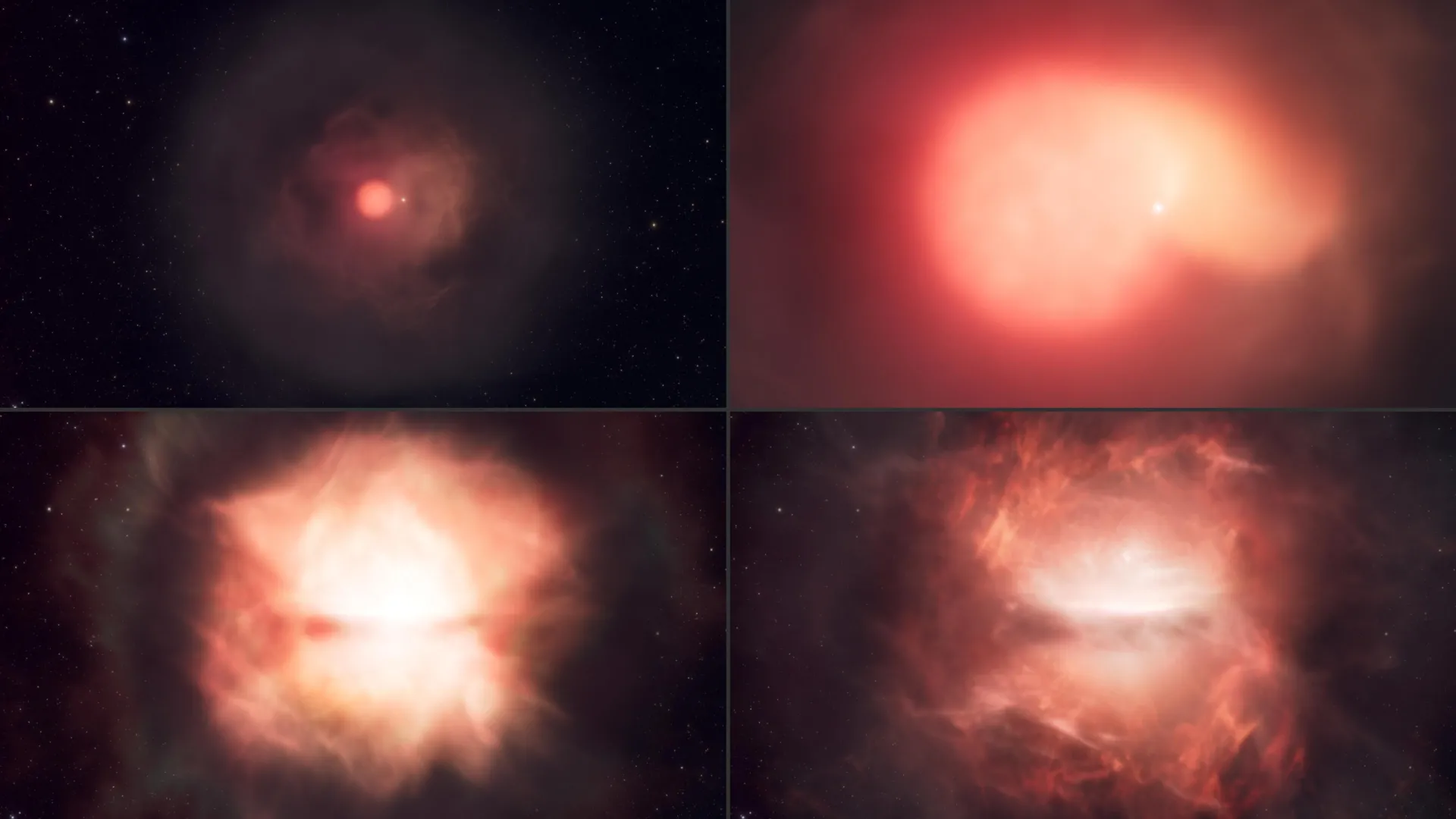
Astronomers have uncovered an extraordinary stellar collision in the neighboring Andromeda galaxy, where a smaller star spiraled into a gigantic supergiant and ultimately merged with it. The rare event, the first of its kind to be identified, left behind a single star that may have been given a new lease on life. Researchers have nicknamed the resulting star Bao, describing it as potentially "rejuvenated" by the merger. The smaller star was slightly less massive than our Sun, while its enormous companion was a swollen supergiant. The dramatic encounter took place near the outer edge of Andromeda and was investigated through a NASA-funded research effort. Observations from NASA's James Webb Space Telescope provided crucial evidence of what happened. By combining Webb's findings with years of measurements from ground-based and space telescopes, scientists were able to reconstruct the stars' remarkable transformation. "Stellar mergers are very, very difficult to observe in real time because they are hard to predict," said Viraj Karambelkar, the first author of a new paper in Nature and a NASA Hubble Fellow at Columbia University in New York. "However, we noticed something unusual was going on in 2023 and continued to monitor the system to see what it would do. Then, in 2025, it erupted! Webb observed Bao only 47 days after the stars' eruption peaked, the earliest ever follow-up of an event like this. The telescope's data helped us characterize what the system looked like before, during, and immediately after the merger, which is absolutely mind-blowing." How a Giant Star Swallowed Its Companion For thousands of years, the two stars existed as a binary system, orbiting one another without merging. That long period of relative stability ended when the smaller star began brushing against the enormous outer atmosphere of its companion. Once that interaction started, the process moved surprisingly quickly. The two stars completed their "unification" after just seven additional orbits (about seven years). Previously observed mergers involving pairs of smaller stars had required thousands of orbits to reach the same outcome. The speed of the final eruption also caught astronomers off guard. "We thought an outburst from such an extended star would take years," said co-author Nadia Blagorodnova, an associate professor at the University of Barcelona in Spain. "One day, its brightness started rising and within a week, it peaked!" Scientists had already detected subtle warning signs before the eruption. As the smaller star moved through the giant's outer atmosphere, it disturbed the surrounding gas and began stripping away material, gradually changing the system's brightness. "When a companion star begins to interact with the outer surface of the primary star, it produces a subtle effect -- a slow brightening, which we clearly saw in Bao's data," said co-author Kishalay De, an assistant professor at Columbia University in New York. "As the companion continues its orbit, it keeps peeling off the primary star's outer layers, and that gas flows away into the surrounding space." A Violent Stellar Merger With More Than One Possible Outcome This kind of interaction is part of a process astronomers call common envelope evolution. It occurs when two stars become surrounded by a shared outer layer of gas, typically after one star expands enough to engulf its companion. As the smaller star moves through that gas, resistance slows its orbit and drains away orbital energy. The companion can then spiral progressively deeper toward the center of the larger star. For Bao, the smaller star ultimately plunged inward and merged with the giant. Webb's observations provided the evidence needed to confirm that the stars had become one. But such encounters do not always end with a merger. Sometimes, both stars survive, losing substantial amounts of material while emerging as two separate objects locked in much tighter orbits. These surviving systems are important because they can eventually produce some of the universe's most extreme phenomena. Depending on how the stars evolve, they may become neutron stars or black holes, undergo violent supernovae, generate gravitational waves that ripple through space-time, or form rapidly rotating objects called millisecond pulsars. Understanding common envelope evolution is therefore essential to explaining how many of these extraordinary cosmic objects come into existence. Reconstructing the Collision With James Webb To understand exactly what happened to Bao, the researchers refined computer simulations of the two stars and compared the results with Webb's observations. The telescope's mid-infrared measurements were particularly valuable because they revealed dust that the giant star had expelled over hundreds of years. Infrared light allows astronomers to study material that can be difficult to detect at visible wavelengths, offering clues about the system's history long before its final eruption. The simulations revealed that the larger star had been truly enormous. Before the merger, it was approximately seven times as massive as the Sun, had a radius 350 times larger, and shone with 18,000 times the Sun's brightness. Those staggering proportions earned it the nickname "Big Bao." "It was an absolute beast of a star, completely outshining its companion in the data," said co-author Karel Temmink, a Ph.D. student at Radboud University in Nijmegen, Netherlands, who led the simulations. The researchers also calculated the mass of the smaller star for the first time. Nicknamed "Little Bao," it was likely somewhat smaller and dimmer than the Sun, with an estimated mass of (about 0.7 solar masses). In other words, it contained roughly 70% as much mass as our star. At first, the simulations suggested that the smaller companion might have retained enough energy to "flee" the giant's gravitational grip and escape the encounter. Further investigation, however, revealed a very different ending. Little Bao had been dragged deep into the core of Big Bao, releasing an immense amount of energy as the two stars merged. Their final encounter was "almost like a bomb exploding inside a living star," De said. The merger has left astronomers with another important question: What is Bao like now? The surviving star contains the legacy of both original stars, but its final structure and mass distribution remain uncertain. Future observations will be needed to determine how its "heft" settles as the newly merged object evolves. Years of Telescope Observations Reveal the Warning Signs One reason this discovery is so valuable is that scientists had been watching Bao long before its dramatic eruption. Although Webb supplied crucial information about the amount of material expelled and how efficiently the common envelope process unfolded, the team also drew on ultraviolet, visible, and near-infrared observations from multiple observatories. Together, these measurements provided a detailed record of the system's changing behavior as the merger approached and unfolded. The researchers had even published an earlier study shortly before the stars erupted. (In fact, they published their first paper right before the eruption in 2025.) The first major clue appeared in February 2023, when astronomers examining archived observations from NASA's retired NEOWISE (Near-Earth Object Wide-Field Infrared Survey Explorer) mission noticed a star whose brightness was behaving unusually. Earlier records showed that the object had maintained a steady luminosity before 2018. Its later variations suggested that something significant was beginning to change. By September 2024, observations from the Wide-field Infrared Transient Explorer (WINTER) showed further evidence of activity. The system was growing brighter and releasing dust into the surrounding space. Another important development came in July 2025, when NASA's SPHEREx (Spectro-Photometer for the History of the Universe, Epoch of Reionization and Ices Explorer) happened to observe Bao during a routine sky survey. The telescope detected a striking change: Bao was rapidly fading in visible light while simultaneously becoming brighter in infrared light. This unusual combination provided another sign that the system was undergoing a major transformation. Then, on October 17, 2025, the Zwicky Transient Facility detected the eruption. The observations revealed a sudden surge in brightness accompanied by a dramatic increase in temperature. Scientists quickly arranged additional observations to capture the unfolding event. In November 2025, NASA's now-retired Neil Gehrels Swift Observatory and NOIRLab's Gemini North telescope in Hawaii supplied valuable new measurements. Webb joined the effort on December 24, 2025, through an urgently approved Director's Discretionary Time program. This special observing opportunity allowed the telescope to examine the aftermath while the system was still undergoing rapid changes. A New Window Into the Lives and Deaths of Stars The successful investigation of Bao, officially designated AT 2025abao, represents an important advance in the study of stellar mergers. Rather than trying to reconstruct a cosmic event that occurred hundreds, thousands, or even millions of years earlier, astronomers were able to observe and analyze the process as it happened. That timing made it possible to measure how efficiently the common envelope interaction transferred energy and expelled material from the system. Such measurements can help researchers improve their models of how binary stars evolve and what determines whether they merge or survive. The discovery also arrives at an especially promising time for astronomy. NASA's recently launched Nancy Grace Roman Space Telescope is preparing to carry out extensive publicly available surveys that could reveal many more unusual stellar events. One of its major observing programs, the Galactic Bulge Time-Domain Survey, will repeatedly monitor large numbers of stars, helping astronomers identify objects whose brightness or appearance changes over time. These temporary or changing phenomena, known as transient events, may include additional systems undergoing transformations similar to Bao's. With more discoveries and coordinated follow-up observations, researchers could gain a much clearer understanding of how often stars engulf their companions and what happens afterward. "There's going to be a large influx of similar discoveries just ahead," Karambelkar said. The research received partial funding through NASA's Astrophysics Data Analysis Program. The James Webb Space Telescope, the largest and most powerful space observatory ever launched, supports the work of thousands of astronomers around the world. Its scientific mission includes investigating objects within our solar system, exploring planets orbiting distant stars, and studying the formation, structure, and evolution of the universe to better understand our cosmic origins and place within it. Webb is an international collaboration led by NASA in partnership with ESA (European Space Agency) and CSA (Canadian Space Agency).
A giant star swallowed another star. James Webb reveals the aftermath
Full Article
Original Source
Read the full article at Sciencedaily →KhanList aggregates and links to publicly available news content. We do not host full articles from third-party sources. Always verify important information with original sources.