
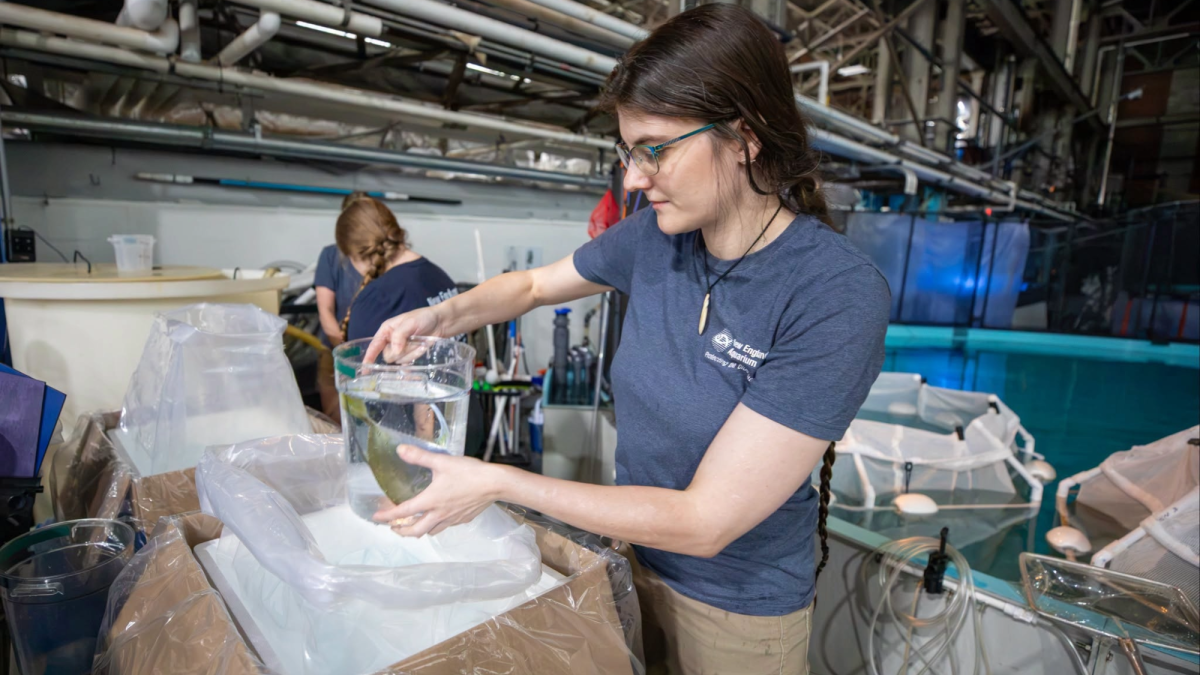
Moving a fish isn’t quite as easy as putting a dog in a crate. Image: New England Aquarium Boston’s New England Aquarium recently shipped a very important package. But it wasn’t exactly an early Christmas gift. The team shipped 22 lookdown fish across the country via air transport. And they’re not the only institution that routinely packs fishes up and sends them elsewhere. The NEA are part of a group of aquariums where each member specializes in raising certain species on behalf of the entire group. They then send the fish to the other member aquariums. “By working together, we are able to raise more fish, and develop aquaculture practices to successfully raise more species, including some that have never been raised before, like copper/glassy sweepers, blue chromis, and brown chromis,” Monika Schmück, manager of sustainability in the fishes department at the New England Aquarium, tells Popular Science. “We typically raise 500-1000 fish annually and distribute them to over 15 institutions on average each year.” Step one of the process is pretty simple—catch the fish. Image: New England Aquarium. Sharing is caring, even amongst aquariums. When it comes time for the fish’s journey, the team needs to decide whether to use air or ground transport. To do this, they consider factors including external temperature, the weight of the shipment, and access to an airport at the destination. Depending on the time of the year, cargo holding and ground transport trucks can experience extreme temperatures, Schmück points out. If it’s a large shipment, the New England Aquarium usually goes for air cargo, whereas smaller shipments are easier to deliver with ground transportation. Overall, ground transportation is the easiest strategy because it doesn’t have to take into account the location of airports. On a smaller scale, moving a fish isn’t as easy as sticking a cat into a crate. In terms of the container in which the animal will travel, the biggest consideration is the size of said animal, which determines how much water it needs. The New England Aquarium team after safely boxing up 22 fish for their journey to Georgia. Image: New England Aquarium. “Since fish must be transported in water, and water is heavy, the design of a fish transport first must address how to safely move the required volume of water to keep the fish safe and secure during the process,” Schmück explains. Ultimately, the fundamentals of fish transport are mostly consistent no matter the species. Experts need to make sure that the water chemistry is good during the entire trip and that other environmental conditions are appropriate for the traveling species and remain stable. Bon voyage! 2026 Popular Science Home of the Future Awards 39 products that will improve your everyday life.
22 fish shipped from Massachusetts to Georgia—very carefully
Full Article
Original Source
Read the full article at Popsci →KhanList aggregates and links to publicly available news content. We do not host full articles from third-party sources. Always verify important information with original sources.