
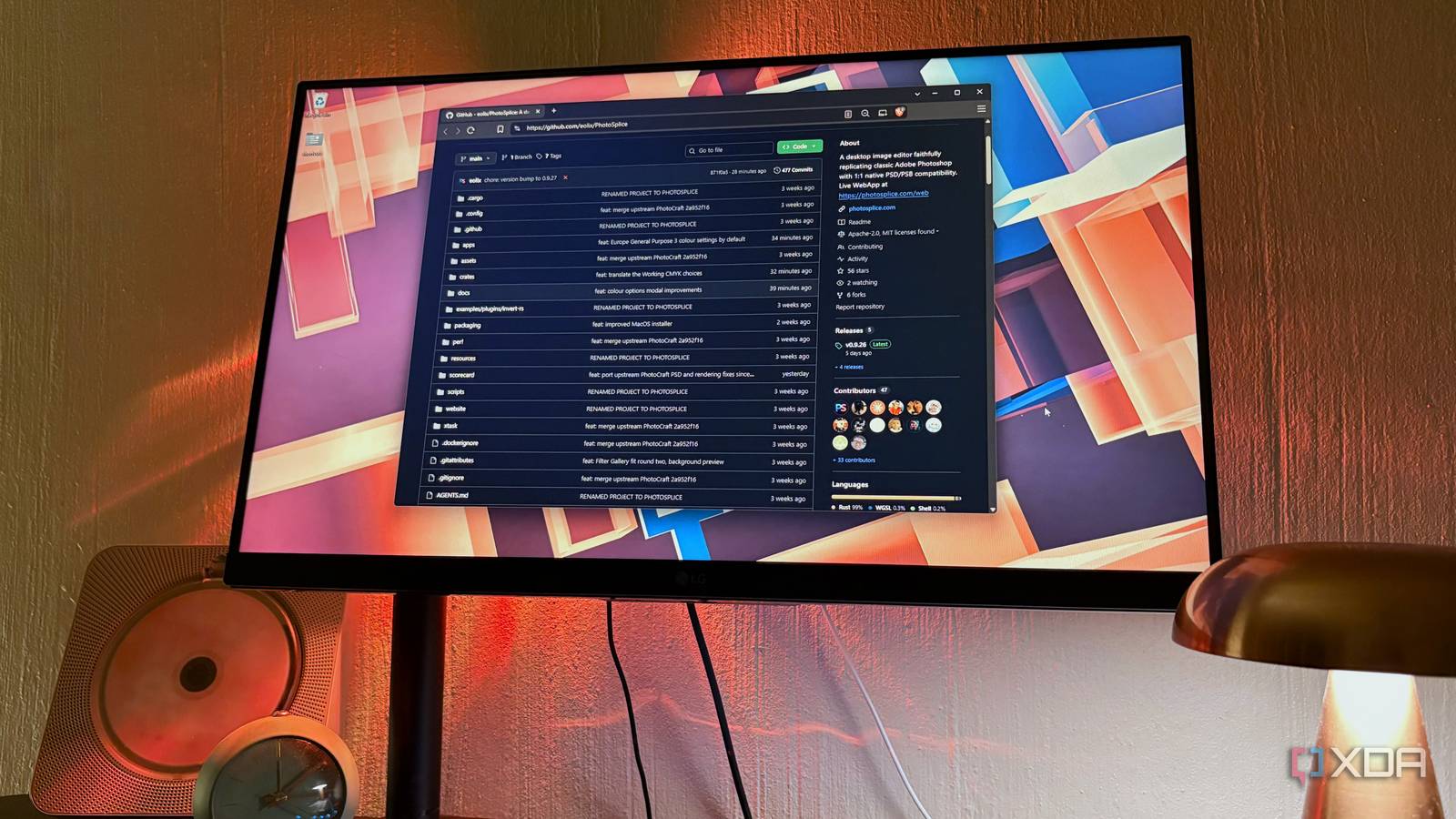
Published Nov 4, 2026, 12:31 PM EST Nolen began their writing career in 2019, with three years dedicated to editing the Creative section at MakeUseOf. Their expertise lies at the crossroads of technology and creativity, covering areas like photography, video editing, and graphic design. Outside of work, you'll often find Nolen diving into a good book, writing their own stories, or playing video games. Free Photoshop alternatives come up constantly in my work, and most of them get recommended on trust. Either there will be a reputable proprietary company behind the tool, or it's on GitHub with an open-source license attached, and for most of us that's pretty much where the vetting stops, admittedly myself included. PhotoSuite looked like a solid find when it showed up in September with Photoshop's classic layout and the open-source license to go with it. But about two weeks later, the developer of Photopea, the browser-based editor a lot of people use instead of paying Adobe and also one of my favorite editors, said it was built from his code. The story actually ended up getting a little messy, and it made me rethink what that open-source label is actually telling us. What's the deal with PhotoSuite? How a free Photoshop alternative got pulled from GitHub I feel like Photopea needs a little background first. Ivan Kutskir has spent about 14 years writing it by hand, mostly on his own, and it runs free in a browser with ads paying for it. But it isn't open-source since Kutskir has never released it under an open-source license, and anyone who wants to host their own copy of Photopea has to pay him. Because it's a website, its code has to load into your browser for it to work at all, so anyone can technically see it, but that's very different from having permission to reuse it. PhotoSuite went public on GitHub in late September. In early October, Kutskir opened an issue on its GitHub page accusing it of being his work repackaged, and pointed to code that matched a 2021 version of Photopea right down to oddly specific labels he came up with. The developer of PhotoSuite, going by eolix, admitted PhotoSuite began from an unofficial offline copy of Photopea that someone else had posted to GitHub. Their defense was that it's been rewritten since then, and that the README credited Photopea anyway. From there, eolix renamed the issue to something softer and then banned Kutskir from it - a smidge dramatic, if you ask me, but I guess there's friction even in the open-source space. Shortly after, the Issues section was gone from the page entirely. PhotoSuite also started crediting a different app, PhotoCraft, as its foundation, which didn't hold up since people digging through the repo found PhotoSuite's own timestamps were older than PhotoCraft. I actually only recently tested out PhotoCraft myself, it's a pretty neat Photoshop alternative created mostly with AI, but it's still built entirely from scratch. Kutskir filed a DMCA notice which is a formal copyright takedown request, and GitHub disabled PhotoSuite in mid-October along with the copies other users already made of it at that point. The notice also listed the offline Photopea copy PhotoSuite started from. eolix is still at it anyway, under a new name, PhotoSplice, which now says it's built on PhotoCraft instead. What I now check before trying new apps You don't need to read code to vet an app I did poke around in PhotoSplice a bit just to see how similar it actually is (though copied code doesn't necessarily mean the GUI will be the same). And admittedly, it does look pretty comprehensive and like the type of tool I cover here all the time. But luckily the dramageddon happened before I had the chance. If you're like me and don't really know your way around a codebase, there are still ways you can vet a project before supporting it. One review site actually read PhotoSuite's code in early October and described it as readable and well-documented. Reading code clearly wasn't going to catch this, which is great news for me. Everything that gave PhotoSuite away was sitting on its GitHub page, and anyone can check for it. First, start with how the project started. GitHub keeps a dated log of every saved change, called commits, and you can scroll back to the very first one. Most real projects start small and a bit messy before growing over months, whereas PhotoSuite's public history opened with roughly 1,000 files in a single go and four releases in five days. Some developers do work privately before going public, so this isn't immediate evidence of anything, but it might be something to take note of. Then there's the license, which many tend to skip. When a README credits another app, I look up whether that app is open source itself. Photopea isn't, so PhotoSuite's open-source license didn't carry much weight, and a thank-you in the README doesn't count as permission. There's also the Issues page to check, which is where people report problems, and I make a point of now opening the closed ones. Watching how a developer handles an awkward question can tell you a lot. If they'll ban someone for asking where the code came from, that's probably red-flaggy. And lastly, the easiest check doesn't happen on GitHub at all. Literally just searching the app's name with words like "stolen" or "copy" on places like Reddit or Hacker News would have turned up the PhotoSuite story long before GitHub did anything about it. There's also a point to be made about AI Why this will probably keep happening Kutskir believes AI did most of the work here. He's said a project like PhotoSuite could be made from Photopea's main code file in about two hours using Claude. eolix never confirmed using AI, so I'm treating it as a suspicion. AI or not, what worries me is how well a rewrite can hide where code came from. One GitHub user in the thread claimed they compared both codebases and found over 99% of PhotoSuite was original, while Kutskir says he can trace every line back to Photopea. A polished app used to mean that someone or a small team spent years building and fine-tuning it, but now it can mean anyone built it in a few days. That's why my checks lean on a project's history over the app itself. If Kutskir's two-hour estimate is correct, that means that a convincing app like this costs almost nothing to produce. A believable history is harder to put together, and PhotoSuite's origin story changed partway through the dispute. I wouldn't count entirely on GitHub to catch these things either. Kutskir also said GitHub ignored his earlier reports about similar copies, and even after this takedown, eolix was back with a renamed project within days. That leaves the checking to whoever's about to install the app, which, let's be real, isn't going to happen most of the time. Where the code came from matters more than how the app looks A lot of people defending PhotoSuite pointed out that Photopea copies Photoshop's layout too. This is true, and even the new PhotoCraft from the ArtCraft suite is practically a mirror of Photoshop. But apps have borrowed each other's look for decades; mirroring one another has always been accepted and it's honestly something users prefer as well because of muscle memory. The point is that developers like Kutskir still wrote his own code to get there.
A free Photoshop alternative turned out to be a copy of an indie project, and now I check this before installing any open-source app
Full Article
Original Source
Read the full article at Xda-developers →KhanList aggregates and links to publicly available news content. We do not host full articles from third-party sources. Always verify important information with original sources.