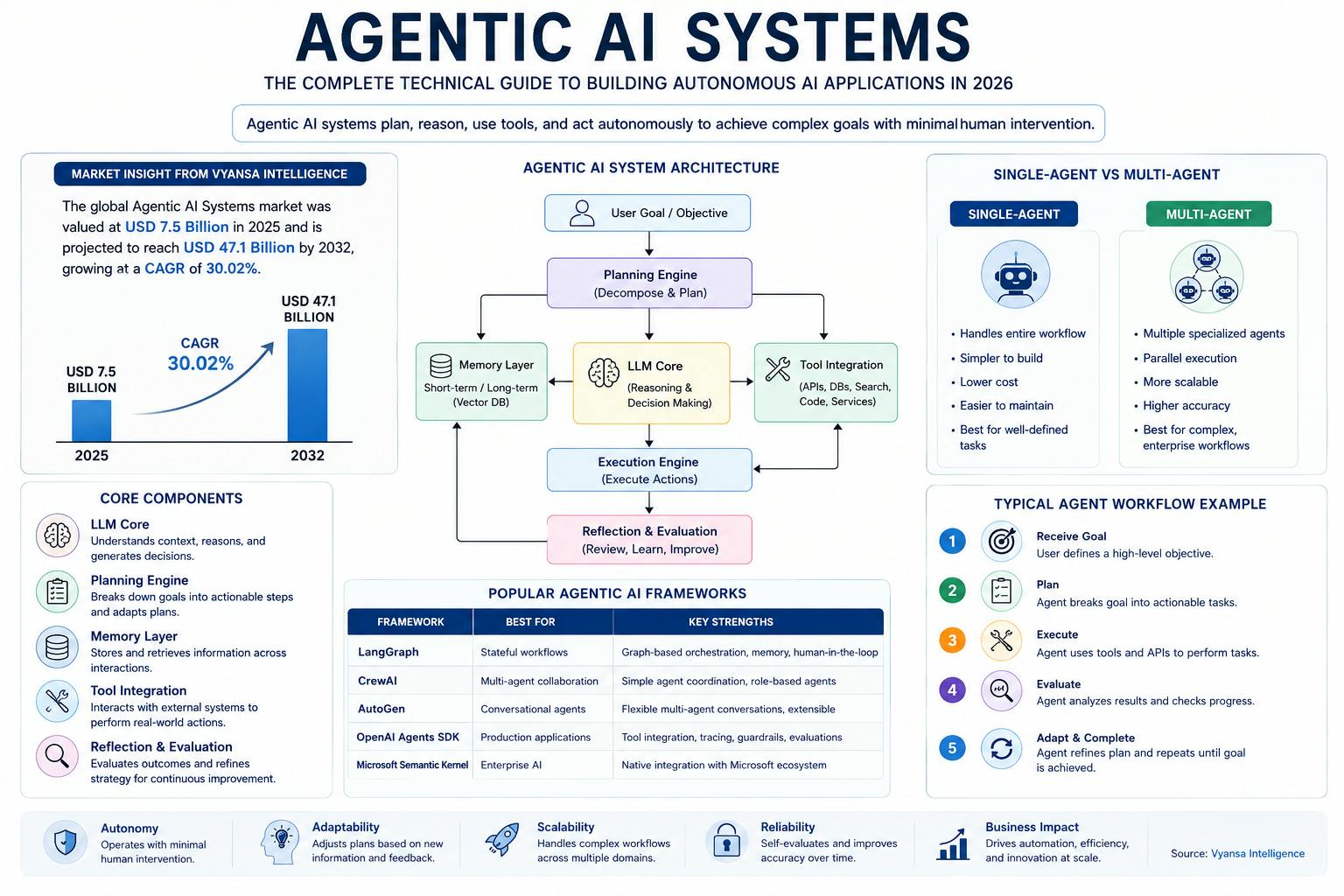
Artificial intelligence has evolved far beyond chatbots that simply respond to prompts. Modern AI systems can now plan, reason, use external tools, retain memory, collaborate with other agents, and complete complex workflows with minimal human intervention. This new paradigm is known as Agentic AI, and it is quickly becoming one of the most transformative technologies in enterprise software.According to Vyansa Intelligence, the global Agentic AI Systems industry was valued at USD 7.5 Billion in 2025 and is projected to reach USD 47.1 Billion by 2032, expanding at a CAGR of 30.02% during the forecast period. Growing enterprise adoption, rapid advancements in large language models (LLMs), and increasing demand for autonomous business automation are driving this remarkable growth.Unlike traditional AI applications that generate a single response based on user input, agentic systems continuously evaluate objectives, make decisions, execute tasks, analyze outcomes, and adapt their strategies until they achieve a defined goal. This shift is redefining software development across customer service, cybersecurity, healthcare, finance, manufacturing, logistics, and software engineering.What Is an Agentic AI System?An agentic AI system is an autonomous software architecture that combines the reasoning capabilities of large language models with planning, memory, external tools, and decision-making mechanisms to accomplish multi-step objectives.Instead of answering isolated questions, an AI agent can:Break large goals into smaller tasksDetermine execution orderRetrieve information from external systemsCall APIsExecute codeStore and recall previous interactionsEvaluate its own progressRevise plans when necessaryFor example, rather than answering, "What are today's airline prices?", an agentic travel assistant could:Search multiple airline websites.Compare prices and travel times.Check hotel availability.Estimate local transportation costs.Recommend the most cost-effective itinerary.Book reservations after receiving approval.The entire workflow is executed as a coordinated sequence rather than a single prompt-response interaction.Why Agentic AI Is Different from Traditional AITraditional AI models operate reactively. They receive an input, process it, and return an output. While highly capable, they generally do not maintain long-term objectives or autonomously decide the next course of action.Agentic AI introduces goal-oriented behavior.Traditional AIAgentic AIResponds to promptsPursues objectivesSingle interactionMulti-step workflowsLimited memoryPersistent memoryMinimal planningDynamic planningStatic responsesContinuous decision-makingUser-directedSemi-autonomous or autonomousThis evolution allows organizations to automate increasingly sophisticated business processes while reducing manual intervention.Core Components of an Agentic AI SystemBuilding a reliable autonomous AI application requires several interconnected components.1. Large Language ModelThe language model serves as the reasoning engine. It interprets objectives, understands context, generates plans, and decides which action should occur next.Popular foundation models include GPT, Claude, Gemini, and open-source alternatives such as Llama.2. Planning EnginePlanning transforms a high-level objective into executable tasks.For example:Goal: Create a quarterly sales report.The planner may generate the following:Retrieve CRM dataClean the datasetGenerate chartsIdentify performance trendsDraft executive summaryExport presentationThis decomposition enables structured automation instead of isolated responses.3. Memory LayerMemory allows an agent to retain information across multiple interactions.Most implementations include:Short-term memoryCurrent conversationActive objectivesTemporary variablesLong-term memoryHistorical conversationsUser preferencesOrganizational knowledgeVector database embeddingsWithout memory, every interaction effectively starts from scratch.4. Tool IntegrationModern AI agents extend beyond language generation by interacting with external systems.Common tools include:Search enginesDatabasesSQL queriesREST APIsEmail servicesCalendarsCloud storagePython executionEnterprise softwareCRM and ERP platformsThese integrations allow agents to perform real-world tasks rather than simply describing them.5. Reflection and EvaluationOne of the defining characteristics of agentic systems is self-evaluation.After completing each task, the agent asks:Was the objective achieved?Is additional information required?Should the strategy change?Is the output reliable?Reflection significantly improves execution quality for long-running workflows.Single-Agent vs Multi-Agent SystemsOrganizations often choose between a single intelligent agent or multiple specialized agents working together.Single-Agent ArchitectureA single agent handles the complete workflow.Advantages include:Simpler implementationLower infrastructure costEasier debuggingFaster deploymentBest suited for:Personal assistantsCustomer supportDocument summarizationResearch assistantsMulti-Agent ArchitectureMultiple specialized agents collaborate under a coordinator.Example:Research AgentData Analysis AgentCoding AgentValidation AgentReporting AgentBenefits include:Better scalabilityParallel executionDomain specializationImproved reliabilityHigher task accuracyMulti-agent systems are increasingly used in enterprise automation, software engineering, cybersecurity operations, and scientific research.High-Level Agentic AI Architecture User Goal │ ▼ ┌──────────────────┐ │ Planning Engine │ └──────────────────┘ │ ┌───────────┼───────────┐ ▼ ▼ ▼ Memory Store LLM Core Tool Router │ │ │ └───────────┼───────────┘ ▼ Execution Engine │ Reflection & Evaluation │ ▼ Final Response This modular architecture enables AI systems to plan, execute, monitor progress, and continuously improve their decisions.Popular Agentic AI FrameworksFrameworkBest Use CaseStrengthsLangGraphStateful workflowsGraph-based orchestration, memory managementCrewAIMulti-agent collaborationSimple agent coordinationAutoGenConversational agentsFlexible multi-agent conversationsOpenAI Agents SDKProduction applicationsTool integration, tracing, guardrailsMicrosoft Semantic KernelEnterprise AINative integration with Microsoft ecosystemSelecting the right framework depends on application complexity, scalability requirements, deployment environment, and integration needs.
A Developer’s Guide to Agentic AI Frameworks and Components
Full Article
Original Source
Read the full article at Hackernoon →KhanList aggregates and links to publicly available news content. We do not host full articles from third-party sources. Always verify important information with original sources.