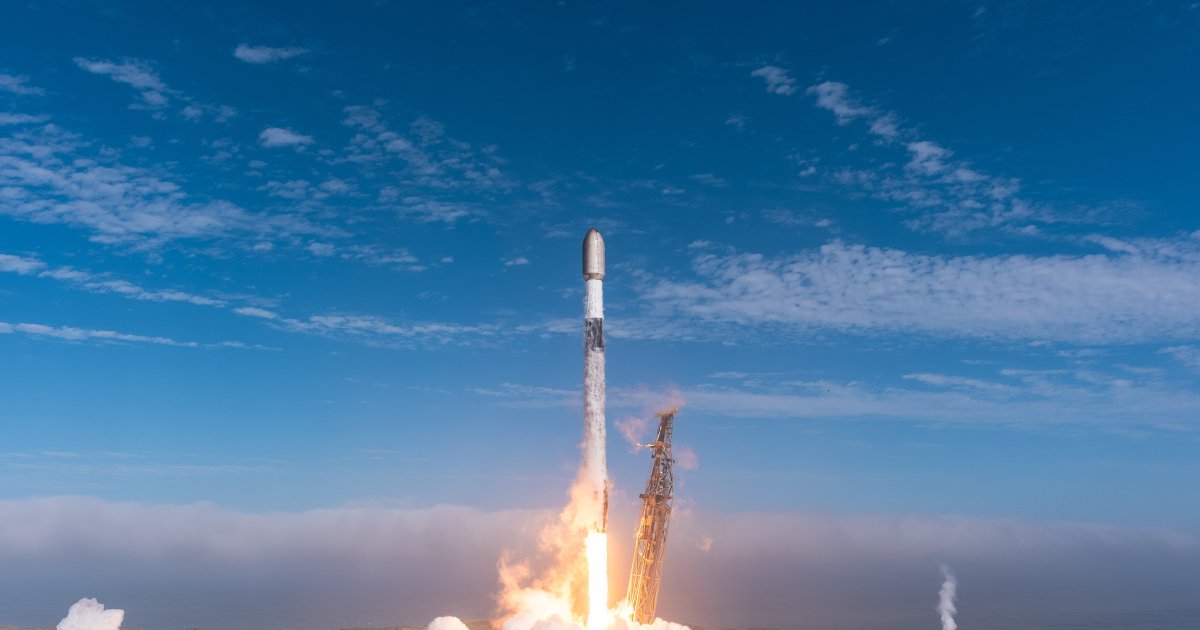
A Falcon 9 rocket lifts off from Vandenberg Space Force Base in California on July 25, carrying two dozen Starlink satellites into orbit. The launch was part of SpaceX's Starlink Group 17-51 mission, one of several Starlink batches the company sent to low Earth orbit that week. Credit: SpaceX via X Rocket launches this week On Wednesday, July 29, at 7:50 a.m. EDT, the state-owned China Aerospace Science and Technology Corporation (CASC) is planning to launch a Long March 7A from Wenchang Space Launch Site on the coast of Hainan Island in the South China Sea, according to tracking from Next Spaceflight. The payload is undisclosed. The Long March 7A is a three-stage, medium-lift rocket powered by liquid oxygen and kerosene with a payload capacity of 26,455 pounds (12,000 kilograms) to low Earth orbit (LEO). Later on Wednesday, July 29, CASC is targeting 9:00 p.m. EDT for the launch of a Long March 6A from Taiyuan Satellite Launch Center, located in the Shanxi Province of northeastern China, according to tracking from Next Spaceflight. The payload is also undisclosed. Slightly smaller than the 7A variant, the Long March 6A is a two-stage medium-lift rocket that runs on a combination of liquid and solid fuel with a payload capacity of 17,640 pounds (8,000 kg) to LEO. SpaceX closes out the day, targeting 10:00 p.m. EDT on Wednesday, July 29, for the launch of Starlink Group 17-52 from California’s Vandenberg Space Force Base. The Falcon 9 rocket will carry a batch of V2 Starlink satellites for the ever-growing internet constellation. It will be the 25th flight for booster B1081, which SpaceX will attempt to land on the droneship Of Course I Still Love You off the coast of California. On Thursday, July 30, at 3:09 a.m. EDT, the National Reconnaissance Office (NRO) is planning to launch its NROL-95 mission from Cape Canaveral, Florida, in partnership with U.S. Space Force Space Systems Command and SpaceX. The mission will fly aboard a Falcon 9 Block 5, and after stage separation the booster B1096 will touch down at SpaceX’s Landing Zone 2 or on a droneship in the Atlantic Ocean. The payload is classified, but likely contains one or more intelligence satellites designed to provide surveillance and reconnaissance information to government users. Closing out the week, SpaceX is targeting 10:00 a.m. EDT on Sunday, Aug. 2, for the launch of Starlink Group 17-53 from Vandenberg Space Force Base. The Falcon 9 will carry two dozen V2 Mini Starlink satellites, with booster B1063 attempting a landing on the droneship Of Course I Still Love You. Rocket launches last week Last week saw a flurry of launch activity across the globe. SpaceX kicked the week off with Starlink Group 17-39 launching from Vandenberg Space Force Base on Falcon 9 on Tuesday July 21, at 10:49 a.m. EDT. The mission carried a batch of V2 Starlink satellites to LEO, with the booster landing on Of Course I Still Love You. Later on Tuesday July 21, SpaceX kept things moving with the launch of MRV-1 from Cape Canaveral at 5:15 p.m. EDT on a Falcon 9. Because the mission required more thrust than a Starlink launch, the booster splashed down in the Atlantic ocean and was not recovered. The spacecraft, Mission Robotic Vehicle (MRV), is the first robotic servicer designed to complete multiple servicing missions without returning to Earth. Its two robotic arms are part of the Robotic Servicing of Geosynchronous Satellites (RSGS) payload, designed by the U.S. Naval Research Laboratory and funded by the Defense Advanced Research Projects Agency (DARPA). The arms can inspect satellites for damage, repair broken components, and install new components on orbit, with potential for on-orbit manufacturing of new components in the future. The spacecraft is also designed to rendezvous with Mission-Extension Pods (MEPs), separately launched jetpack-style propulsion devices that MRV can attach to satellites in geosynchronous orbit and designed to propel a satellite low on fuel for an additional six years. To close out the day on Tuesday July 21, China’s private aerospace firm Orienspace launched nine satellites to orbit on a rideshare mission from Haiyang Oriental Spaceport, located in the Yellow Sea off the eastern coast of China. The mission launched on Orienspace’s four-stage medium-lift solid rocket, Gravity 1, which can carry 14,000 pounds (6,350 kg) to LEO. On Thursday, July 23, at 8:00 a.m. EDT, CASC launched the Tianlian II-06 satellite on a Long March 3B/E from Xichang Satellite Launch Center in Sichuan Province, China. Tianlian II-06 is a data relay satellite that will provide crucial telemetry, tracking, and command information for future launches, including crewed missions and satellite deployments. Later on Thursday, July 23, at 7:33 p.m. EDT, commercial launch company CAS Space launched a Kinetica 1 solid-fueled rocket carrying five satellites from the Dongfeng Commercial Space Innovation Pilot Zone in northwest China. The specific satellites and their purposes weren’t disclosed. On Friday, July 24, SpaceX conducted the 13th test flight of its Starship-Super Heavy vehicle from Starbase, Texas at 6:51 p.m. EDT. Dubbed “Lucky 13” by SpaceX, the flight was the second outing for the Starship V3 and addressed engine issues that had marred the vehicle’s debut during Flight 12. The launch was initially scheduled for July 16 but was scrubbed at the last second when four of the Raptor engines failed to fire. This time, all 33 Raptor engines on the Super Heavy booster fired at liftoff. After stage separation, the Ship deployed 20 next-generation Starlink V3 satellites through its onboard PEZ dispenser system. Rather than attempting a catch or landing, both stages were intentionally splashed down as part of the test profile: the Super Heavy booster relit its engines for a controlled splashdown in the Gulf of Mexico, although not all of the engines relit as planned; and the Starship came down intact in the Indian Ocean in the softest splashdown yet for the vehicle. On Saturday, July 25, SpaceX closed out the week with the Starlink Group 17-51 mission, launching a Falcon 9 Block 5 from Vandenberg Space Force Base at 11:51 a.m. EDT. The booster landed on Of Course I Still Love You in the Pacific Ocean. Upcoming rocket launches On Tuesday, Aug. 4, at 4:50 a.m. EDT, CASC is targeting the launch of a Long March 8A from Wenchang Space Launch Site, according to tracking from Next Spaceflight. The payload is undisclosed. On Thursday, Aug. 6, at 3:30 p.m. EDT, Japan’s Mitsubishi Heavy Industries (MHI) is targeting the launch of an H3-22S — the company’s medium-lift two-stage rocket developed with the Japan Aerospace Exploration Agency (JAXA) — carrying the Michibiki 7 (QZS-7) navigation satellite from Tanegashima Space Center, Japan. On Sunday, Aug. 9, at 7:00 a.m. EDT, CASC is targeting the launch of a Long March 7A from Wenchang Space Launch Site, according to tracking from Next Spaceflight. The payload is undisclosed. Brooks Mendenhall is a staff writer for Astronomy magazine and is based in Chattanooga, Tennessee.
A classified NRO launch and a Chinese triple-header set to launch this week
Full Article
Original Source
Read the full article at Astronomy →KhanList aggregates and links to publicly available news content. We do not host full articles from third-party sources. Always verify important information with original sources.