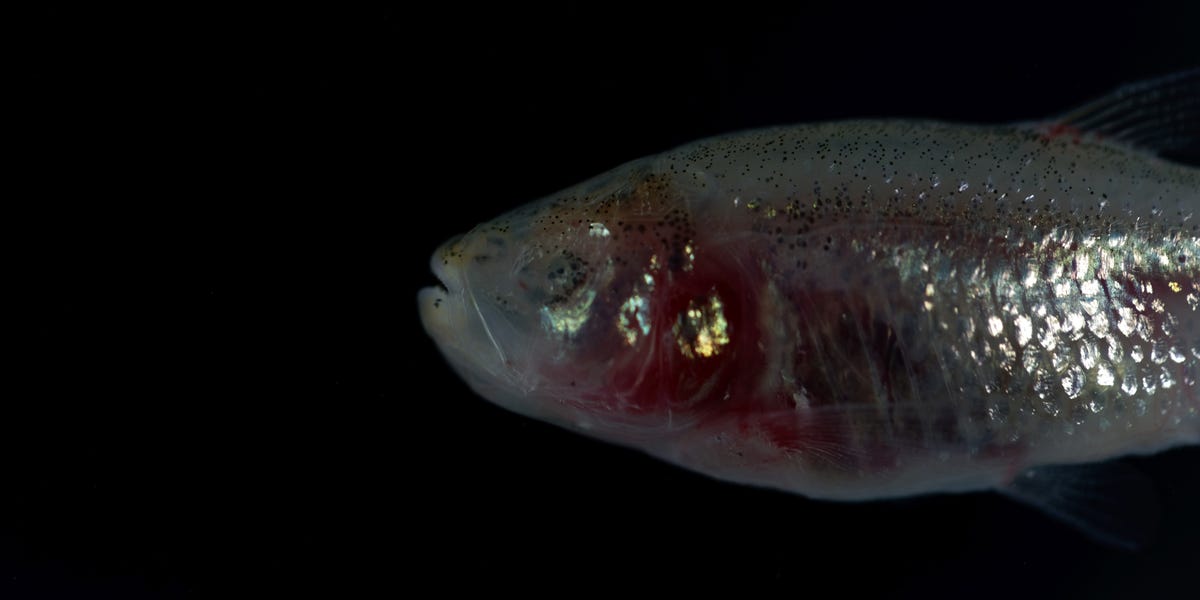
3 min readHere’s what you’ll learn when you read this story:Below the U.S. Army’s Redstone Arsenal in Huntsville, Alabama, lies Bobcat Cave—a well-monitored karst cave system already known for its endemic species, such as the Alabama cave shrimp.A new study highlights a previously unknown genus of cavefish named Demogorgonichthys arcanus (or more affectionately called the “demon cavefish”), which also calls the cave home. The cavefish is evolutionarily distinct from another species, the southern cavefish (Typhlichthys subterraneus), showing that even small cave systems can support evolutionary diversity across millions of years.On October 25, 1941—mere months before a surprise attack at Pearl Harbor pushed the U.S. into World War II—the U.S. Army broke ground on the Redstone Ordnance Plant, known today as the Redstone Arsenal. Over the decades, the nearby small farm town of Huntsville, Alabama, transformed into a high-tech aerospace and defense hub, earning the moniker “Rocket City.”However, the establishment of the Redstone Arsenal—originally a chemical weapons manufacturing plant before transitioning into a rocket development hub for NASA—also created a large swath of federally-protected land in northern Alabama. While it’s typical for military bases and weapons manufacturing sites to inadvertently establish protected ecosystems in their shadow, few military sites care about what lies beneath those installations.In this way, Redstone is a bit different because directly below the site lies Bobcat Cave, a heavily-monitored karst cave system. The cave is well known for harboring endemic life in its subterranean chambers—including the endangered Alabama cave shrimp—but in a new study published in the journal Scientific Reports, a team of scientists from the University of Alabama in Huntsville (UAH), Auburn University, and Mississippi State University discovered that this well-researched cave system still holds many surprises.In the study, researchers detail a new kind of cavefish that isn’t just a new species, but an entirely new genus. Called the Demogorgonichthys arcanus (a reference to the mythological demogorgon and arcanus, meaning “secret”), or the “demon cavefish,” its most distinctive trait is its lack of eyes—a common feature among cavefish. At first glance, the researchers suspected that the fish might be closely related to the southern cavefish (Typhlichthys subterraneus), which is also found in the cave, but detailed anatomical studies, CT scans, and genetic analyses ruled out the relation.“The Demon Cavefish shares its cave, and the very same pools, with the Southern Cavefish, yet the two aren't close relatives,” Matthew Niemiller, the lead author of the study, said in a press statement. “Each found its own separate way into the underground world and lost its eyes and pigment independently, millions of years apart. It's a vivid case of convergent evolution.”What’s also remarkable is that the fish is only being discovered now. According to UAH, Bobcat Cave has been regularly monitored four times a year for the past 30 years. A big clue that could explain the demon cavefish’s reclusiveness lies in one of the key differences between it and the southern cavefish. The southern cavefish contains a rhodopsin gene, which is related to light sensitivity, but the newly discovered demon cavefish lacked part of this gene (according to researchers). This could explain why D. arcanus typically dwells deeper in the aquifer, beyond human observation.“It may have been living down in the aquifer and only recently made its way up,” Auburn University’s Jonathan Armbruster, a co-author of the study, said in another press statement. “Or it may have been there before, and we just never saw it.”The secret strategy behind the demon cavefish’s success could be an accidental one—the federally protected land above the cave, which serves as a vital recharge basin, helped protect D. arcanus and the other endemic subterranean creatures in Bobcat Cave. It’s uncertain whether the new genus of cavefish will be the last discovery in this cave system, but finding more new species lurking in its depths will require humans to protect the land on which these caves rely.“North Alabama sits atop one of the richest cave landscapes in the country, and the life in its groundwater is remarkable and still incompletely cataloged […] the Demon Cavefish is a reminder that our inventories are far from finished, even in well-explored places," Niemiller said in a press statement. “Being known from a single cave and its aquifer makes it inherently vulnerable. The central challenge is that the threats come from outside the cave.”Darren lives in Portland, has a cat, and writes/edits about sci-fi and how our world works. You can find his previous stuff at Gizmodo and Paste if you look hard enough.
A Blind ‘Demon’ Is Lurking in a Cave Beneath a U.S. Army Base. Scientists Just Found It.
Full Article
Original Source
Read the full article at Popularmechanics →KhanList aggregates and links to publicly available news content. We do not host full articles from third-party sources. Always verify important information with original sources.