
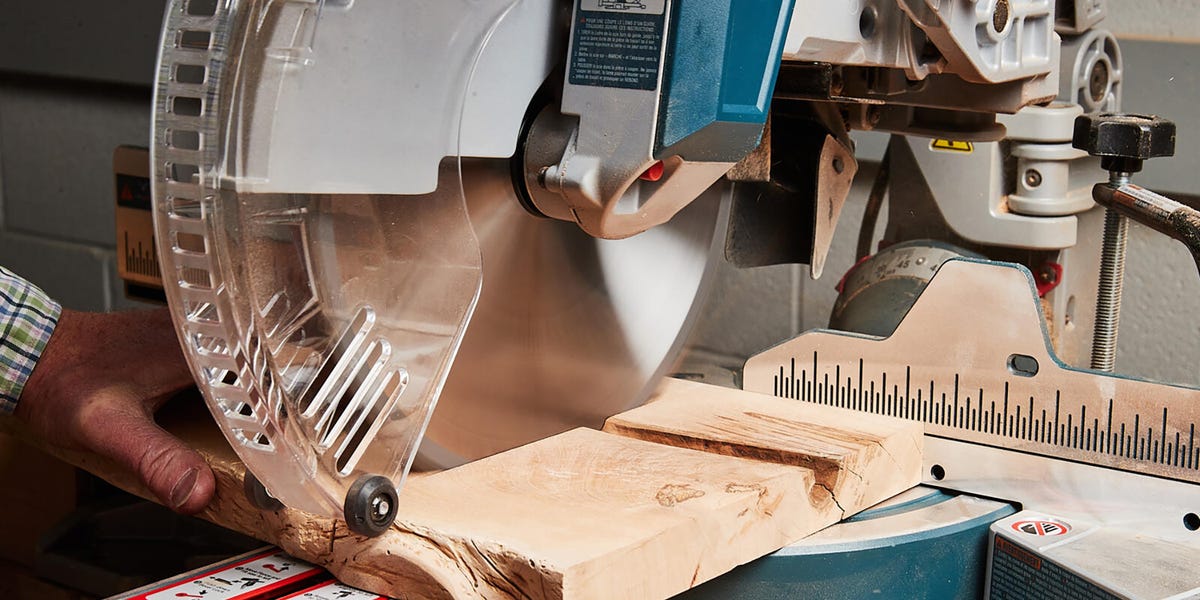
3 min readGiven the choice of two power tools of varying capacity, I’ve always erred on the side of sizing up. I mostly attribute that to the notion that I’m probably going to do more with the larger tool down the road as my skill set improves.For the most part, that philosophy has held true. In choosing between a 6-1/2- or 7-1/4-inch circular saw blade, two of the most common sizes, I’ll always take the bigger blade. With table saws, I gravitate toward larger tools rather than smaller benchtop models. But where miter saws are concerned, that bigger-is-better sensibility isn’t always the case.Fifteen years ago, I bought a Ridgid 12-inch model. It’s served me well because I need a 12-inch saw for the types of projects I tackle, but it’s heavy and may be too much tool for the average homeowner. If you don’t have a miter saw or are considering replacing an older model, here’s why a 10-inch may be your best bet.What Can You Actually Cut With 10- and 12-Inch Miter Saws?The obvious difference between these two types of miter saws is 2 inches of blade diameter, but I wouldn’t automatically assume that translates directly into additional cutting capacity. Whether the blade head slides—and how the manufacturer designs the rails, fence, and blade assembly—has a huge effect on what the saw itself can cut.Take, for example, the Skil MS6305, a 10-inch dual-bevel slider I’ve used on occasion and we recommend as the best value miter saw for most people. It crosscuts a 2x12 at 90 degrees and a 2x8 at 45 degrees. It also cuts dimensional lumber as large as a 4x6 at 90 degrees—and I mean fully cut. For most projects around the house, that’s as much saw as you’ll ever need.Key SpecsModelMS6305-00PowerCorded 15 ampBlade10-in, 40-toothMax cross-cut12 inMax speed4,800 rpmWeight39.4 lbTwelve-inch saws are different in that they can make larger cuts vertically. The Bosch GCM12SD, our best overall pick, has a 3-1/2-inch by 13-1/2-inch maximum crosscut at 90 degrees. That means you can put a dimensional 4x4 on the turntable and cut straight through it in one pass. It also accommodates baseboards up to 6 inches tall when it’s standing vertically against the fence.Key SpecsItem model numberGCM12SDPowerCorded 15 ampBlade12-in, 60-toothMax cross-cut13-1/2-inMax speed4,000 rpmWeight65 lbWho Needs a 10-Inch Miter Saw?If you’re mostly cutting standard dimensional lumber and trim, a good 10-inch slider is capable of most jobs. For the average homeowner, a saw this size typically takes up real estate under a workbench, on a shelf, or tucked against a wall until Saturday morning rolls up.A smaller saw is easier to transport to wherever the work is happening. Sometimes, I’m going room to room while installing new trim. If I can easily move my saw setup from place to place, I’m saving steps on a consistent basis as opposed to running up and down the stairs each time I need to make—or worse, check—a cut.Why Consider a 12-Inch Saw At All?There are times when you absolutely might want the bigger saw. If you routinely cut 4x4s, large crown molding, tall baseboard, or other oversized material, a 12-inch saw removes a lot of the guesswork from the equation. There’s also a lot to be said for knowing the tool can handle pretty much anything you might need to throw at it in future projects.That’s why I chose that Ridgid saw all those years ago. Owning an old farmhouse, I knew my work would wander in scope. I might be cutting 2x6s one day and installing crown the next, and having the spec sheet of my saw determine how I approach a project didn’t exactly thrill me. The trade-off was obvious: I paid for that unused capacity every time I lifted, transported, and especially stored a saw of that size.The VerdictI find the additional capacity of a 12-inch saw useful. Plus, there’s the added benefit of the broader, sturdier surface area for your workpiece to sit on. Yet if I’m advising a homeowner who needs to carry the saw out of storage every time a project comes up, I’d have a much harder time making that recommendation. A capable 10-inch dual-bevel slider handles an enormous range of projects while being considerably less cumbersome.I still like the idea of having more saw than I need. But I’ve come around to the idea that the best miter saw isn’t the one that’s necessarily the most capable of making the biggest cut.Other Miter Saws We RecommendPaul Russell Smith is a former NYC ironworker turned screenwriter (Grace Point) and home renovation specialist. He lives in a crooked old farmhouse in Stockton, NJ, where he’s just as likely to be clearing a clogged pipe as rewriting a third act. When he’s not working, he enjoys hiking, pedestrian beer, and cooking over a live fire. His self-proclaimed spirit animal is the English Bulldog.
A 12-Inch Miter Saw Isn’t Always Better. Here’s Why a 10-Inch Model May Be the Smarter Buy.
Full Article
Original Source
Read the full article at Popularmechanics →KhanList aggregates and links to publicly available news content. We do not host full articles from third-party sources. Always verify important information with original sources.