
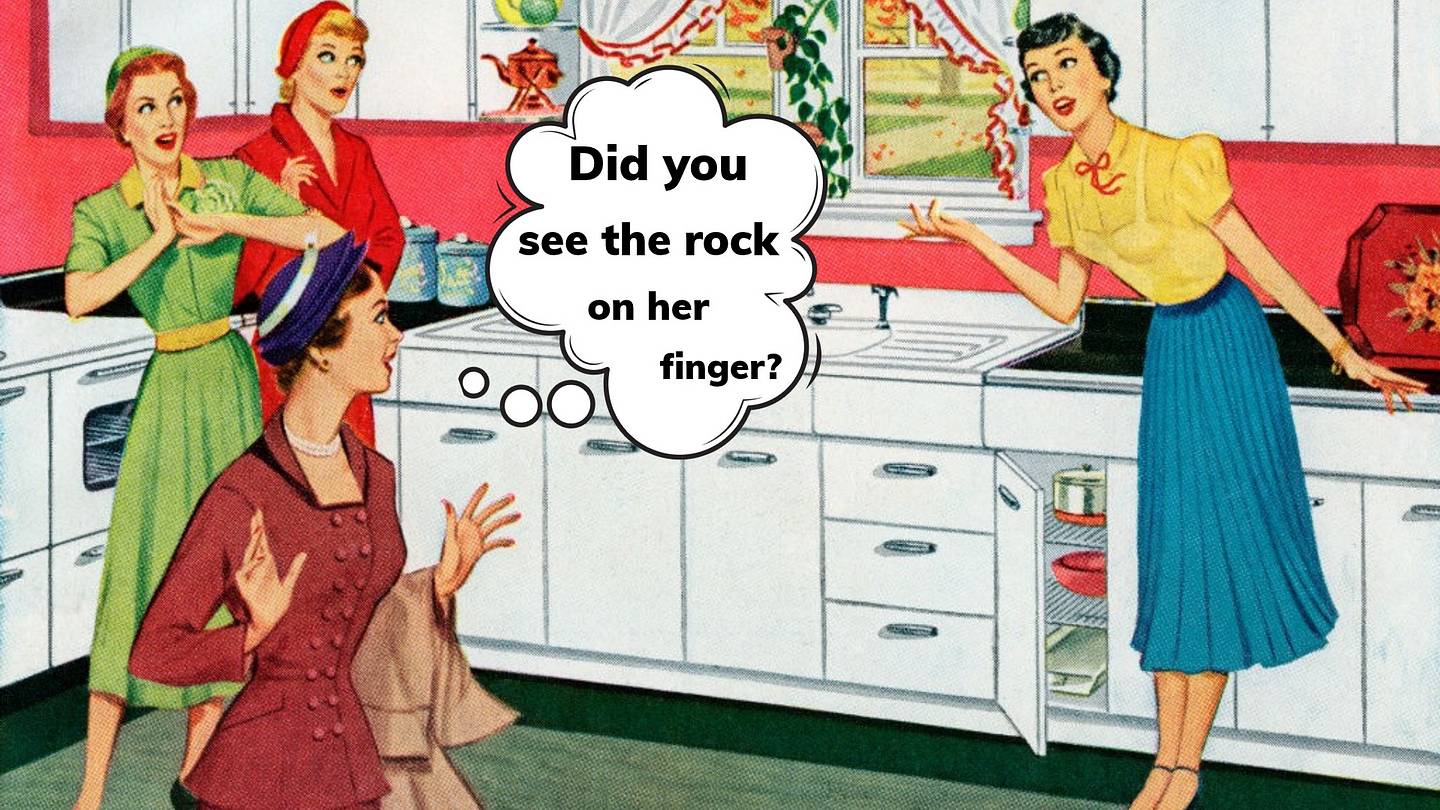
We borrow clothes from the past, music, traditions, art, and sometimes, without even realizing it, we borrow words.It's no surprise that all the words you use today originated in the past, whether thousands of years ago, a few decades ago, or mere weeks ago (thank you, Gen Alpha). A handful come from the 1950s, and some are just as relevant as they were 70 years ago.In 2026, we use these words to describe how something looks, how it makes us feel, or how we feel about something or someone, just as they did in the decade of rock and roll. Here are six slang words and phrases that originated in the '50s and are still part of our vocabulary today.Rock Big DealParty Pooper NerdBarfQueen Rock Wedding Ring on hand | Millisenta/GettyImagesDictionary definition: "gem, diamond."The word "rock" means many things: a stone, moving back and forth, and even an entire genre of music. But in the 1950s, "rock" became slang for a giant diamond, especially the kind you find on a woman's finger. When a woman showed off her wedding ring, instead of saying, "what a beautiful piece of jewelry," it wasn't uncommon for someone to exclaim, "look at that rock!" Even now, we use "rock" to describe an engagement or wedding ring that's especially massive.In a sentence: Did you see the rock on her finger?Big DealNo big deal. | benzoix/GettyImagesDictionary definition: "something of special importance, sometimes used ironically as an interjection."If something is a "big deal," it's typically very important, but 70 years ago people began using the phrase ironically, as if to say “so what?” You didn't get invited to the party? Big deal; there's always another. You didn’t ace the test? Big deal; you'll ace the next! In 2026, we still use this informally to say "who cares?" and reassure someone the situation might not be as serious as it seems.In a sentence: So you missed your flight, big deal!Party Pooper Grumpy at Christmas | SteveLuker/GettyImagesDictionary definition: "a person who refuses to join in the fun of a party, one who refuses to go along with everyone else."While it's not extremely common to call someone a party pooper today, we all know what it means, and though we might not always say it out loud, we've definitely thought it at some point. If someone's mood dampens the fun or their unwillingness to participate brings down the group energy, they might be labeled a “party pooper.”Being called a party pooper is often subjective; what one person finds boring, another might appreciate. The label depends on the event and who's using it. A party pooper in the 1950s might have skipped a drag race or a night at the dance hall; in 2026, they might miss a friend's promotion celebration, or back out of a trip because it’s not in the budget. In a sentence: You're such a party pooper; everyone else is going to her birthday celebration!NerdFunny Nerdy Man Looking Intensely at Vintage Computer | sjharmon/GettyImagesDictionary definition: "a person devoted to intellectual, academic, or technical pursuits or interests; an unstylish or socially awkward person."Once again, this is a subjective slang term: a nerd is someone another person considers "uncool," according to Merriam-Webster's Dictionary. What's cool to one might seem "nerdy" to another, whether it's a fashion choice or a hobby. It's one of those words that's widely understood, but has multiple meanings depending on who's using it, like “cool.” The word supposedly originated from Dr. Seuss' If I Ran the Zoo, the first example of the word in print. In 1951, it was coined as an official slang term to describe someone who would have been called a "square" in earlier decades.While nerd was (and still is) associated with an “unstylish or socially awkward person,” in 2026, many proudly claim the status and embrace what they “nerd out” on, like books, music, movies, or video games, taking ownership of the label.In a sentence: Trust me, I was a nerd in high school... always buried in a book!BarfAn unrecognizable woman vomits in the bathroom | Lajst/GettyImagesDictionary definition: "vomit."This one is pretty self-explanatory (and not exactly glamorous). Before the 1950s, if you threw up, you vomited, and that was that. But during that decade, a new, descriptive word debuted: barf. Suddenly, if you had to vomit, you had to barf, and the two terms have been used interchangeably ever since. Other slang terms for vomit, like hurl, upchuck, or blow chunks, have come along, but "barf" has stuck around. In a sentence: The fruit I ate this morning was expired, and now I feel like I have to barf!Queen Crown | skodonnell/GettyImagesDictionary definition: "an attractive girl or woman; a woman eminent in rank, power, or attractions."The informal definition of "queen" has evolved over the years. We know it (formally) as a term for a female monarch, but today, we also use it as a compliment for a woman's strength and achievements. In the 1950s, "queen" was used to describe a popular girl, according to Your Dictionary. While people back then probably didn't use it to describe women excelling in business or personal endeavors, the term still served as a way to praise a female.In a sentence: She built her business empire on her own; what a queen!Read More:
6 Slang Words From the 1950s We Still Use Today
Full Article
Original Source
Read the full article at Mentalfloss →KhanList aggregates and links to publicly available news content. We do not host full articles from third-party sources. Always verify important information with original sources.