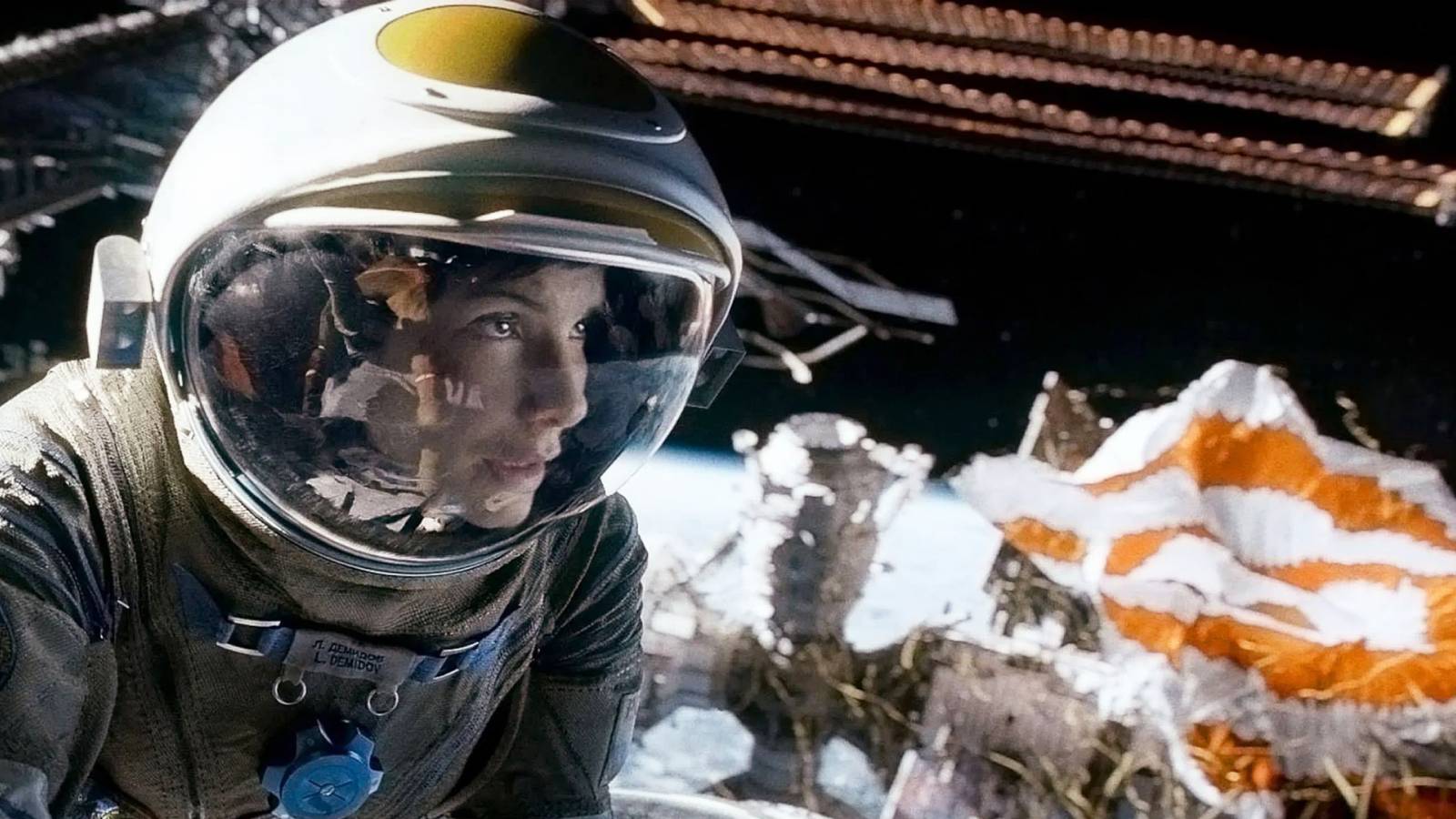
Image via Warner Bros. Pictures Published Jul 20, 2026, 7:54 AM EDT Andrea M. Ciriaco is a long-time script reader and former entertainment editor who specializes in classic movies and Hollywood history. She was a student film critic at Kent State University for three years and worked at Warner Bros Studio in Burbank and The Safran Company for several years. Based on her vast taste and range of knowledge, many consider Andrea to be a walking IMDb who knows dozens of underrated movies and is a vital assesst to any trivia night. While movies are her expertise, Andrea is also a diehard fan of iconic shows including The Sopranos, Boardwalk Empire, Rod Serling's The Twilight Zone, Will & Grace and South Park. Some of her favorite filmmakers are Walt Disney,John Huston, Fritz Lang, Alfred Hitchcock, John Ford, Mel Brooks, Quentin Tarantino, Martin Scorsese and Howard Hawks. Sign in to your Collider account The hard science fiction genre takes alluring storytelling and combines it with a genuine respect for scientific principles, granting it a unique place in the world of cinema. Unlike traditional science fiction movies that dabble in fantasy and the supernatural, hard science fiction films build their narratives around plausible scenarios that are rooted in areas such as physics, astronomy, or artificial intelligence and essentially challenge audiences to immerse themselves into a world that feels both extraordinary and believable. Since 2000, filmmakers like Christopher Nolan and Ridley Scott have embraced this approach with remarkable ambition, delivering visually stunning stories such as The Martian, Ex Machina, and Interstellar that explore humanity's relationship with science and technology. From intimate character studies like in Spike Jonze's Her to the thrilling space adventure of Gravity starring Sandra Bullock and George Clooney, these are six hard science fiction movies that demonstrate how scientific accuracy and emotional depth can coexist while inspiring curiosity about the real universe, making them the best hard sci-fi films of the 21st century. 6 'Ex Machina' (2014) Image via A24 Ex Machina is a thoughtful and realistic exploration of artificial intelligence grounded in contemporary research, notably the Turing Test, which evaluates a machine's ability to exhibit intelligent behavior, making its central premise feel plausible rather than fantastical. The movie follows a young programmer, Caleb (Domhnall Gleeson), who wins the chance to stay for a week at the private estate of his company's CEO, Nathan Bateman (Oscar Isaac). When he arrives, Caleb discovers that he's been chosen as the human component to test the abilities of a beautiful robot named Ava (Alicia Vikander), unaware that she is far more aware and conscious of her surroundings than he or Bateman ever expected. Ex Machina goes beyond its scientific foundation and raises enduring and thought-provoking questions about consciousness, free will, manipulation, and the responsibilities of technological innovation. Combined with its minimalist storytelling, intelligent screenplay, and compelling performances, especially by Viaknder, who received rave reviews from audiences and critics, Ex Machina demonstrates how hard science fiction can use credible science to explore profound philosophical issues, earning its reputation as a defining hard science fiction film of the 21st century. 5 'Gravity' (2013) Image via Warner Bros. Sandra Bullock and George Clooney star in Alfonso Cuarón's Oscar-winning movie Gravity as astronauts, Dr. Ryan Stone and Lieutenant Matt Kowalski, who become stranded in deep space after their space shuttle is destroyed while in orbit and must find a way to return to Earth. The film emphasizes scientifically grounded concepts and features a remarkably realistic depiction of spaceflight and the dangers of Earth's orbital environment, creating a tense survival story rooted in real-world physics. It also received positive reception from several NASA astronauts, including Buzz Aldrin, who was captivated by the visual effects and impressed by the film's authentic display of outer space. Gravity received ten Academy Award nominations, including Best Picture and Best Actress for Bullock, and went on to win seven of its nominations, notably for Best Director, Best Cinematography, and Best Visual Effects. While it takes a few dramatic liberties to enhance the narrative, the film's attention to the challenges of operating in space, such as isolation, limited resources, and the unforgiving vacuum, not only sets Gravity apart from more fantastical science fiction but also deems it to be one of the best modern contributions to the hard science fiction genre. 4 'Her' (2013) Image via Warner Bros. Pictures Her is an endearing hard science fiction movie that features a deeply human exploration of artificial intelligence and the impact it has on society, specifically socialization. Joaquin Phoenix stars as a sensitive and lonely writer, Theodore, who, after being left heartbroken by his failed marriage, connects with an advanced operating system known as Samantha (Scarlett Johansson), sparking an unexpected friendship between man and machine that soon turns into an unconventional romance. Rather than focusing on futuristic action or advanced fantasy-based technology, the film examines how increasingly sophisticated AI could reshape relationships, communication, and personal identity, ultimately solidifying its place on this list. Its depiction of a highly advanced operating system capable of learning, emotional growth, and natural conversation builds on trends already emerging in artificial intelligence and human-computer interaction, making its premise feel plausible (and even a bit unsettling). Her earned five Academy Award nominations, including Best Picture, Best Original Score, and Best Production Design, and went on to win for Best Original Screenplay for Jonze. By exploring themes of loneliness, love, consciousness, and the evolving relationship between humans and intelligent machines, Her is the prime example of how to effectively combine scientific credibility with emotional depth without losing its realistic footing. Collider Exclusive · Sci-Fi Survival Quiz Which Sci-Fi World Would You Survive? The Matrix · Mad Max · Blade Runner · Dune · Star Wars Five universes. Five completely different ways the future went wrong — or sideways, or up in flames. Only one of them is the world your instincts were built for. Eight questions will figure out which dystopia, galaxy, or desert wasteland you'd actually make it out of alive. 💊The Matrix 🔥Mad Max 🌧️Blade Runner 🏜️Dune 🚀Star Wars TEST YOUR SURVIVAL → 01 You sense something is deeply wrong with the world around you. What do you do? The first instinct is often the truest one. APull on every thread until I understand the system — then figure out how to break it. BStop asking questions and start stockpiling — food, fuel, weapons. Questions don't keep you alive. CKeep my head down, observe carefully, and trust no one until I know who's pulling the strings. DStudy the patterns. Every system has a rhythm — learn it, and you learn how to survive it. EFind the people fighting back and join them. You can't fix a broken galaxy alone. NEXT QUESTION → 02 In a world of scarcity, what resource do you guard most fiercely? What we protect reveals what we believe survival actually requires. AKnowledge. If you understand the system, you don't need resources — you can generate them. BFuel. Everything else — movement, power, escape — runs on it. CTrust. In a world of fakes and informants, a truly reliable ally is rarer than any commodity. DWater. And after water, information — the two things empires are truly built on. EShips and credits. The galaxy is big — you survive it by being able to move through it freely. NEXT QUESTION → 03 What kind of threat keeps you up at night? Fear is useful data — if you're honest about what you're actually afraid of. AThat reality itself is a lie — that everything I experience has been constructed to keep me compliant. BA raid. No warning, no mercy — just the roar of engines and then nothing left. CBeing identified. Once someone with power decides you're a problem, you're already out of time. DBeing outmanoeuvred — losing a political game I didn't even know I was playing. EThe Empire tightening its grip until there's nowhere left to run. NEXT QUESTION → 04 How do you deal with authority you don't trust? Every dystopia has a power structure. Your approach to it determines everything. ASubvert it from the inside — learn its rules well enough to weaponise them against it. BIgnore it and stay out of its reach. The further from any power structure, the better. CAppear to comply while doing exactly what I need to do. Visibility is the enemy. DManoeuvre within it carefully. You can't beat a system you refuse to understand. EResist openly when I have to. Some things are worth the risk of being seen. NEXT QUESTION → 05 Which environment could you actually endure long-term? Survival isn't just tactical — it's physical, psychological, and very much about where you are. AUnderground bunkers and server rooms — cramped, artificial, but with access to everything that matters. BOpen wasteland — brutal sun, no shelter, constant movement. At least the threat is honest. CA dense, rain-soaked city where you can disappear into the crowd and nobody asks questions. DMerciless desert — extreme heat, no water, and something enormous living beneath the sand. EThe fringe — backwater planets and busy spaceports where the Empire's attention rarely reaches. NEXT QUESTION → 06 Who do you want in your corner when things fall apart? The company you keep is the clearest signal of who you actually are. AA tight crew of believers who've seen behind the curtain and have nothing left to lose. BOne or two people I'd trust with my life. Any more than that and someone talks. CNobody, ideally. Alliances are liabilities. I work alone unless I have no choice. DA community bound by shared hardship and mutual survival — people who need each other to last. EA ragtag team with wildly different skills and total commitment when it counts. NEXT QUESTION → 07 Where do you draw the line — if you draw one at all? Every survivor eventually faces a moment that tests what they're actually made of. AI won't harm the innocent — even the ones who'd report me without hesitation. BI do what I have to to protect the people I've chosen. Everything else is negotiable. CThe line shifts depending on who's asking and what's at stake. DI draw a long-term line — nothing that compromises my people's future, even if it'd help now. ESome lines, once crossed, can't be uncrossed. I know which ones they are. NEXT QUESTION → 08 What would actually make survival worth it? Staying alive is one thing. Having a reason to is another. AWaking others up — dismantling the illusion so no one else has to live inside it. BFinding somewhere — or someone — worth protecting. A reason to keep moving. CAnswers. Understanding what I am, what any of this means, before time runs out. DLegacy — shaping the future in a way that outlasts me by generations. EFreedom — for myself, for others, for every world still living under someone else's boot. REVEAL MY WORLD → Your Fate Has Been Calculated You'd Survive In…Your answers point to the world your instincts were built for. This is the universe your temperament, your survival instincts, and your particular brand of stubbornness were made for. The MatrixYou took the red pill a long time ago — probably before anyone offered it to you. You're a systems thinker who can't help but notice the seams in things. You're drawn to understanding how the system works before figuring out how to break it. You'd find the Resistance, or it would find you — your instinct for spotting constructed realities is the machines' worst nightmare. You function best when you have access to information and the freedom to act on it. The Matrix built an airtight prison. You'd be the one probing the walls for the door. Mad MaxThe wasteland doesn't reward the clever or the well-connected — it rewards those who are hard to kill and harder to break. That's you. You don't need comfort, community, or a cause larger than the next horizon. You need a vehicle, a clear threat, and enough fuel to outrun it — and you're good at all three. You are unsentimental enough to survive that world, and decent enough — just barely — to be something more than another raider. In the wasteland, that distinction is everything. Blade RunnerYou'd survive here because you know how to exist in moral grey areas without losing yourself completely. You read people accurately, keep your circle small, and ask the questions others prefer not to answer. In a city where humanity is a legal designation rather than a feeling, you hold onto something that keeps you functional. You're not a hero. But you're not lost, either. In Blade Runner's world, that distinction is everything. DuneArrakis is the most hostile environment in the known universe — and you are precisely the kind of person it rewards. Patience, discipline, and political awareness are your core strengths — and on Arrakis, they're survival tools. You understand that the long game matters more than any single victory. Others come to Dune and are consumed by it. You'd learn its logic and earn its respect. In time, you wouldn't just survive Arrakis — you'd begin to reshape it. Star WarsThe galaxy far, far away is vast, loud, and in a constant state of violent political upheaval — and you wouldn't have it any other way. You find meaning in being part of something larger than yourself — a cause, a crew, a rebellion. You'd gravitate toward the Rebellion, or the fringes, or whatever pocket of the galaxy still believes the Empire's grip can be broken. You fight — not because you have to, but because standing aside isn't something you're capable of. In Star Wars, that willingness is what makes all the difference. ↻ RETAKE THE QUIZ 3 'Arrival' (2016) Arrival is widely recognized as one of the best hard science fiction movies in recent years because of its scientifically grounded approach to humans making first contact with extraterrestrial life, which is brilliantly meshed with relatable themes of grief, loss, and morality. Amy Adams stars in one of her best films as Louise Banks, a linguistics professor, who finds herself in a race against time to find a way to communicate with recent extraterrestrial visitors before a potential global war erupts. Instead of emphasizing conflict or spectacle, the film centers on linguistics, communication theory, and the scientific process, portraying how language shapes understanding and perception. While its exploration of non-linear time is speculative, Arrival is presented through a thoughtful framework that encourages audiences to consider the relationship between language, cognition, and reality, which resonates with audiences on an unusually emotional level. The film's careful attention to problem-solving and scientific inquiry, combined with its emotional storytelling and philosophical depth, distinguishes it from conventional science fiction, placing it in its own category of an ingenious man versus alien tale. By blending plausible scientific concepts with profound questions about communication, choice, and human experience, Arrival undoubtedly stands as one of the most original and influential hard science fiction films of the 21st century. 2 'The Martian' (2015) Image via 20th Century Studios Ridley Scott's The Martian is a thrilling adaptation of Andy Weir's 2011 novel of the same name, and its strong commitment to scientific realism and problem-solving ultimately makes it one of the best hard sci-fi films released since 2000. The movie follows a group of astronauts who, after landing on Mars, are caught in a severe storm that forces them to evacuate the planet. Shortly after taking off, they realize they accidentally left Mark Watney (Matt Damon) behind, who they believed had died in the storm. With limited supplies and resources, Watney fights to survive on the desolate planet as his team and NASA devise a plan to save him before it's too late. The film portrays the challenges of surviving alone on Mars using plausible engineering, botany, chemistry, and spaceflight principles, with Damon's character relying on scientific knowledge and ingenuity rather than fictional technology. Although it takes a few creative liberties, Scott strived for scientific accuracy, and the film's depiction of life-support systems, resource management, and NASA's mission planning is grounded in real science, which was supported by the expertise of James L. Green, the Director of the Planetary Science Division at NASA's Science Mission Directorate. The Martian demonstrates how hard science fiction can create an exciting and emotionally engaging story while remaining firmly rooted in scientific possibility, making it one of the greatest hard science fiction films of the last twenty years. 1 'Interstellar' (2014) Image via Paramount Pictures Matthew McConaughey stars in Christopher Nolan's epic science fiction film, Interstellar, as a former NASA pilot, Cooper, who is recruited by a physicist, Professor Brand (Michael Caine), to find a new planet where the human race could survive before Earth becomes entirely uninhabitable, putting the fate of all of humanity in his hands. Guided by the expertise of theoretical physicist Kip Thorne, Interstellar presents scientifically informed depictions of black holes, wormholes, gravitational time dilation, and relativistic space travel, pushing the boundaries of what hard science fiction can achieve on screen. While some elements become more speculative in the film's final act, it remains grounded in real scientific theories and explores the practical and philosophical challenges of humanity's search for a new home, effortlessly captivating audiences from start to finish. Interstellar earned five Academy Award nominations, including Best Original Score and Best Sound Editing, and went on to win for Best Visual Effects. Combined with breathtaking visuals, memorable performances, and the enduring power of human connection, Interstellar exemplifies how hard science fiction can inspire wonder while remaining rooted in credible scientific ideas, securing its place as the greatest hard science fiction film to be released since 2000. Interstellar Release Date November 5, 2014 Runtime 169 minutes
6 Best Hard Sci-fi Movies Released Since 2000
Full Article
Original Source
Read the full article at Collider →KhanList aggregates and links to publicly available news content. We do not host full articles from third-party sources. Always verify important information with original sources.