
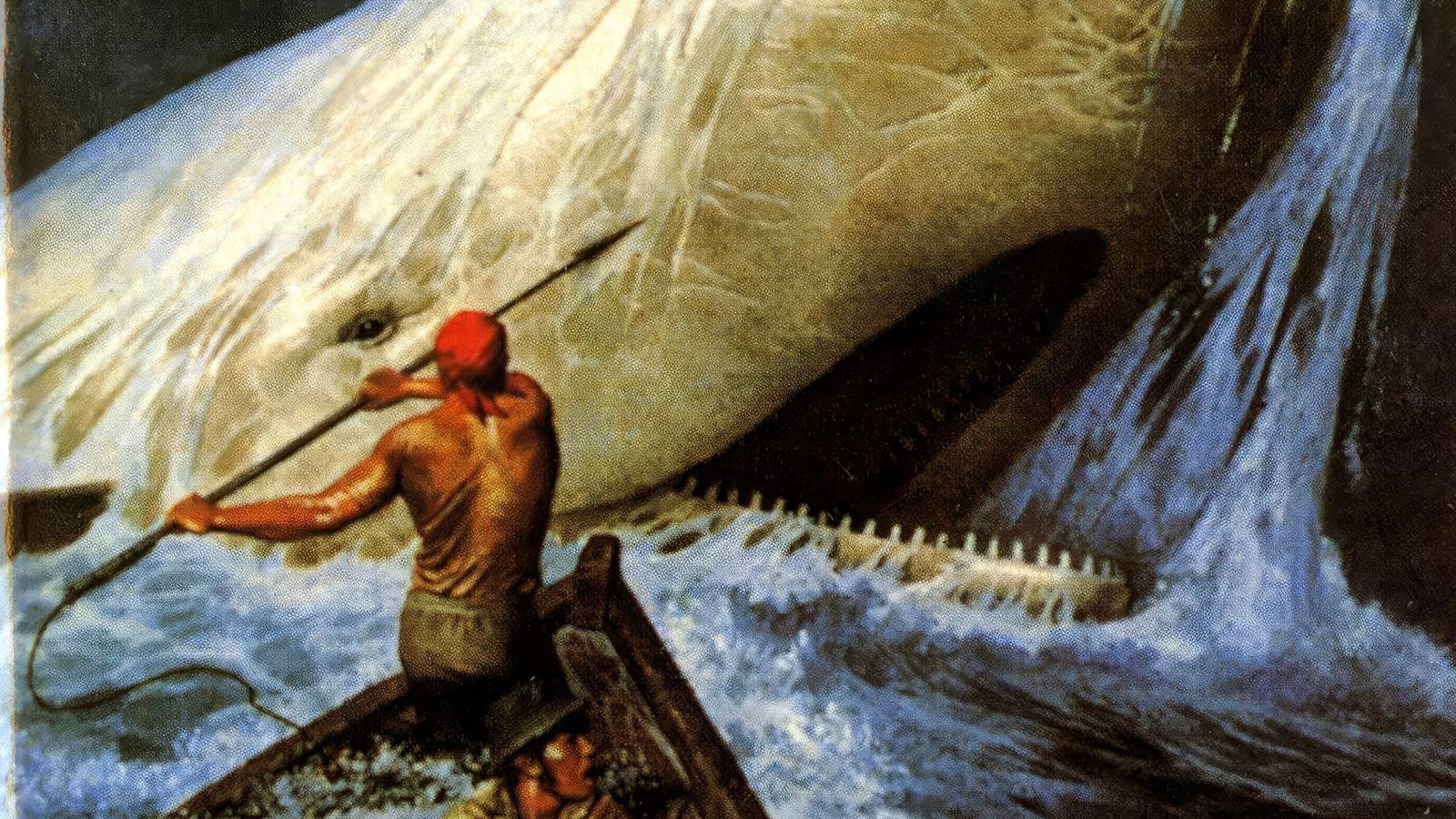
Image via Tor Classics Published Nov 24, 2026, 12:18 AM EST At any given moment, Scott Simone has at least three books jockeying for his attention. He’ll never turn down a campus novel with a literary bent, nor will he hesitate to add yet another mystery to his Leaning Tower of Pisa-inspired to-be-read pile — which is built upon the bedrocks of too many short story collections, how-are-these-real true crime books, and classics waiting to be cracked open again. Topics that have him ripping through pages the fastest include closed-circle murders, unhappy professors, life-questioning philosophical deep dives, so long as they feature sharp sentences, a dark sense of humor, and at least a little malice. He’s spent so much time in book shops over the years he is, to his wife’s chagrin, continuing to build a library that doesn’t quite respect the dimensions of the apartment meant to contain it. Sign in to your Collider account It's hard to describe Moby-Dick. On the surface, it's a simple story of revenge, about a ship captain hunting the whale that took his leg. But the novel comes in waves. There are chapters about whale anatomy and the whaling industry. There's an entire chapter devoted to the color white. These chapters, at times, drown the whole whale hunting business until it once again bobs its head above it all. Yet all that diving and resurfacing is what made Moby Dick such uncharted territory. Herman Melville hooks you with the promise of adventure, but it's the examination of obsession, of fate, and of man's relationship with nature that continues reeling you in. It's an attempt to understand and to make sense of the world, and it reads part adventure, part encyclopedia, part philosophical argument. And somehow it all works. That's what the greatest novels manage to do. They use a simple story — about a man, about a family, about one small part of the world — as the basis to explore so much more. They make us care about people we might otherwise despise, or they find tragedy in the ridiculous. They don't need to be so obviously about absolutely everything as Melville was. Some manage an extraordinary amount with very little. Some sprawl across generations, taking us so far from where we began that it's difficult to believe we're still reading the same book. So, sure, Moby-Dick deserves its place among the greatest novels ever written. But it's hardly the only one to make an improbable story into something extraordinary; and a few have managed to do it even better. 'Don Quixote' (1615) Image via Penguin Classics Don Quixote has become something of a punch line. A sort of shorthand for anyone undertaking an obviously outlandish pursuit. It’s about an aging man who reads one too many stories about knights. He decides he ought to become one himself and heads off to fight giants that turn out to be windmills. It's all a little ridiculous. But while Miguel de Cervantes' deluded knight is farcical, he has a way of exposing some truths. Yes, he's hopelessly out of touch with reality; but, he still believes in honor and justice, and takes it upon himself to defend anyone who needs protection. Then there's Sancho Panza. A grand promise of an island to govern sends him trotting alongside Don Quixote. We're to think he's the sensible one despite that. After all, he knows that windmills aren't giants. Yet he follows Don Quixote from one absurd adventure to the next. He argues with him, sure, but he also loves to indulge Don Quixote. He even has the tendency to get caught up in all the nonsense goings-on himself. As the whole thing unfolds, it becomes harder and harder to pinpoint who the actual fool is. Because it's the people who humiliate Don Quixote that have a much uglier view of the world, and we're not talking about his tendency to see castles where everyone sees inns. Like Melville's Ahab, he's a man possessed by an idea, unwilling to accept anything that contradicts it. But where Ahab's obsession leaves death and destruction in its wake, Don Quixote's produces something altogether more complicated. 'Crime and Punishment' (1866) Image via Penguin Classics Rodion Raskolnikov has a theory: the usual rules of morality don't apply to certain men. They're just a bit too special. Napoleon didn't get where he did by worrying about all the people who died along the way. And Raskolnikov, a penniless former student living in St. Petersburg, decides he might belong to that exclusive club. So he decides to test his little theory and murders an elderly pawnbroker, reasoning that her money could be put to better use. Then he murders her sister, too. But the murders take up little of Crime and Punishment. The real story is about Raskolnikov trying to get on with his life afterward. He's feverish and he's paranoid. He's insufferable to the few people who still give a damn about him. He panics after perfectly innocent conversations. Every encounter with Porfiry Petrovich, the magistrate investigating the murders, is fraught with tension; not only the pitter and the patter between the two, but internally as he contemplates whether he's about to be arrested or merely imagining things. Raskolnikov, like Melville's Ahab, has convinced himself he's somehow above the rest of humanity. But unlike Ahab's obsession dragging an entire ship toward disaster, it's Raskolnikov dragging himself, and only himself, into demise. 'Middlemarch' (1872) Image via Macmillan Collector's Library Middlemarch sounds like a hard sell. Nearly 800 pages about the goings-on in a provincial English town. People marry the wrong people. They borrow money. They gossip, and they meddle in one another's affairs. There's not exactly a whale to chase. But there is Dorothea Brooke, who's desperate to do something with her life. She convinces herself she can help Edward Casaubon, an older scholar, produce some great intellectual work. And so she marries him. There's just one little issue to contend with: Casaubon isn't nearly as brilliant as she imagines. What makes Middlemarch engrossing is how decisions tend to become someone else's problem. A marriage made with the best intentions turns miserable. A few unpaid bills threaten to derail a promising career. And a bit of gossip, passed from one drawing room to another, can do more damage than anyone intended. Nobody is entirely innocent in all this, though few are outright villains. Even the most infuriating characters have their reasons for behaving as they do, and we get to see how they came by them. George Eliot gives us an entire town of people pursuing their own ideas of happiness, often at the expense of someone else's. Melville sends Ahab halfway around the world to examine the forces that govern human lives; Eliot hardly needs to leave the confines of a small English town. Collider Exclusive · 8 Questions · 2 Minutes Which British Mystery Series Should You Live In? Midsomer · Broadchurch · Luther · Vera Answer eight quick questions and we will tell you which one you belong in. Four of the biggest British detective shows ever made, four completely different tones, and four very different ideas of what a detective is for. 🏡Midsomer(Midsomer Murders) 🌊Broadchurch(Broadchurch) 🌚Luther(Luther) 🧥Vera(Vera) FIND YOUR SERIES → 01 Where would you most want to live? Pick the one that sounds most like you. AA village with a very old pub. BA seaside town under a cliff. CA flat in east London. DSomewhere windy with a long view. NEXT QUESTION → 02 How do you feel about your neighbours? Be honest. AI know all of them and their business. BWe genuinely look out for each other. CI have never met a single one. DThey know to leave me to it. NEXT QUESTION → 03 How would your friends describe you? Pick the closest answer. ACheerful, and a little bit nosy. BKind, and you feel everything. CIntense. Occasionally alarming. DBlunt, and usually right. NEXT QUESTION → 04 How do you solve a problem at work? One answer only. AChat to everybody until it clicks. BPatiently, and it costs me something. CStraight through the middle of it. DAsk the question nobody else will. NEXT QUESTION → 05 Pick a coat. No wrong answers here. AA waxed jacket and wellies. BWhatever was nearest the door. CA long dark overcoat. DA battered hat and an old mac. NEXT QUESTION → 06 How do you take bad news? Pick the closest answer. AMake tea and sit down with it. BTake it personally, every time. CGo very quiet, then move fast. DGet straight on with the job. NEXT QUESTION → 07 What is your relationship with the rules? Think about work, not parking. ARules are what hold a place together. BI follow them and they still fail people. CRules are for people with more time. DI bend the ones that get in the way. NEXT QUESTION → 08 What matters most to you in a case? Last one. This is the one that decides it. AThat the village gets its peace back. BThat the family finally gets an answer. CThat whoever did it is stopped. DThat somebody finally listened. REVEAL MY SERIES → Previously, On ITV Your Series Is…Britain makes more detective television than any country has any business making, and somehow almost all of it is good. Here is the one you belong in, what it says about you, and the case for it being the best of the four. Midsomer MurdersYou want the tea, the gossip and the vicar behaving oddly. Midsomer is a county where the scenery is beautiful, the fete is on Saturday and the murder rate is roughly that of a small war, and absolutely nobody involved thinks this is strange. You are sociable, curious and the first to notice that somebody has changed their routine. It has been running since 1997 and sells to well over two hundred territories worldwide. John Nettles handed over to Neil Dudgeon in 2011 and the show did not miss a step. Your flaw is that the line between caring about people and enjoying the gossip is thinner than you admit. BroadchurchYou feel other people's grief as if it were handed to you personally. Broadchurch is less a whodunnit than a study of what a small town does to itself when it finds out that the answer was always going to be somebody everybody already knew. You are the one people tell the truth to, and you carry all of it afterwards. Olivia Colman won the BAFTA for Best Actress for the first series and David Tennant has never been better. Chris Chibnall wrote it before taking over Doctor Who, and took Jodie Whittaker with him. Your risk is absorbing so much of other people's pain that nobody notices yours. LutherYou go through things rather than around them. John Luther is the best detective in London and a liability to everybody who works with him, and the show is completely honest that those two facts are the same fact. You are the one people call when the normal approach has already failed. Idris Elba won a Golden Globe for it in 2012 and it made him a film star more or less overnight. Luther: The Fallen Sun arrived on Netflix in 2023 and took the character properly cinematic. Your weakness is that doing the right thing your way still leaves a mess for somebody else. VeraYou say the thing and you do not dress it up. Vera Stanhope turns up in a hat and a mac, is rude to almost everybody, and is the only person in the room prepared to ask the question that the family has been waiting years for somebody to ask. You have no patience for performance, and the people who like you really like you. Brenda Blethyn played her for fourteen series before stepping away, and ITV ended the show rather than recast. Ann Cleeves wrote the novels, and also wrote the books behind Shetland, which is the same trick in a colder place. Your flaw is that blunt and kind can be the same thing, but only if people already know you. ↻ RETAKE THE QUIZ 'Germinal' (1885) Image via Penguin Classics Germinal takes us underground. Deep underground, into the coal mines of northern France. Émile Zola introduces us to Étienne Lantier, who finds work at Le Voreux, a mine that's been swallowing generations of workers. Take the Maheu family. Nearly everyone works in the mines, yet there's hardly enough money to put food on the table. They spend their days risking their lives. They come home exhausted, get up the next day to dig. Rinse, repeat. All the while, the mine owners live a comfortable existence. So when the company makes an already miserable existence even harder, Étienne helps organize a strike. But refusing to work means no food. As the strike drags on, the cupboards empty. Families who barely had enough to begin with now have nothing. Solidarity amongst the miners fractures. Some want to hold out. Others are desperate to get back to work. People who've spent their lives working alongside one another are turning against each other. There's anger and there’s violence. That's what makes Germinal so devastating. Zola gives us an entire community whose lives are dictated by the work that's slowly killing them. Like Melville, he's interested in man's struggle against forces much bigger than himself. But while Ahab drags his crew halfway around the world to confront the source of his misery, Zola's miners have to descend into theirs every morning. 'One Hundred Years of Solitude' (1967) Image via Harper Perennial Modern Classics Good luck keeping track of the Buendía family in One Hundred Years of Solitude. The foliage that the various José Arcadios and Aurelianos alone occupy on the family tree is astounding. And that's before getting into all the strange things happening around them. An outbreak of insomnia leaves people forgetting the names of everyday objects, so they start sticking labels on everything. A young woman floats off to heaven while folding bedsheets. The dead occasionally stop by for a visit. And nobody seems particularly bothered by any of it. In Gabriel García Márquez's world, the impossible is just another part of everyday life. But the names aren't the only things that keep repeating. Over seven generations, the Buendías fall into the same traps as their parents and grandparents. They pursue doomed romances and they nurse old grudges. They throw themselves into grand ambitions that inevitably come to very little. And their hometown of Macondo experiences its own troubles. There are civil wars. There are political upheavals. There's the arrival of a foreign banana company. When striking workers are massacred, the authorities insist it never happened. And before long, almost everyone seems to believe them. Where Melville uses the pursuit of a single whale to examine mankind's place in the world, García Márquez gives us a century of births, deaths, wars, and family squabbles to explore how history gets repeated, distorted, and sometimes forgotten altogether. One Hundred Years of Solitude Release Date 2024 - 2026-00-00 Network Netflix Cast Gino Montesinos Melchiades the Alchemist Claudio Cataño Colonel Aureliano Buendía Directors Laura Mora, Alex Garcia Lopez, Carlos Moreno Writers Jose Rivera Main Genre Drama Seasons 2 Producers Josep Amorós Streaming Service(s) Netflix Release Window 2024 Executive Producer(s) Alex Garcia Lopez, Andrés Calderón, Carolina Caicedo, Diego Ramírez Schrempp, Gonzalo García Barcha, Jose Rivera, Josep Amorós, Juliana Flórez Luna, Laura Moran, Rodrigo García
5 Classic Books Better Than 'Moby-Dick'
Full Article
Original Source
Read the full article at Collider →KhanList aggregates and links to publicly available news content. We do not host full articles from third-party sources. Always verify important information with original sources.