
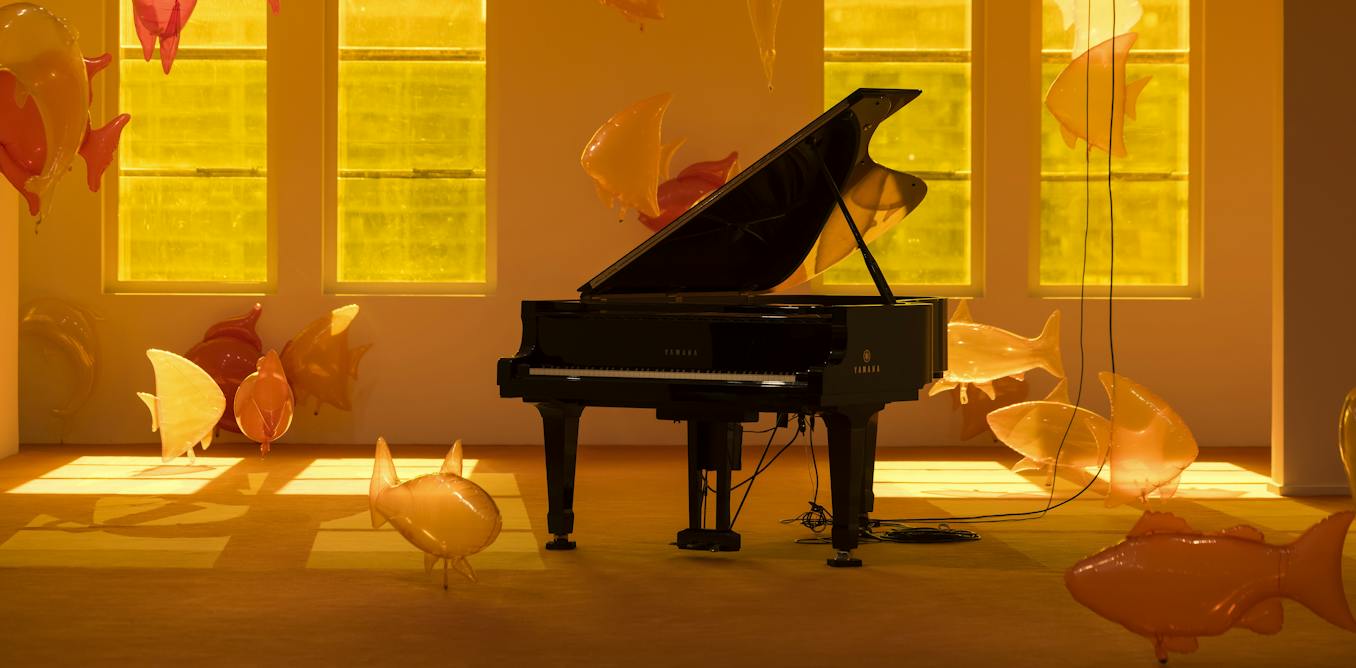
Golden light streams into the gallery through yellow tinted windows, casting angular shadows across vivid orange carpet. An electronically wired baby grand piano plays a sparse doleful tune. Fish-shaped helium balloons float above. On bench seats lay piles of coloured A4 paper with printed text saying things like “Attachment is simply the result of our inadequate perception of reality”. This is one of the immersive installations created by French artist Philippe Parreno for his exhibition 5 Moons, at the Museum of Contemporary Art Australia (MCA) in Sydney. Co-curated by MCA director Suzanne Cotter with Anna Davis and Tim Riley Walsh, it’s Parreno’s first major exhibition in Australia. Born in Algeria in 1964 and moving to France as a child, Parreno became internationally recognised in the 1990s for exhibitions that questioned conventional relationships between artist, artwork and audience. Rather than static art objects for contemplation, Parreno’s artworks are conceived as characters in immersive, choreographed experiences. In a theatrette, a two-hour cinematic portrait of a cuttlefish is screening. Anna Kučera/MCA Parreno is often associated with Relational Aesthetics, a term coined by French curator and critic Nicolas Bourriaud in the late ‘90s. This was a new type of art in which artists facilitated experiences. Audience participation and social relations were foregrounded. Sharing meals, conversations, and community gatherings could all be art. 5 Moons extends Parreno’s fascination with shared realities by creating a series of connected environments throughout the museum. Each room is like a stage or set that invites viewers to experience something communally. Powered by nature The centre of the exhibition is the 11-hour film 5 Moons, featuring nighttime footage shot on an abandoned almond farm in the Tabernas desert in southeastern Spain. It’s projected on a massive floor-to-ceiling screen. Real-time atmospheric data from the farm – such as temperature, humidity and wind – is converted into electronic signals that power different parts of the exhibition, like a central nervous system. This data influences the exhibition’s lighting and sound, as well as three large-scale industrial fan sculptures (Levente, 2024) that conjure the desert wind throughout the galleries. 5 Moons was filmed on an abandoned almond farm in the Tabernas desert, during the night. Anna Kučera/MCA Live audio from the farm – including birds and insects – feeds into different rooms. While the precise technical operations are hidden, the exhibition’s abundant cables, sensors and electronics evidence networked connectivity. Like a cuttlefish’s light-sensing skin, the exhibition’s sensors receive and transmit information beyond human perception. The exhibition as ecosystem The exhibition functions as a kind of ecosystem in which artworks co-exist and interact. In the exhibition’s first room, on level one, is a cluster of kinetic light sculptures that flicker and move in response to atmospheric data from the abandoned farm. Audio from the site also plays through speakers. Parreno’s exhibitions often feature lights and flickering effects. Anna Kučera/MCA In the MCA’s theatrette is Otherwhence (Ineluctable Modality of the Visible) (2026), a two-hour cinematic portrait of a cuttlefish, with its changing pigmentation and iridescence displayed in lush, close-up detail. The cephalopod ignores the cinematic fourth wall, gazing persistently back at the camera. Combined with a glitchy atmospheric soundtrack, the result is an uncanny sense of telepathic, sentient connection. As with other spaces in the exhibition, the theatrette contains several interconnected works. Each seat bears a digital print of an abstracted cuttlefish pupil on fabric. On either side of the screen are two flat panel speakers that rotate and tilt, radiating the soundtrack like laser beams. Even the screen is an artwork: light bulbs behind the projection surface pulse intermittently to interrupt and add to the imagery. Three fans throughout the exhibition are activated by live data from the almond farm in Spain, evoking a breeze within the gallery. Anna Kučera/MCA The main exhibition space, on level three, features around 15 works across eight spaces. In one room, overlooking Sydney Harbour, tinted windows cast a tangerine light (Orange Bay, After Gabriel Tarde’s Underground Man: Fragment of Future History, 2002–ongoing) while window blinds rise and fall (Blind Sisters, 2018). In another space, the ceiling is covered with helium-filled speech bubble balloons (Speech Bubbles, 2026) and a hexagonal LED light illuminates the room with ever-changing hues (Mount Analogue, 2001). De-centring humans Parreno’s exhibition is notable for its delegation of human agency. The flux of lights, sounds and motion creates animated, immersive environments – but ones that seem powered by something other than people. The piano plays without a pianist, speech bubbles float without speech, lights dim and flicker automatically. There are moments of merry wonder (who can resist an inflatable dolphin balloon?), but the dominant undercurrent is melancholy. The gaps created by Parreno’s delegated authorship are unsettling. But they also trigger very human processes of reflection, imagination, anticipation and projection. By awakening these perceptual capacities, Parreno’s installations ask audiences to consider how human, natural and technological agencies are interconnected. Relational Aesthetics highlighted the power of social connection. Today, as environmental and technological changes seem to gather runaway momentum, returning the cuttlefish’s gaze means more than recognising its sentience. It means revitalising our shared responsibility for collective futures. Philippe Parreno: 5 Moons is showing at the Museum of Contemporary Art, Sydney until April 26 2027.
Who can resist an inflatable dolphin balloon? The wonder and melancholy of artist Philippe Parreno
Full Article
Original Source
Read the full article at Theconversation →KhanList aggregates and links to publicly available news content. We do not host full articles from third-party sources. Always verify important information with original sources.