
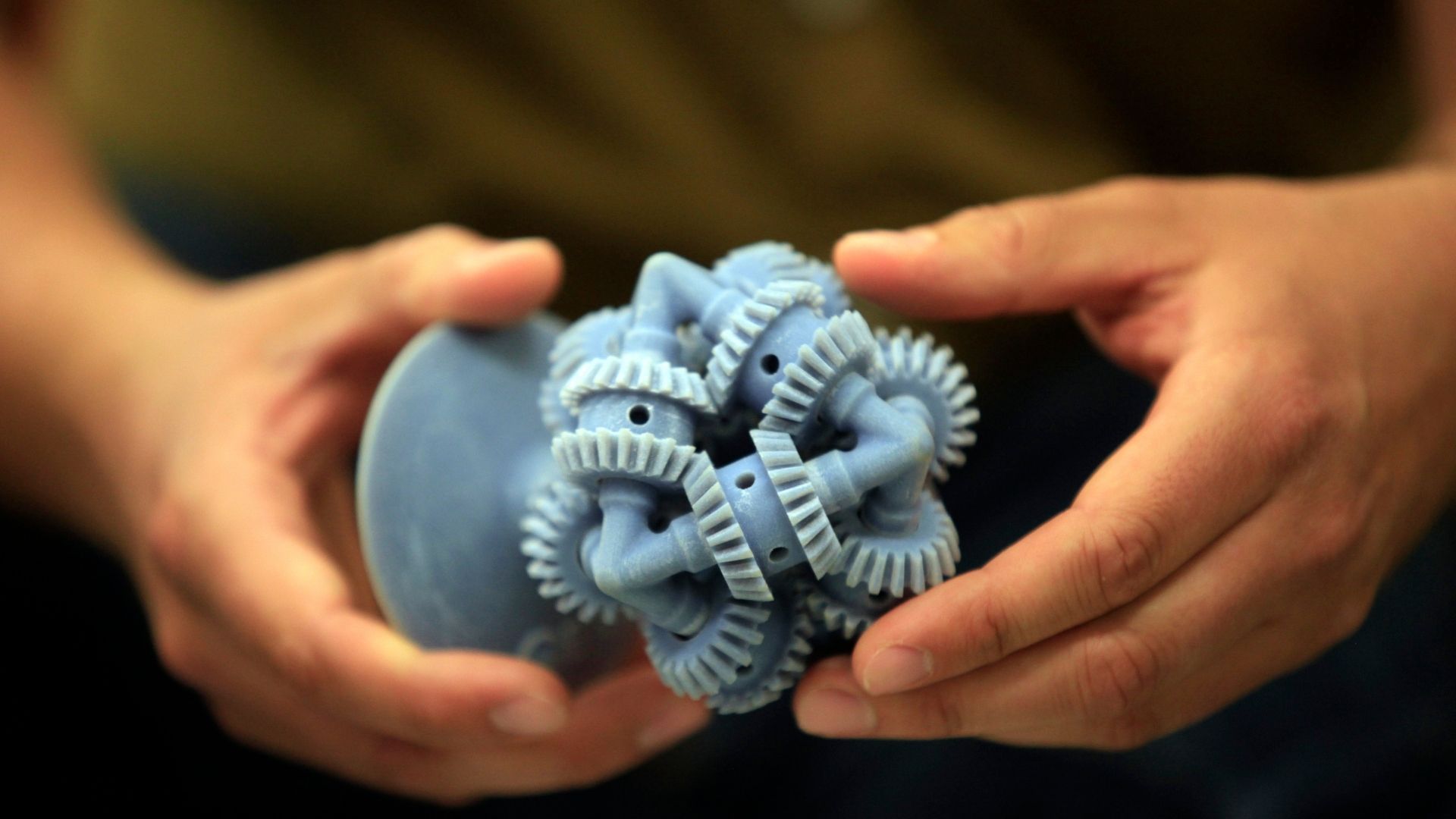
Imagine printing an object that does not remain exactly as it came out of the printer. Expose it to heat, water, light, or another trigger, and it could bend, fold, expand, or otherwise change its shape. That is the basic idea behind 4D printing. It builds on 3D printing by adding something unusual to the finished object: the ability to respond to its surroundings and change over time. The concept was popularized by architect and computer scientist Skylar Tibbits in 2013. More than a decade later, researchers are developing increasingly sophisticated materials and printing techniques that could turn the idea into useful engineering systems. So, what exactly is 4D printing? Traditional 3D printing creates a physical object by depositing or solidifying material layer by layer according to a digital design. Once printed, the object generally has a fixed geometry and performs its intended function without fundamentally changing shape. 4D printing uses a similar additive-manufacturing foundation, but the printed structure contains programmable, stimulus-responsive materials. These materials can be engineered to respond to triggers such as temperature, moisture, light, pH changes, magnetic fields, or electrical stimulation. The response can be designed into the material and the way its structure is printed, allowing a flat or compact object to transform into a predetermined configuration. Importantly, the “fourth dimension” is time. It does not mean that engineers are printing objects with an additional spatial dimension. 3D vs 4D printing: What’s the difference? The simplest distinction is that 3D printing creates the structure, while 4D printing can create a structure that changes after fabrication. A conventional 3D-printed component might be designed to maintain its shape throughout its service life. A 4D-printed component could instead be programmed to transform when it encounters a particular environmental condition. The two technologies can even use similar printing hardware. The major difference lies in the materials, structural design, and programming of the object’s response. That makes 4D printing less about inventing an entirely new type of printer and more about combining additive manufacturing with smart materials and carefully engineered structures. What materials make 4D printing possible? Researchers are experimenting with several classes of responsive materials. Shape-memory polymers can be programmed to return to a particular shape after exposure to a stimulus, often heat. Hydrogels can swell or contract in response to water and other environmental conditions. Researchers are also investigating liquid-crystal elastomers and self-healing polymers, along with composite materials that combine multiple properties. The printing process can also control how different materials are arranged, allowing different sections of an object to respond differently. This creates the possibility of programmed bending, folding, or more complex movements. Where could 4D printing be used? The technology has attracted interest across several engineering fields. In medicine, researchers are investigating 4D-printed structures for drug delivery, tissue engineering, diagnostic devices, and implants that could respond to conditions inside the body. In soft robotics, printed structures could potentially act as lightweight actuators that change shape without conventional motors. Aerospace is another intriguing application. Adaptive structures could potentially change configuration in response to environmental conditions, while lightweight deployable components could be printed in compact forms and transform when activated. Researchers are also exploring applications in electronics, smart textiles, automotive components and construction, where materials that respond to their surroundings could offer capabilities conventional static components cannot. Is 4D printing ready for mass production? Not yet. Research has advanced considerably, but much of 4D printing remains at the laboratory and proof-of-concept stage. A 2025 Chemical Reviews assessment highlighted challenges involving materials, fabrication complexity and the need for further development before widespread adoption. Researchers also need better control over transformation speed, durability, repeatability and operating conditions. Scaling responsive materials into large, reliable industrial components is another major challenge. The future of 4D printing therefore may not be about replacing conventional 3D printing. Instead, the two could increasingly complement each other. 3D printing gives engineers extraordinary control over where material goes. 4D printing adds another question: what should that material do after it has been printed? That shift, from manufacturing static objects to manufacturing objects capable of adapting, could ultimately make 4D printing one of the more interesting directions in the evolution of additive manufacturing. Get the latest in engineering, tech, space & science - delivered daily to your inbox.Kaif Shaikh is a journalist and writer passionate about turning complex information into clear, impactful stories. His writing covers technology, sustainability, geopolitics, and occasionally fiction. A graduate in Journalism and Mass Communication, his work has appeared in the Times of India and beyond. After a near-fatal experience, Kaif began seeing both stories and silences differently. Outside work, he juggles far too many projects and passions, but always makes time to read, reflect, and hold onto the thread of wonder.
4D printing explained: How it differs from 3D printing and where it could go next
Full Article
Original Source
Read the full article at Interestingengineering →KhanList aggregates and links to publicly available news content. We do not host full articles from third-party sources. Always verify important information with original sources.