
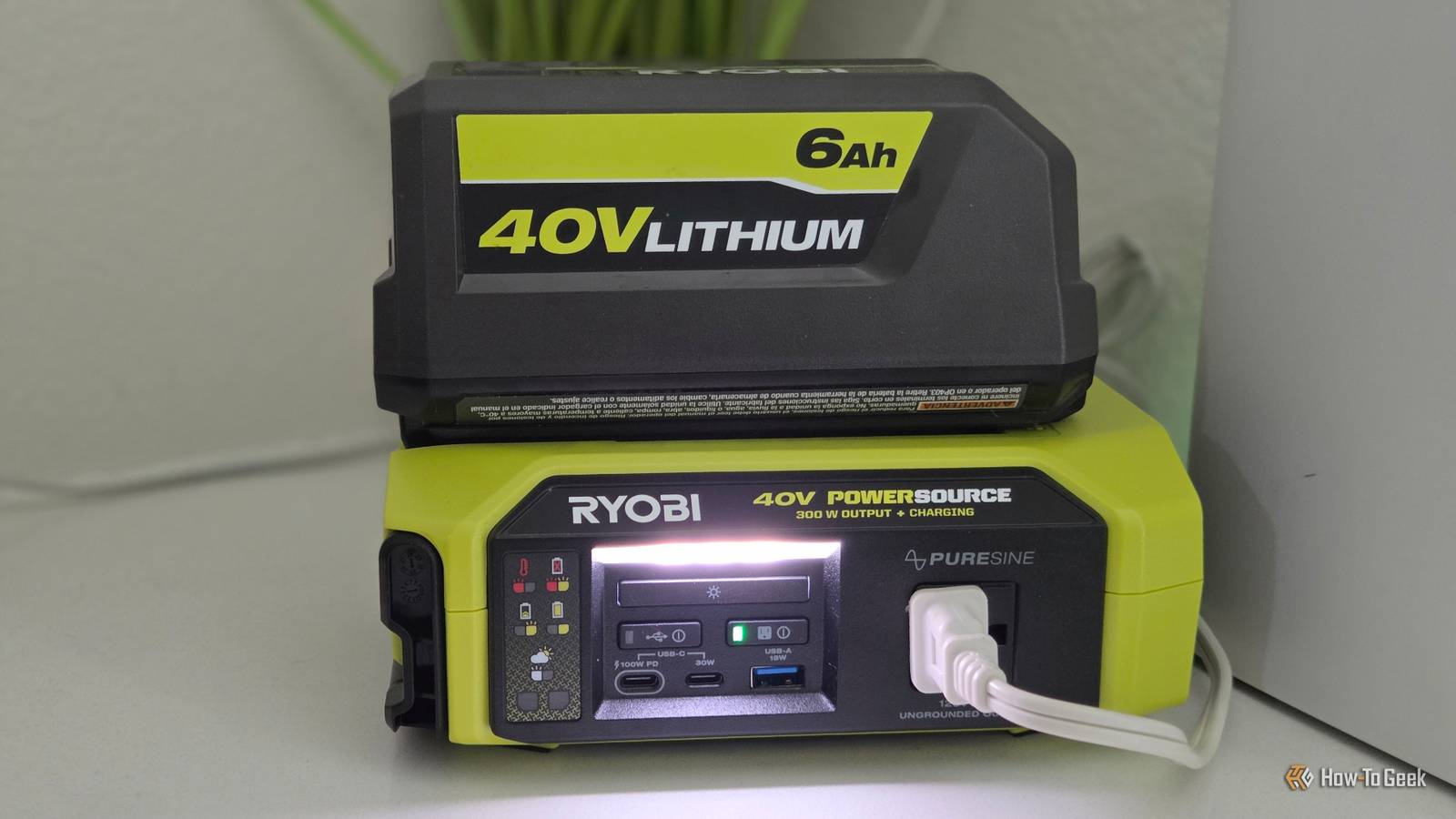
Published Nov 19, 2026, 12:00 PM EST Cory Gunther is a senior author and Newsletter Editor at Valnet, covering cutting-edge tech, Android, and more for How-To Geek. He's covered Android, cars, and technology for over a decade. When he's not reviewing the latest gadget, you can find him off-roading in his Toyota truck, fixing said truck, or doing something outdoors with friends and family. He's covered CES, SEMA, and MWC and reviewed countless phones, TVs, speakers, EVs, e-bikes, and more. Before Valnet, Cory worked for GottaBeMobile. His writing has also appeared on SlashGear, InputMag, and AndroidCentral. He's written over 9,000 articles. Ryobi is one of the most popular power tool brands, with a large lineup of tools, but it also makes a ton of other products that run on the same 18V or 40V battery packs. For many homeowners and DIYers, all those other accessories are a huge selling point. Case in point: the new power source chargers double as portable power stations and are packed with ports. One of my favorite Ryobi purchases lately is the 40V (300W) Power Source Charger. It's a versatile accessory that turns your boring battery charger into a charging dock in the garage for other gear, and into a go-anywhere portable power station for phones, tablets, and more. Here's what you need to know, and a few things you can do with it besides charging tool batteries. Ryobi's 18V and 40V Power Source Chargers Charge your battery and phone, use it as a power bank, and more Credit: Ryobi For starters, there's an 18V ONE+ 200W Power Source and Charger that'll work with all your regular 18V ONE+ battery packs, along with a larger 40V 300W Power Source. And while Ryobi's been making power inverter adapters for battery packs for years, these latest models are a little different: they pack 100W USB-C (on the 40V) and 60W USB-C (on the 18V) ports and have a lot to offer. The idea here is simple. This accessory will work like any other Ryobi battery charger you already own. However, while it's charging your tool battery, you can also use the built-in LED light, the 30W USB-C port, the USB-A port, or the 120V AC wall plug. It essentially turns your charger into a dock of sorts. That was my first thought when it was announced, and I love having one device on top of my toolbox that charges my battery and my smartphone. Better yet, during an emergency power outage or a camping trip, you can take the entire Power Source charger and your battery with you, and use that 4Ah or 6Ah battery pack as portable juice — almost like a power bank or power station. Only now you can use the 30W and 100W USB-C ports (on the 40V model), USB-A, and more to power all the things. It's versatile, and that's why I bought one. If you didn't know these existed, you're welcome. And now that you do, you're thinking about all the ways to use it. With that in mind, here are some great use cases beyond charging your tool's battery. Charge phones, tablets, and small electronics Your Ryobi battery can top off all sorts of tech With this accessory, your mundane Ryobi battery charger (and packs) become a power source for anything that can run or recharge via USB, as well as for smaller items with a 120V AC plug. While the Ryobi power source charger sits in your garage or workshop, use its USB-A and USB-C ports to top up smartphones, tablets, smartwatches, cameras, drones, and wireless headphones, to name a few. I actually have a USB-A-powered clock and thermometer sitting above my toolbox, powered by my Ryobi 40V 300W Power Source. Then, you can do all of that and more while on the go. Obviously, this is way heavier than your typical Anker 20k power bank, but it's nice to have the option. It'll be great to have during an emergency power outage as an extra option to keep small lights on or phones charged, and I plan to take it camping once the weather warms up in 2027. Power laptops or other machines Constant reliable power Being able to recharge phones and other electronics via USB-C cables is nice, but when you're using this accessory and getting power from the battery pack rather than the wall, it still offers several benefits. Depending on the model, like my bigger 40V 300W Power Source Charger, you'll get continuous 120V pure sine wave AC power. That means you can safely and reliably power a laptop, rather than simply recharge one. Even the smaller 200W Power Source, which uses Ryobi 18V battery packs, can do this. And technically, you could run a CPAP machine or a humidifier from the 120V AC outlet on Ryobi's power source, although Home Depot's website advises against using it for essential medical equipment. As long as it's not essential equipment, the continuous 120V pure sine-wave AC power should be able to power many devices that don't exceed the 300W limit. Additionally, if you want to use your Ryobi battery as a power source and aren't as worried about charging, the company makes a 40V 300W power inverter for only $99. Run fans, lights, and other small AC appliances I used mine to power my Wi-Fi router during an outage Depending on the Ryobi Power Source model you own, you'll be able to run or power all sorts of things. In fact, you can plug a bunch of low-wattage AC devices into your Ryobi power source and continue with your day. The Ryobi 40V model delivers 300W of constant power, which is more than enough for fans, string lights, a mini-fridge, or even a TV. Ryobi states a 40V 4Ah battery can run a standard 10W light for 12 hours, fans for over 6 hours, and a small TV for around 4 hours. I wanted to try it for myself, plus we get a lot of power outages and inclement weather here in Texas, so I plugged my 40V 300W Power source into my Wi-Fi router, and it kept the internet flowing for over 5 hours without a problem. Basically, anything that requires 300W or less can run for at least a little while on this neat accessory. Keep in mind that things like a coffee machine, hair dryer, or even small portable heaters draw a lot of power, so Ryobi's little adapters won't be able to power them. Ryobi offers power source chargers or inverters at 150W, 200W, and 300W. Pair it with solar panels Or power gear on a road trip Credit: Ryobi By now, you're probably starting to see all the ways a Ryobi Power Source Charger can come in handy. Recharge your tool battery packs, charge phones, power laptops, take it camping, use it while tailgating at the next big college football game, and so much more. Additionally, you can actually take these on the road or on outdoor adventures and stay topped off with a compatible solar panel. Seriously, Ryobi actually makes a pretty decent 60W Foldable Solar Panel, and you can use the USB-C ports to keep devices charged up with the sun. Road trip or vanlife folks can also use a compatible 12V vehicle adapter with USB-C output to power the Power Source/Charger, allowing you to keep devices and batteries powered off-grid or on a road trip. More than just tools for the house and yard As you can see, Ryobi is a lot more than just a brand that makes tools for DIY projects or maintaining the yard. In fact, Ryobi offers a wide selection of camping accessories, lights, fans, a portable battery-powered cooler, and much more. The company even has a 1,000W automotive power inverter that runs on an 18V battery, a car battery, or a 12V plug. I'll have a few 40V battery packs charged all winter in case I need to use them with my 300W adapter, and I can't wait to take it camping or on my next outdoor adventure. The options are endless. Ryobi 40V (300W) Portable Power Source Tool Type Solar Panel Warranty 3 Year Limited Snap your Ryobi 40V battery into this portable power source accessory and use it to charge phones, power fans, lights, and more. One 40V battery gives you 300 watts of continuous power.
4 ways to use Ryobi's Power Source charger beyond recharging batteries
Full Article
Original Source
Read the full article at Howtogeek →KhanList aggregates and links to publicly available news content. We do not host full articles from third-party sources. Always verify important information with original sources.