
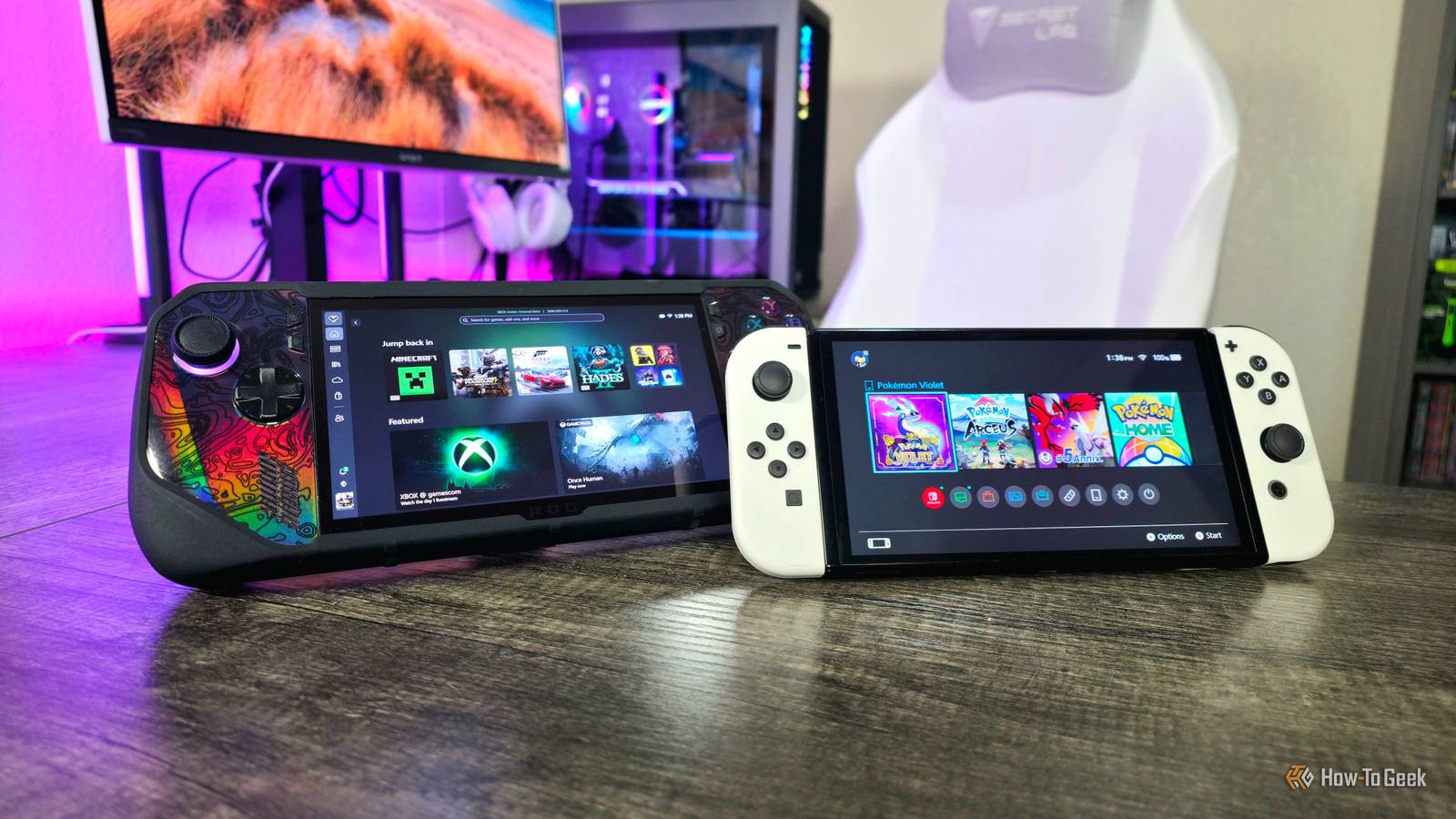
Published Aug 27, 2026, 11:45 AM EDT Zachary Boddy is a seasoned journalist with over six years of experience covering technology and video games, and is now contributing to How-To Geek. Zachary's career began at Windows Central, where their long-running, deep-rooted passion as a tech and gaming nerd fueled thousands of published articles, including reviews, guides, interviews, editorials, and so much more. When Zachary isn't writing, they're playing video games, reading books, listening to music, and spending time with their family, a very food-motivated cat and an exceptionally creative daughter. Handheld gaming has exploded in mainstream popularity since the rise of the Nintendo Switch, and the advent of powerful PC handhelds has led to a lot of innovation in the category. I keep the ASUS ROG Ally X on my desk, and it is a fantastic device. More often than not, though, I still find myself choosing my XBOX Series X over my ROG Ally X for my gaming needs, even if it means being confined to my living room. That trend has nothing to do with my XBOX being the more powerful device, either. PC handhelds are still lacking in several ways that keep me choosing a traditional console, and remind me why the Nintendo Switch is the best-selling handheld on the market (by a very large margin). PC handhelds are still too large Ergonomics and weight matter Let's start with what's most obvious at a glance: PC handhelds are massive. The Nintendo Switch 2 is already considerably larger than the original (a fact that has received no small amount of criticism), but is positively svelte at approximately 534g compared to the XBOX Ally's roughly 670g mass (which is also about the same as a Steam Deck, by the way). That's on the light side for a full-feature PC handheld, too, as the monstrous Lenovo Legion Go 2 comes in at around 920g. When you're expected to hold these handhelds for long periods of time, every added gram is felt. Granted, the last few years have seen companies like ASUS and Lenovo refine their grip designs to be far more ergonomic than Nintendo's Joy-Cons, and therefore more comfortable for extended play sessions. Alas, there's simply no denying physics; whenever I use my ROG Ally X in bed (usually for Minecraft shenanigans), it's often the weariness of holding the thing that ends my session, not a lack of desire to continue playing. A great pair of augmented reality glasses, like from XREAL, can be a great solution to this problem, as you no longer have to worry about holding your handheld up so you can see the display ... but AR glasses add additional cost, inconvenience, and other compromises that don't fundamentally change the gargantuan nature of most PC gaming handhelds. Even if these handhelds lost some weight, though, it wouldn't help another flaw shared by practically everything device in the space. Gaming without a charger nearby is risky Handheld batteries can't take the heat The ultimate selling point for gaming handhelds is the ability to play all of your games wherever you are, and all good handhelds do technically deliver. However, handhelds' proclivity to losing charge mid-game is a weakness that even the dominating Nintendo Switch can't avoid—and PC handhelds consistently perform worse when it comes to endurance. I take my ROG Ally X with me to my family's nearly every weekend to stay the night playing pool and Minecraft, and almost always find myself tethered to the charger before the night is done. Once again, the Switch 2 is negatively compared to its predecessor as possessing inferior endurance with 2-6 hours of runtime, but its battery can still outlast the XBOX Ally and Lenovo Legion Go 2 by 50% or more. The Steam Deck and XBOX Ally X put up better fights (with lower-powered hardware or a much larger battery, respectively), but all modern handhelds fall short in my opinion. In my opinion, Nintendo nailed the longevity balance with the Switch OLED, which could last between 4 and 9 hours depending on the game. That's enough juice to comfortably last your average airplane flight, for example, and is more than good enough for most gaming sessions. With most PC handhelds, though, I won't even consider carrying it out of the house unless I know it's fully charged—if it's not and I'm out of time, I'm likely to fall back to books or Solitaire and social media on my phone, instead. It's getting harder and harder to swallow the price PC handhelds are too expensive for many Arguably the largest obstacle to mainstream adoption for PC handhelds is price. Despite their greater hardware, superior versatility, and wider library of compatible video games, PC handhelds are held back because they're simply too expensive for most people to justify. For the third time, the Nintendo Switch 2 pulls ahead with a $450 starting price, strengthened by Nintendo's exclusive catalog of iconic franchises. The original Steam Deck broke the mold with its incredible $400 price tag for the original LCD model, but that reality has long been relegated to the past. Now, the Steam Deck OLED will set you back well over $700, leaving the entry-level XBOX Ally as the "value" option at $600. Many well-rounded PC handhelds casually approach or even surpass the $1,000 threshold, which is much more than most people are willing to spend on a device that—even if technically far more capable than a Nintendo Switch or Android-powered handheld—will probably only be used to play games. This isn't entirely the fault of device manufacturers, of course; the rising prices of memory and storage has had a lasting impact on the entire gaming industry, and PC handhelds selling in relatively small volumes stand no chance of competing price-wise. Ultimately, it can be difficult to justify a PC gaming handheld when pitted against traditional laptops, consoles, or the persistently relevant Nintendo Switch. You may have noticed a trend here. Despite offering far greater power and versatility on average, PC handhelds still fall behind the Nintendo Switch whether you're considering weight, size, endurance, or price. That promised performance is a substantial reason why people still choose a PC handheld over the Switch or other options, but PC handhelds have a weakness beyond bulky hardware. My greatest qualm with this category fully captures the direction I believe PC handhelds need to go—and it's not the fault of the companies actually making these devices. Windows can't provide the best handheld experience Consoles are still far smoother and more convenient Even the greatest PC handheld hardware is unfortunately held back by its operating system. Windows 11 may be extremely powerful and runs well on hundreds of millions of unique devices, but abundant features are paired with a lack of optimization and refinement. These weaknesses are most noticeable with PC handhelds, which are used very differently than your average laptop or desktop computer. Consoles like the XBOX Series X, PlayStation 5, and Nintendo Switch are immensely accessible to even the most casual gamers because their operating systems are designed from the ground up with gaming in mind. Being able to navigate the entire interface with only a controller is the bare minimum, every game is held to similar expectations of performance and compatibility, and unnecessary features are stripped away to focus on gaming and entertainment. The Nintendo Switch is the current gold standard for how smooth the handheld experience should be. The Steam Deck with its Linux-based SteamOS is also excellent, striking a great balance between the streamlined convenience of the Switch's operating system with added features, more control, and a massive library of Steam Deck Verified PC games. Windows simply isn't here yet, even with its full-screen XBOX Mode that debuted with the XBOX Ally handhelds. Don't get me wrong, the XBOX Mode on my ROG Ally X is good enough most of the time, and is a huge improvement over how PC handhelds used to be—but it still needs to be better. The interface is still incredibly awkward to intuitively navigate with a controller, using the controller often doesn't work at all (even if you stay inside the siloed XBOX Mode), Windows 11 is littered with bugs (why has my ROG Ally X "forgotten" my PIN entirely twice now?), and Windows' general performance, RAM management, and Sleep/Wake functionality leave a lot to be desired. Microsoft is working on improving Windows 11's fundamental performance, and there are rumors major changes are coming to the XBOX Mode in the future. I'll be very glad to see it when those upgrades arrive, but the software experience right now is a regular source of frustration whenever I pick up a PC gaming handheld. Handheld gaming PCs and consoles will coexist for a long time There's a Nintendo Switch OLED behind my TV. An ASUS ROG Ally X on my desk. A Lenovo Legion Go S in my drawer. I've used the Steam Deck, cloud-based handhelds, Android handhelds, and many more. It's all experience that has told me PC gaming handhelds are awesome, but they can still get so much better than they are now. In the meantime, I won't be giving up my traditional XBOX console any time soon.
4 ways PC gaming handhelds still need to improve
Full Article
Original Source
Read the full article at Howtogeek →KhanList aggregates and links to publicly available news content. We do not host full articles from third-party sources. Always verify important information with original sources.