
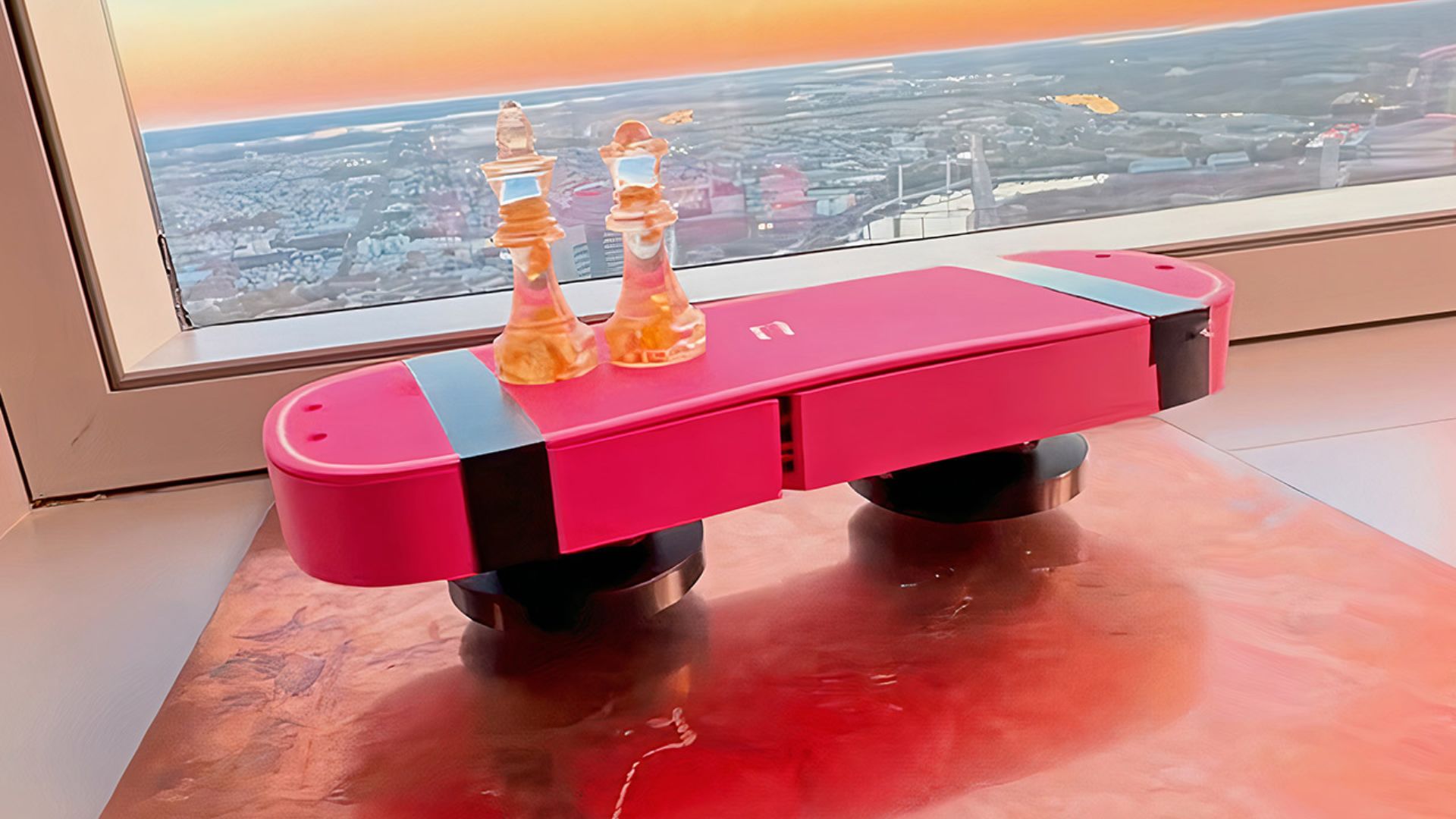
Jake Roger's working prototype of hoverboard that he built in his garage.YT/Jake RogerKey TakeawaysJake Rogers built a miniature hoverboard that he describes as a working prototype that floats above a thick copper plate, completely untethered.The palm-sized device is powered by a 22.2-volt battery inside the device.He aims to build a full-size ride-on board, HALO-1, that would require a conductive surface to ride on. Anyone who has watched Back to the Future II, a science-fiction movie that came out in 1989, has been eagerly waiting to ride the hoverboard that Marty McFly rode. But no one knew how long the wait would be before the technology reached the market. Ten years ago, things began to change as multiple attempts were made over the years to develop the technology. While none has yet delivered a commercially viable hoverboard, enthusiasts continue to push the concept further. Recently, Jake Rogers tried his hand at making a palm-sized hoverboard using 3D-printed material, magnets, brushless motors, and a bunch of knick-knacks from his garage. After spending weeks on the project, he built a miniature hoverboard that he describes as a working prototype that floats above a thick copper plate, completely untethered, with no wheels or air cushion. Halbach configuration for magnets The final design houses two rotors spinning in opposite directions, electronic speed controllers (ESP2), a converter that drops the voltage for the board, and two batteries inside the 3D-printed soft pink casing made with polymaker filament. To maximize performance, Rogers also custom-printed the rotors to accommodate a ring of twelve N52 neodymium magnets organized in a Halbach configuration. He chose the specific arrangement to ensure that the strong field points downward while the weak field above remains weak. However, he arrived at this untethered, battery-powered version only after multiple rounds of adjustments and testing. During his early trials, he started with a single motor to lift a lightweight frame off the ground. But the setup with multiple exposed wires was wobbly and twisted erratically due to reaction torque. Battery-powered lift off To counter the twisting, he paired it with a second motor. At first, the device kept flipping, which he overcame after fixing the jumbled-up wiring. Yet another challenge soon emerged: the magnets kept flinging themselves outward due to strong centrifugal force. By lowering the number of magnets from the initial sixteen to twelve per motor, he reduced the outward force by around 40% while maintaining the same speed. With those issues addressed, Rogers carried out one final redesign. He removed the dead batteries added to balance an earlier chassis and placed live 3S battery packs between the motors. As a result, the compact little board could now glide around on the copper on its own. The untethered flight was made possible by using a battery pack that could supply 22.2 volts when powered on. However, Rogers demonstrated that it wasn’t completely steady yet and still required help to stay level. To better understand the lift force generated by the design, Rogers also placed a sensor on the device and used simulations to perform calculations. According to his estimates, a force of around 61 newtons was exerted on a 3.84-gram magnet rotating at 8,000 rpm, while one entire rotor generated a staggering 941 grams-force at 3,000 rpm with a 5 mm gap. However, he refrained from relying on these simulation-based statistics, as they were generated from a device that rattled vigorously while hovering. Despite those limitations, Rogers believes the concept has room to evolve. Moving forward, he said in his YouTube video that he aims to build a full-size ride-on board, HALO-1, that would require a conductive surface to ride on. However, before chasing that vision, he will first try out a pocket-sized fingerboard toy. Get the latest in engineering, tech, space & science - delivered daily to your inbox.
3D-printed hoverboard prototype levitates over copper plate using spinning neodymium magnets
Full Article
Original Source
Read the full article at Interestingengineering →KhanList aggregates and links to publicly available news content. We do not host full articles from third-party sources. Always verify important information with original sources.