
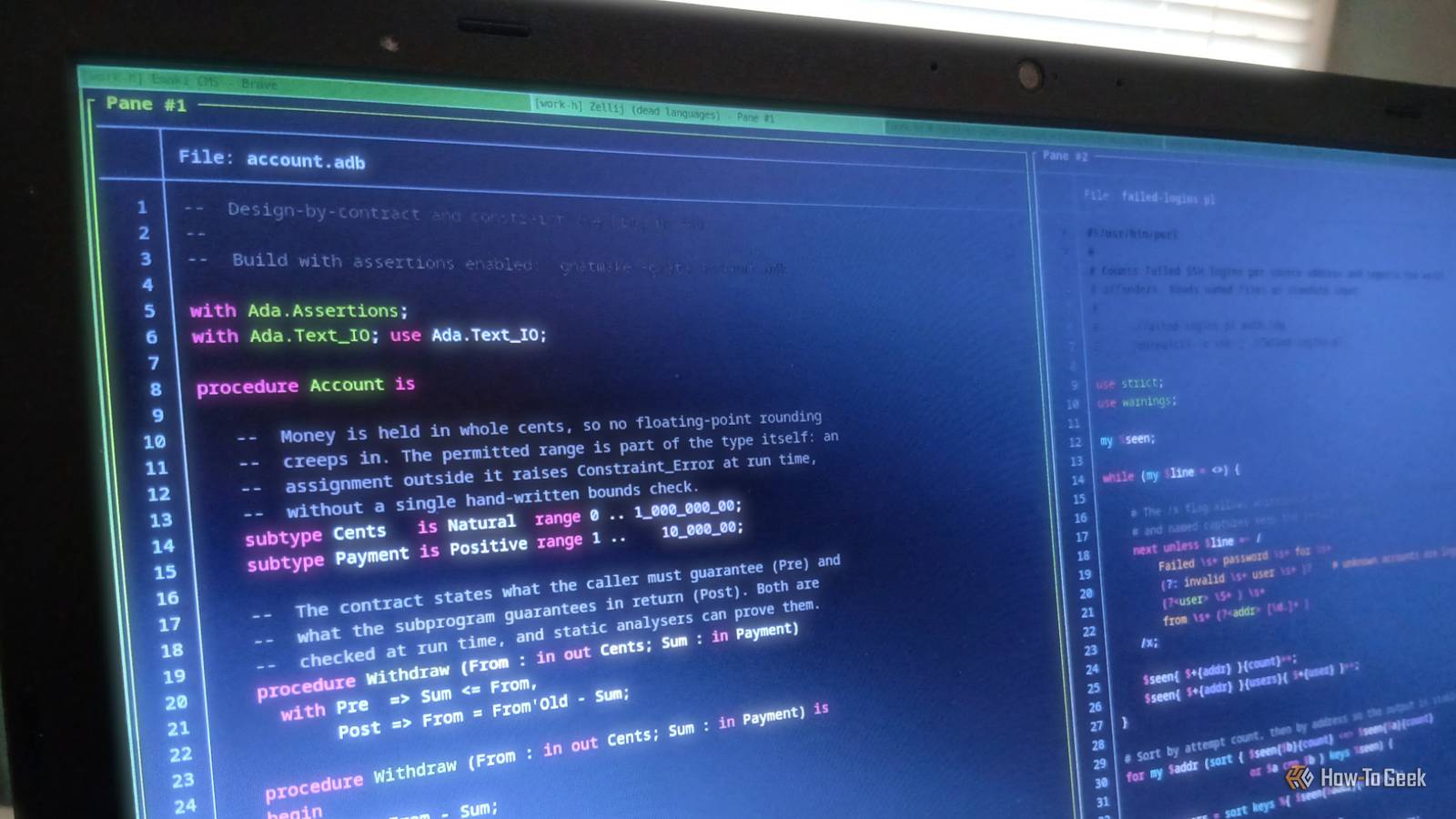
Published Sep 7, 2026, 8:00 PM EDT Graeme Peacock is a seasoned Linux expert with more than 15 years of hands-on experience. He has worked extensively with Ubuntu, Gentoo, Arch Linux, Qubes, and Fedora, gaining deep proficiency in everything from routine terminal operations to highly customized system builds. Graeme began his journey with Ubuntu, quickly mastering the command line and essential system administration skills. A year later, he moved to Arch Linux, where he spent nearly a decade refining his expertise through the installation and configuration of multiple minimalist systems. After some time, he moved to Gentoo, where he configured and compiled both server and desktop environments using normal and hardened profiles and frequently compiled custom kernels. Graeme moved to Qubes in 2016, where he has remained ever since. Graeme has extensive experience with highly configurable tools such as Vim, Neovim, and Emacs, and he maintains his own complex configurations. He is also highly proficient with Bash, Zsh, and dozens of utilities. Graeme holds a B.S. in software engineering and has a strong passion for programming and web development. He is proficient in Golang, Python, Bash, JavaScript, TypeScript, HTML, and CSS. He also has considerable experience with Docker and is currently working on learning Kubernetes. The programming world isn't just about Rust or TypeScript, and huge swaths of the economy rely on systems and technologies we rarely think about. These represent an opportunity, and dying languages that carry a lot of weight may offer the best of them. If niche technologies spark your interest, then this one's for you. A legacy language is one that was left behind. However, in reality, such languages never really go away. COBOL was invented in an era when smoking cigarettes was considered perfectly healthy, yet it still underpins most of the world's finances. Learning one means picking up tools that others have long forgotten about, sometimes giving you a distinct advantage, and earning staying power in fields that desperately need your skills. Here are three programming languages that could make you invaluable to certain employers. Common Business-Oriented Language (COBOL) ~$100k salary to maintain legacy code COBOL was one of the earliest high-level languages ever conceived, appearing in 1960—almost a full decade before we landed a tin can on the moon. Its initial purpose was to keep ordinary stakeholders (like managers) in the loop with complex business processes by using plain old English as its syntax. Since then, it has transformed into a behemoth, working its way into the heart of nearly every business transaction on Earth. Today, it's thought to handle a significant portion of the world's business and financial processes, such as 95% of ATM transactions and 40% of online-banking systems. The US government still relies on COBOL heavily across the board, not least the IRS. COBOL primarily runs on mainframe computers, where it crunches numbers and batch-processes data for a variety of industries. However, most code is in maintenance mode, and organizations are likely to phase it out over the next… say… 500 years. Franklin University reports the median salary of COBOL developers at around $99k, with the top of that range, roughly $167k, reserved for expertise in the finance industry. So, if you're looking to break into the financial sector and have an encyclopedic knowledge of proprietary financial systems, you can find a list of companies that rely on COBOL via TheirStack. Ada: For high-assurance applications ~$86k salary, and a resurgence in popularity in 2025 Ada (named after Ada Lovelace) first appeared in the early 80s as a project of the DoD. The intent was to replace the litany of programming languages it used at the time. It targets embedded and real-time systems where high assurance is critical, like avionics, air traffic control, transportation, military, and space technologies. Famous examples include the Boeing 777, F-22 Raptor, Eurofighter Typhoon, and satellites. The language has a strong focus on code correctness and a proven ecosystem in safety-critical industries, which is why it has survived as long as it has. One of Ada's primary features is its first-class support for design-by-contract (DbC): essentially preconditions, postconditions, and invariants that create strong guarantees on program state. Ada also provides built-in constraint checks, which catch memory access violations, range errors, and off-by-one errors at runtime. In addition to those, it has a strong type system and provides low-level access. The DoD dropped its Ada mandate sometime during the 90s, and outside its established moat, the language sort of just faded away. However, given recent incentives to adopt and use memory-safe languages, Ada attracted significant interest in 2025, moving it into a top-ten spot in the TIOBE Programming Community Index, ahead of popular choices like Rust and TypeScript. I am personally fascinated by design-by-contract, and it's a brilliant way to ensure the utmost code correctness while reducing the size and complexity of a test suite. Landing an Ada job will earn you an average salary between $86k and $113k, depending on experience, according to PayScale. Perl: The glue code of the early web ~$106k salary, but its days are numbered Perl debuted in 1987 as a general-purpose Unix scripting language, and it is well regarded for its flexibility. Its primary strengths are string processing and pattern matching, which proved so favorable that it influenced the powerful Perl Compatible Regular Expressions (PCRE) library that's still in wide use today. A large part of Perl's legacy lies in CGI scripts, which web servers run to perform various backend tasks. Perl's days are now numbered, and long gone is its heyday. However, legacy Perl code still persists in the modern era, and TheirStack lists 39,192 companies that mention it in their job postings. PayScale describes the average salary at around $106k, which isn't an insignificant amount. Docker OS Windows, macOS, Linux Brand Docker Free trial Free version with limited features Price Starting at $9/month Docker is an application that makes it easy to develop new apps. Rare technologies may mean better job security, but do more research Obviously, don't make career decisions based on my opinion, and do further research on the languages for yourself. COBOL is definitely important, but how easy is it to accumulate the financial-sector knowledge required to land a position? I also doubt learning Ada is something that will land you work on the F-22 Raptor, but the broader scope of high-assurance computing could certainly seed some interesting ideas. The programming landscape isn't all TypeScript, Rust, and Zig, and many industries are desperate for applicants with a particular set of skills. Knowing these, especially the unusual ones, may just provide strong job security that yet another JavaScript developer doesn't have. Or it may simply make you a better programmer.
3 long-dead programming languages that can still land you a good job
Full Article
Original Source
Read the full article at Howtogeek →KhanList aggregates and links to publicly available news content. We do not host full articles from third-party sources. Always verify important information with original sources.