
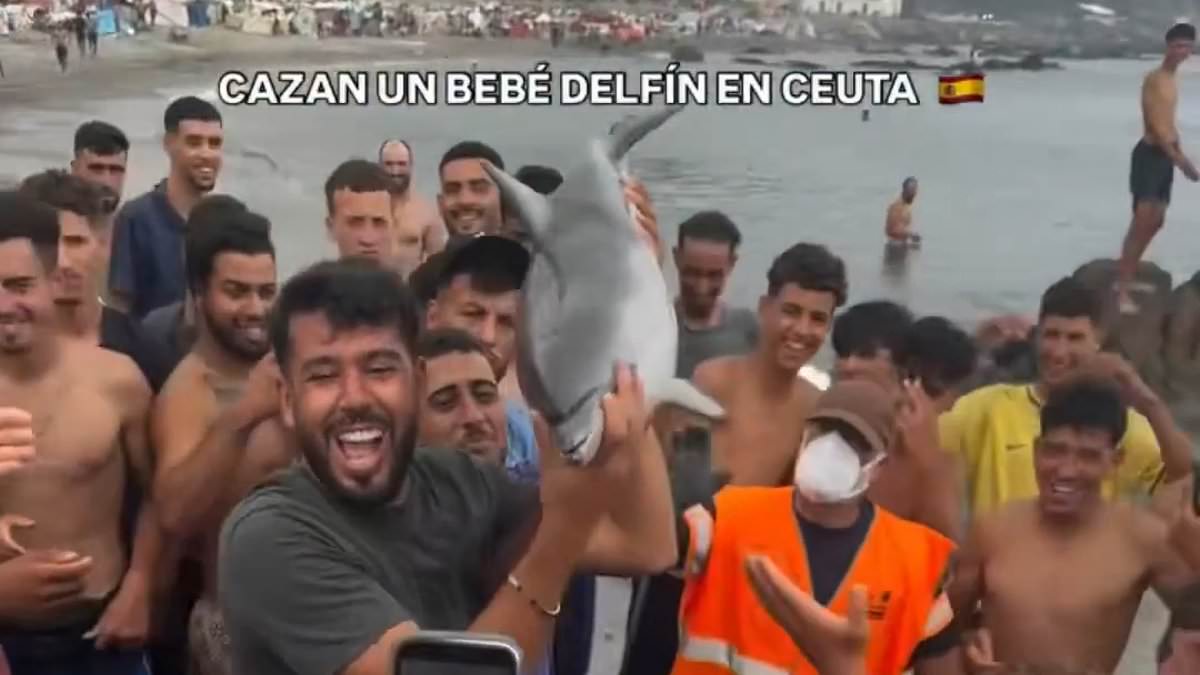
When Leonora Heredia saw a mob of migrants surging towards her tiny corner shop, she feared the worst.A regular customer who was inside with her helped move a heavy wooden counter across the doorway to stop the horde, but for the next 20 minutes they were under siege as they struggled to close the shutters.A terrifying video shows the crowd outside the convenience store scattering as the police finally arrive after being called three times.Similar scenes were being enacted all over Ceuta that day, July 30, which the Spanish locals in this enclave on the tip of Morocco refer to universally as 'the invasion'.In one day, migrants streaming in from Morocco virtually doubled the population of Ceuta, this sliver of Spain, which with a similar enclave called Melilla, represent the EU's only land border with Africa, a back door which the bungling Spanish Socialist government left wide open.The chaos that transpired – and the after-effects which still persist – were an object lesson for anyone on the Left who still advocates 'open borders'. Since July 30, at the beginning of what locals in the Spanish enclave of Ceuta, on the tip of Morocco, refer to as 'the invasion', hordes of migrants have made the beach their home Living in makeshift tents, the 10,000 or so who remain here have created an unsanitised shanty town making dwellings from sheets, plastic tarpaulin or whatever they can lay their hands on Many of the estimated 70,000 men, mostly from Morocco, have returned to their homeland, but around ten percent remain, waiting to reach what they see as their right – a ticket to mainland Europe A sense of unease clouds Cueta, where there have been frequent outbreaks of trouble – migrants throwing rocks and corrosive substances at the police and soldiers, and a mob of locals trashing one the migrants' shanty towns A line of migrants – almost exclusively young men – wait for handouts of food and water, as authorities in Cueta work out what to do with them next, a process that could take months Back at Leonora's shop, Comestibles Leo, she was determined to defend her territory in a way the government has spectacularly failed to do on a larger scale.Leonora recalled: 'They were going to ransack everything, trying climb over the counter which we put there as a barricade.'It was terrifying but we managed to hold them off and called the police twice. I had an anxiety attack afterwards and didn't open for the next two days.'Now I only open in the mornings and I'm afraid to be on the streets after 9pm.'The Prime Minister Pedro Sanchez angered locals like Leonora when he claimed that 98 per cent of the the influx had returned to Morocco, a statement which Andy Burnham erroneously parroted.The truth is that an estimated 10,000 people – mostly young men, though there women and children, too – are still here, and they've brought with them a mini crime wave, with 21 sexual assaults reported in the last month, five of which involved penetration and nine committed against minors.It is an unimaginable burden for the citizens of Ceuta, an area the size of Windsor Great Park, even with hundreds of troops and extra police drafted in. The migrants now number more than 11 per cent of the population, which would equate in British terms, to eight million people.Snr Sanchez has vowed that his government will resolve the crisis with 'dignity' in accordance with the law.That would mean all these migrants would be allowed to file asylum claims, which could take months.None of the Moroccans we spoke to – who make up the vast majority of the influx – claimed to be anything other than economic migrants. One young man said he simply left his truck driving job, an hour away across the border in Tetouan, to hot-foot it to the border when he heard 'Spain was open'.Another was training as an electrician, but decided to walk 36 hours with two friends in search of a better job in Europe.But while the waiting game continues, the crisis has turned Ceuta into a bubbling cauldron of tension and violence between locals, Spanish authorities and the remaining migrants.There's a pervading sense of unease about the place, and there have been frequent outbreaks of trouble – migrants throwing rocks and corrosive substances at the police and soldiers, and a mob of locals trashing a migrants' shanty town on one of the beaches while police appeared to stand by watching, at least initially.On Wednesday, Ceuta's 'national day', there were flag-waving celebrations all over Spain in solidarity with the benighted enclave.As we approached one march, at first it appeared an almost festive gathering, but the chants were insistent: 'Migrants go home'. A placard read: 'Spain unites us: our beliefs enrich us.' Leonora Heredia remembers only too well what happened on the day the migrants arrived to Ceuta. She saw a mob of them surging towards her tiny corner shop, Comestibles Leo, and moved quickly to shut the door and secure it With help from a customer, Leonora moved a heavy wooden counter across the doorway to stop the horde, but for the next 20 minutes they were under siege as they struggled to close the shuttersThe closer you get to the district of Principe, where the largest concentration of migrants is to be found, the more uneasy the atmosphere.As we rounded the bay stretching towards the border with Morocco, a huge number of young men were visible on the roadside.Stretching way out to sea was a floating barrier, intended to stop any more migrants swimming around the coast from Morocco, but it's far too late to stop those who are already here.Further inland, endless rows of military tents came into view, which were set up as an aid station and processing point.Outside it, hundreds of migrants sat or lay on the pavement, corralled by soldiers.Every so often, police cars and vans turned up, lights flashing, officers bristling with weaponry; and at one vantage point, a road overlooking the sprawling aid station, a Humvee manned by Spanish soldiers sat in readiness.The overriding sense you get driving and walking around Ceuta's sweltering streets is of people waiting. The migrants, some in small groups, but often in large numbers, wait in hope of being allowed into Europe proper, as they believed is their right.But the residents are also waiting – for their national government to step in and save them from this invading force, or simply to send them home again.On the beach, at first sight, it looks like holidaymakers swimming in the surf, but on closer inspection, there are only young men to be seen anywhere. From the detritus left behind, it's clear most are living here, and from the smell wafting up from the retaining wall, it's also clear that sanitation is a pressing issue.It is here on the beach that a video emerged this week of migrants capturing a young dolphin swimming in shallow waters, hitting it with a stick to the horror of onlookers. The video shared online shows a group of men crowding round the dolphin calf as it is held in the air 'like a trophy' and lifted above their heads as onlookers cheer – before enraged locals confront them.One of the Spaniards shouts 'No! No! No!', warning the migrants that it is illegal to touch or eat the dolphin.An online petition has been launched demanding those responsible are identified and brought before the courts.The disturbing moment a group of migrants on a Ceuta beach hold up a dolphin calf as if it were a trophy after allegedly hitting it over the head with a stickA few miles along the coast, towards the western border with Morocco, lies El Trampolín beach, with every inch of sand and shale covered in ramshackle shelters, as volunteers from a German NGO called Mission Lifeline hand out food and charge up the migrants' mobile phones.The director, Nolte Bauer, said he had received death threats and that local people had attempted to slash the wheels of his truck.Protesters have also tried to stop Red Cross vehicles from distributing food to migrants.'We understand that the current situation is stressful for local people,' said Bauer, 'but threatening people with death, hunting them down and setting camps on fire – that crosses a line.'He said he and his organisation are in favour of 'controlled, open migration' and the present crisis was an inevitable consequence of denying legal visas to migrants.'Europe is over there,' he said, pointing across the Strait of Gibraltar to the Spanish coast only 11 miles away. 'There is plenty of space.'Among the flag-waving locals protesting against the migrants was 23-year-old business consultant María Seaone, marching with her aunt and uncle. They live in the working-class neighbourhood of Juan XXIII, next to the immigrant's shanty towns in Principe. Residents of Ceuta who have had their world turned upside down in the past five weeks have been out in force to protest against the Spanish government's feeble attempts to secure its borders Among those protesting was María Seaone with her aunt and uncle. They live in the working-class neighbourhood of Juan XXIII, next to the immigrant's shanty towns in Principe – she says nothing has been normal for a month A firefighter protests outside the offices of the Delegation of the Central Government in Ceuta during a rally called by public servants to demand more 'Resources, Means and Solutions' amid the migrant crisis 'Nothing has been normal here for the last month,' she told the Daily Mail. 'Since then, we can't go to the beach as I'm afraid to catch some kind of infection from all the human waste.'I'm scared even to walk my dog. When I leave work there are young men on the street corners in the middle of the day calling to me.'One said I was pretty in Spanish, then other stuff in Arabic I didn't understand. Imagine what it would be like at night.'People's houses have been broken into in our neighbourhood. I understand some of these people are escaping bad situations, but that's no excuse to steal or worse.'We have been robbed of our normality and we feel abandoned by the government.'At least five members of the Guardia Civil have been injured since the 'invasion', according to Guillermo Jose Lorenzo, a spokesperson for the local police trade union.'There are assaults when you go to identify people involved in a fight,' he told the Daily Mail. 'They turn on the officers. In some of these incidents, there have been injuries.'He said that over time the prevailing mood has become darker.'In the first few days there weren't so many clashes; they weren't so burned out. They were euphoric about staying, about entering, and about staying. But now there is more trouble.'There's also been an increase in robberies. They are more desperate because of their situation and because they don't know what will become of them.' With the new arrivals comes crime – there have been robberies and lootings as the police and army has struggled to keep order, and 21 sex attacks have been reported since the end of July Soldiers patrol the streets following mass crossings of migrants on foot and by sea from Morocco into the Spanish territory Troops in military vehicles have been deployed on the streets of the Spanish enclave. An official from a neighbourhood association told the Daily Mail: 'People are living in fear. When night falls, Ceuta completely shuts down' Migrant camps have sprung up in Ceuta, including on Trampoline BeachThe local police, the Guardia Civil, and the army are patrolling all areas of the city, and will intervene in fights.'But we lack clear instructions, procedures and legal backing when acting in any situation. So you don't know what to do,' said Snr Lorenzo.'Tension on the streets rises after nightfall. All the women carry pepper spray in their handbags – the shops have run out of it.'Local politicians have expressed their anger at the national government.The enclave's mayor Juan Jesus Vivas – who has called for the immediate expulsion of all the arrivals and 'real' EU border reinforcement to protect his people – recently begged the European Parliament for more emergency help.Francisco Garcia, President of the Federation of Neighbourhood Associations of Ceuta told the Daily Mail: 'People are living in fear. When night falls, Ceuta completely shuts down.'The longer this goes on, the more fights there will be, the more hunger, they'll resort to thefts and violence.'The other day we witnessed three fights in less than half an hour. Despite what we're going through, we have compassion; we give them water if they want it, but we don't give them money.'He sincerely believes that the crisis in Ceuta could even bring down the government in Madrid.'[Prime minister] Sanchez is a complete idiot. He came to Ceuta to spout forth stupid things, such a saying that Morocco is a friend of Spain, and that's a load of crap.'There have never been such large demonstrations across Spain in nearly every city. It speaks volumes, considering everything that's happened. It's telling the president to resign. Spain doesn't want him.'Just outside the huge Mercadona supermarket near one of Ceuta's newly 'colonised' beaches, police and soldiers make the migrants wait in line, only allowing a handful through at any one time.Not far away, we meet Mohammed, 26 from western Morocco, who is wearing a Cristiano Ronaldo Portugal T-shirt. He's had it on since July 30. Mohammed, wearing a Cristiano Ronaldo Portugal T-shirt, and his friend Elaldian headed for Ceuta when they heard the border was open A migrant films himself on the swim from Fnideq, Morocco, to the beach in Spanish territoryAs soon as Mohammed heard the border at Ceuta was open, he headed there with his friend Elaldian without telling his parents. The two young men, along with others, made the three-hour swim from Fnideq in Morocco to the Spanish territory, and told the Daily Mail that he saw bodies floating in the water. It was six days before he was able to borrow a phone to tell his parents he was safe.Since then, the pair have been sleeping rough and eating food provided by the Red Cross.Mohammed, who was a truck driver in Morocco, said he rated his chances of achieving his dream of settling in Europe as 50:50. Elaldian said he was working as a farmer. Neither man claimed to have any serious need for asylum – they just hope for a better paid job, and it seems doubtful their requests will be granted.Mustafa, 21, walked 36 hours with two friends from their homes in Larache to reach Ceuta.'I am a trainee electrician, so I hope I will be able to find work in Spain,' he said. With the youth unemployment rate at 23 per cent in Spain, it seems unlikely, even if he were to be granted asylum. Mustafa, 21,a trainee electrician, told the Daily Mail that he is hoping to find work in SpainOver at El Trampolin beach, young men appear to be walking on the water as they stand on outcrops of rock, fishing.A cheerful young man called Abul Rafar, 23, from Casablanca says he is a semi-professional footballer back in Morocco, and now wants to play in Spain. He probably has a better chance of playing for Real Madrid than he does of being granted asylum.Ahmed Zayda, 27, and his brother, Mohammed, 18 would appear to have more grounds for optimism. They paid 'someone' around $7,000 to be smuggled out of Gaza by tunnel into Egypt, then made their way overland to Ceuta. Ahmed Zayda (right) and his brother Mohammed paid a people smuggler $7,000 to get out of Gaza via tunnel into Egypt, then made their way overland to CeutaThey've been sleeping in the streets and in woodland ever since.'I have managed to register, but my brother hasn't,' said Ahmed, who claims to be a cyber security expert.He is hopeful of claiming asylum and is likely to succeed, given his Palestinian Authority passport, but before that, he and his sibling must survive in a different hostile environment from their homeland.'It took us eight hours to swim round, and now we have to beg for water and bread, but we will make it.'Additional reporting: Guillem Andrés Ruiz
10,000 migrants are living in makeshift tents on a beach covered in human waste... and with them comes a crime wave of 21 sex attacks, including nine on children. For anyone still advocating open borders, welcome to the dystopian Spanish enclave of Ceuta
Full Article
Original Source
Read the full article at Dailymail →KhanList aggregates and links to publicly available news content. We do not host full articles from third-party sources. Always verify important information with original sources.