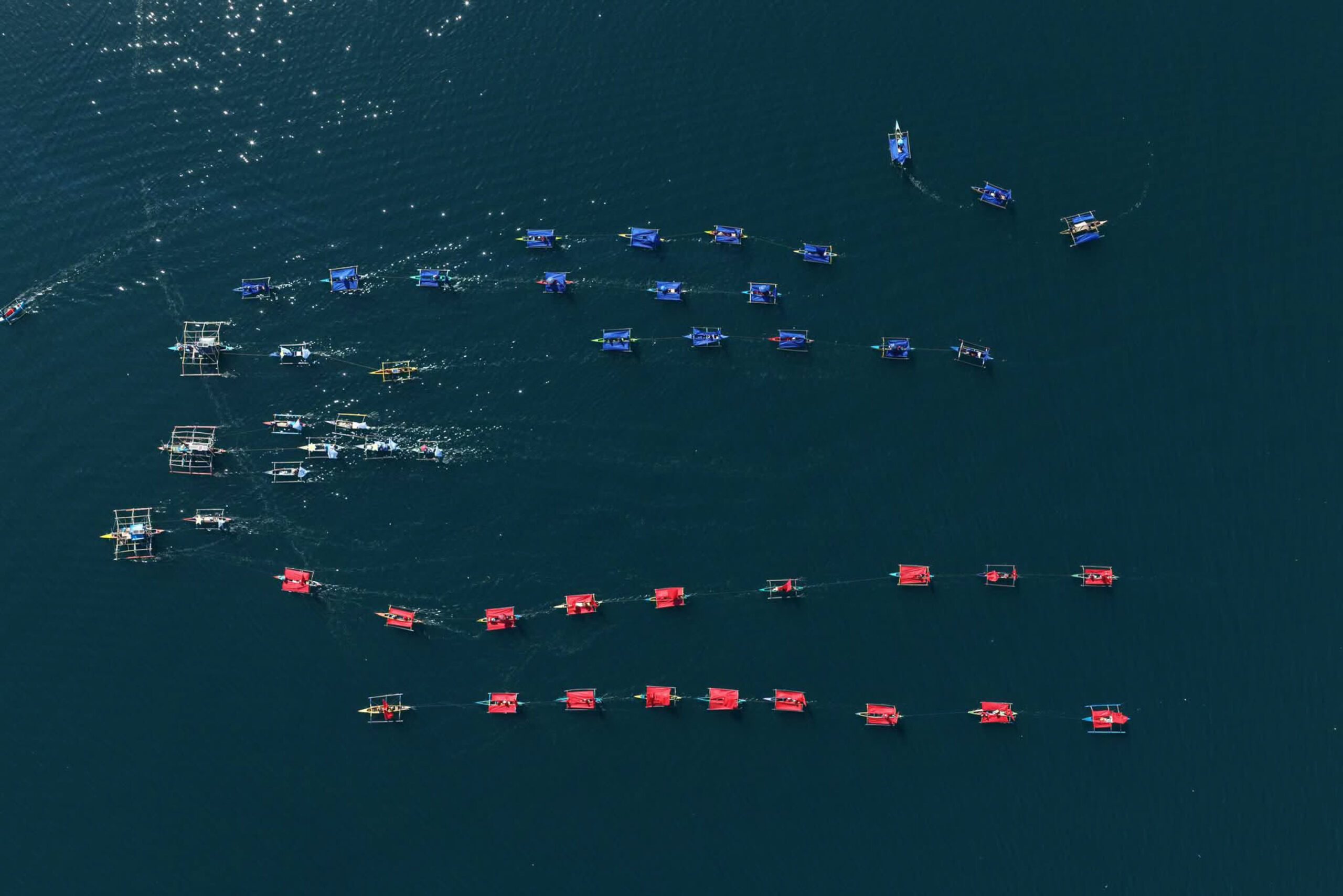
CELEBRATE. Fisherfolk on their boats form the colors of the Philippine flag as they kick off the commemoration of the 10th anniversary of the Philippines’ landmark 2016 Arbitral Ruling, in Zambales on July 5, 2026. Atin Ito! Coaliton Is the President’s passion for the West Philippine Sea cause commensurate to the support Filipino marine scientists are getting? President Ferdinand Marcos Jr. ended his State of the Nation Address with an impassioned vow to “do all that is necessary” to uphold the 2016 Arbitral Tribunal Award, proof of the Philippines’ victory against China’s claims in the South China Sea. Marcos thanked the Armed Forces, the Coast Guard, and the small fisherfolk who “patrol and ply our seas in the face of great risks.” A day after Marcos gave his speech at the Batasan, Filipino marine scientists gathered in Quezon City to celebrate the 10th anniversary of the Arbitral Award. Science has helped the Philippine case by establishing the environmental damage caused by China’s extensive reclamation activities in the area. A decade later, scientists are still asking for programmed funds to support marine scientific research in the West Philippine Sea. Programmed funds can help scientists plan long-term, eliminate the constraints imposed by the uncertainty of where to get the next tranche of funds. “Is the support commensurate?” Fernando Siringan, professor at the University of the Philippines Marine Science Institute, asked on Tuesday, July 28. “First, we thank the national government for all the support that we have received thus far. But that support is not sufficient. There needs to be a continuing support and a programmatic support.” Siringan had first-hand experience of harassment from Chinese maritime forces in 2024, when he led researchers for an acoustic and coral assessment survey at Escoda Shoal. “We’re only making do with the opportunities available,” said Siringan. “But it’s better to have a program that one can follow through time.” Marine scientists operate on a grants-based approach. They pitch, get funding if approved, and try to finish the work on time amid bureaucratic barriers and the uncertain, fluid circumstances of scientific research. One thing I was told in a recent visit to the Marine Science Institute in the University of the Philippines is that laboratories are accumulated equipment from various grants. “To go at sea is not cheap,” said Siringan. Crude oil, crew to man the ship — we’re talking about millions already, the expert said. And there is much of the Philippine seas that should be covered. Big funds are needed to go where the scientists need to go. On top of that, much is yet to be done in deep sea research. Many of the studies on the West Philippine Sea that the scientists presented are all done on shallow waters (18 meters and shallower). What is the magnitude of the West Philippine Sea beyond the depth of 18 meters? Much life in our own waters are yet to be known. As the Arbitral Award has shown, scientific research in the contested waters serves the Philippines’ sovereign rights and national security. And work at sea is not easy, Siringan said. It is physically demanding to the crew. Waters can be unforgiving to equipment. For Mariglo Laririt, assistant director of the Biodiversity Management Bureau (BMB), the budget for marine scientific research is “the carriage, not the horse.” “Meaning the budget will come if it becomes clear which is the lead agency for ocean governance,” Laririt told Rappler during a phone call. “So for DENR’s part, specifically for BMB, we’re contributing by working towards a national ocean environments policy in the hopes that this will help — this will aid decision makers to determine where best to lodge ocean governance as a lead agency.” The environment department has a budget for management and rehabilitation of coastal and marine resources. “But [ocean] governance, obviously, is another thing because it requires so many things,” said Laririt. “It requires integration of all efforts.” In the name of conservation and the Arbitral Award, there is a popular push among experts and government officials to campaign for a declaration of marine protected areas in the West Philippine Sea. A basic requirement for proposed marine protected areas is baseline ecological data. What is in the waters that ought to be protected? That would require time at sea, the right tools for sound analysis, and dedicated, hard-working scientists. Will Marcos match his zeal, lauded in the international community, with the institutional support scientists need? The President should, unless he wants to be accused of being all bark, no bite. – Rappler.com Quotes are translated to English for brevity. How does this make you feel? Loading
10 years after Arbitral Award, marine scientists still await programmed funding
Full Article
Original Source
Read the full article at Rappler →KhanList aggregates and links to publicly available news content. We do not host full articles from third-party sources. Always verify important information with original sources.