
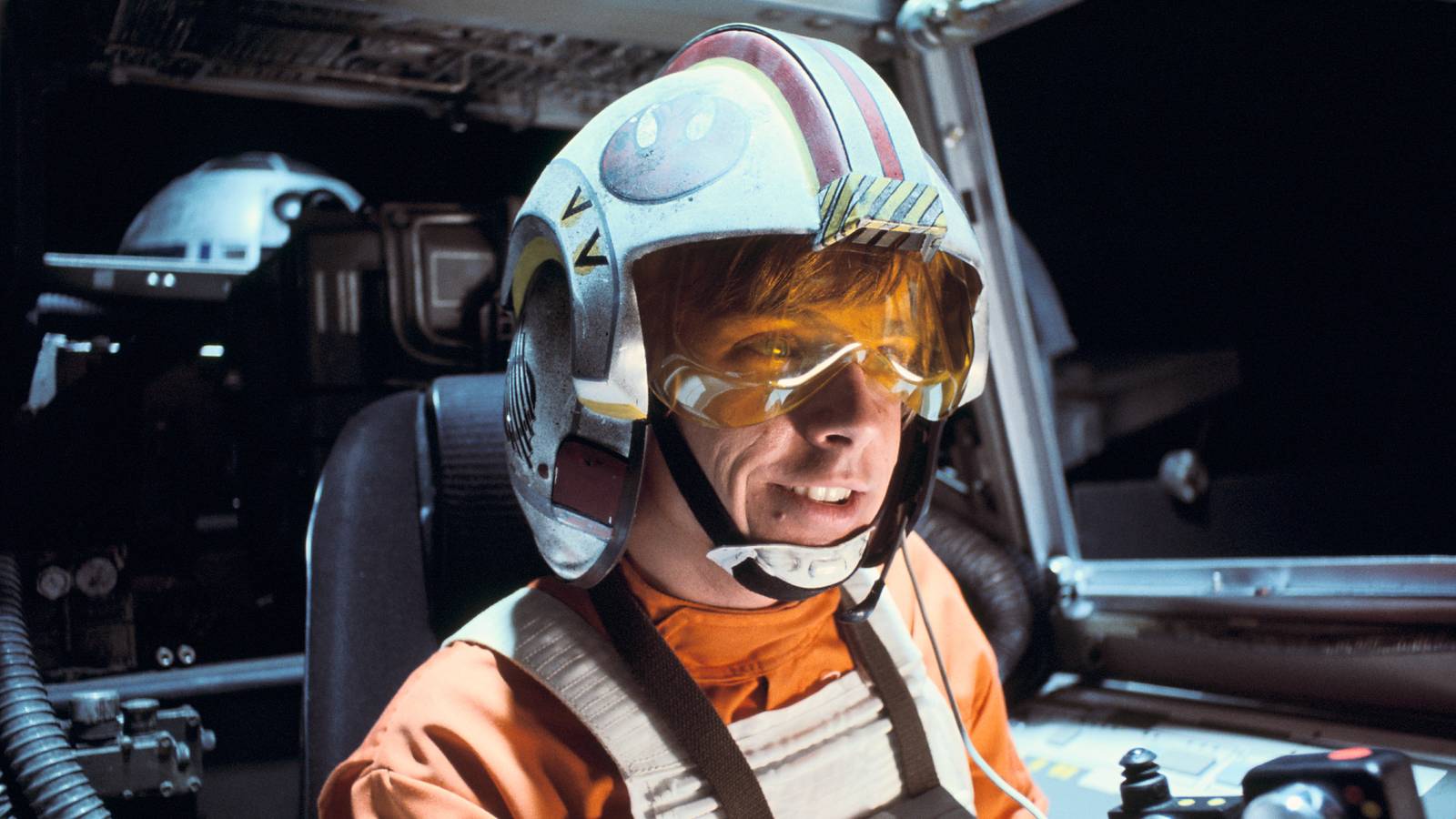
Published Sep 4, 2026, 12:08 PM EDT Richard Craig is a Senior Author at Screen Rant covering film and TV. Richard has also written extensively about horror and film soundtracks, contributing a chapter to the first major academic collection on the folk horror genre, The Routledge Companion to Folk Horror. Richard is also a performing musician and holds an MA in Music and Sound Art. Sign in to your ScreenRant account Star Wars may have defined the modern space opera, but George Lucas' galaxy far, far away was hardly the only place where filmmakers were telling enormous stories among the stars. Throughout the 20th century, science-fiction cinema produced space adventures featuring alien civilizations, interstellar warfare, strange planets, advanced technology and heroes who were considerably more complicated than their spaceships' instruction manuals suggested. When George Lucas released Star Wars in 1977, he combined the scale of a classic intergalactic adventure with the visual language of Flash Gordon serials, the mythology of Joseph Campbell and the swashbuckling energy of old Hollywood. Lightsaber duels, starfighters, alien cantinas and sprawling galactic conflicts quickly became defining elements of science-fiction cinema. That success also makes it easy to forget that space opera was already an established cinematic tradition. Films had been sending characters to distant planets, confronting alien civilizations and imagining technologically advanced futures long before Luke Skywalker first looked toward the twin suns of Tatooine. Some of those earlier movies directly influenced Lucas, while others took the genre in radically different directions. The decades following Star Wars produced even more alternatives. Filmmakers experimented with animation, comedy, pulp adventure, surrealism and lavish production design, proving that a space opera did not need lightsabers or the Force to create a memorable galaxy. The Last Starfighter (1984) The Last Starfighter turns a surprisingly simple premise into one of the most charming space operas of the 1980s. Alex Rogan is a teenager living in a trailer park who spends his free time playing Starfighter, an arcade game that secretly functions as a recruitment test for an interstellar war. The Last Starfighter's central appeal comes from its collision between mundane adolescence and genuine cosmic adventure. Alex initially wants nothing more than to escape his limited circumstances, only to discover that his gaming skills have made him valuable in a war against the Ko-Dan Armada. The Last Starfighter boasts some of the earliest CGI sequences and has since earned a cult following. Treasured for its plucky adventure narrative, there have been rumblings of a Last Starfighter sequel for several years. Fantastic Planet (1973) René Laloux's Fantastic Planet is unlike almost any other space opera of its era. Adapted from Stefan Wul's novel Oms en série, the French-Czech animated film takes place on the planet Ygam, where enormous blue humanoids called Draags treat humans, known as Oms, as primitive animals. Fantastic Planet explores oppression, resistance and cultural conflict through surreal imagery. The Draags' technology is vastly more sophisticated than humanity's, but their treatment of the Oms creates a disturbing hierarchy that eventually sparks rebellion. Fantastic Planet's distinctive cutout animation gives Ygam an appropriately alien appearance, filled with bizarre creatures and landscapes. Its strange tone and political subtext separate it from more conventional space adventures, making it an even more distinct and unique galactic adventure. Barbarella (1968) Roger Vadim's Barbarella is one of the strangest entries in the genre, and that is precisely why it deserves its place here. Jane Fonda stars as the titular interstellar adventurer, who travels across the planet Tau Ceti to locate the missing scientist Durand-Durand, whose positronic ray could threaten the galaxy. Barbarella is unapologetically psychedelic. The production design draws heavily from 1960s pop art and European comic books, creating a future that looks more like a fashion magazine having an extraterrestrial fever dream than a conventional military science-fiction setting. Fonda's performance balances Barbarella's deliberately sensual presentation with resourcefulness. This produced a space opera that is campy, visually inventive and unmistakably tied to the counterculture of its decade. Forbidden Planet (1956) Fred M. Wilcox's Forbidden Planet brought a remarkable amount of sophistication to 1950s science fiction. Set in the 23rd century, the film follows Commander J.J. Adams and the crew of the United Planets cruiser C-57D as they investigate the disappearance of an expedition on the distant planet Altair IV. They discover Dr. Edward Morbius, his daughter Altaira and the robot Robby, along with evidence of the ancient Krell civilization. Forbidden Planet's Shakespearean influence is explicit. It functions as a science-fiction adaptation of The Tempest, with Morbius paralleling Prospero and Robby occupying a futuristic equivalent to Ariel. Forbidden Planet’s electronic score, elaborate production design and groundbreaking special effects also helped establish a template for serious cinematic science fiction long before Star Wars. The Fifth Element (1997) Luc Besson's The Fifth Element is arguably the most exuberant space opera of the 1990s. Bruce Willis plays Korben Dallas, a former special-forces operative working as a taxi driver in a sprawling futuristic New York City. His life changes when Leeloo, a mysterious woman, falls into his cab. Gary Oldman's Jean-Baptiste Emanuel Zorg provides The Fifth Element with a suitably ridiculous villain, while Chris Tucker's Ruby Rhod supplies enough flamboyance to power a small starship. Jean-Paul Gaultier's costumes and the film's densely populated production design give Besson's future an unmistakable visual identity. Unlike the comparatively lived-in environments of Star Wars, The Fifth Element embraces exaggerated colors, architecture and fashion. Its mixture of action, comedy, romance and cosmic mythology makes it one of the century's most distinctive space adventures. Battle Beyond The Stars (1980) Roger Corman's Battle Beyond the Stars is essentially The Magnificent Seven transplanted into space. The setup follows young Shad, whose peaceful planet Akir is threatened by the villainous Sador and his massive warship, the Hammerhead. Unable to defeat Sador alone, Shad travels across the galaxy recruiting a team of fighters. Battle Beyond the Stars’ greatest strength is its eclectic group of characters. Robert Vaughn plays Gelt, a mysterious outlaw; Sybil Danning plays Saint-Exmin, a Valkyrie-like warrior; and George Peppard appears as space pilot Cowboy. The special effects were produced on a modest budget, but the enormous ambitions are obvious. Its model work, colorful aliens and sweeping space battles make Battle Beyond the Stars a quintessential piece of low-budget 1980s space opera. Les Maîtres Du Temps (1982) René Laloux returned to animated science fiction with Les Maîtres du temps, better known in English as Time Masters. The film follows young Piel, stranded on the hostile planet Perdide after a deadly insect attack destroys his family's settlement. His only connection to safety is a communication device linking him to the space pilot Jaffar. The narrative gradually expands from a straightforward rescue mission into something much more mysterious involving the titular Masters of Time. Moebius, one of France's most influential comic artists, provided the visual designs, giving Time Masters an instantly recognizable aesthetic. Its strange creatures, elaborate spacecraft and dreamlike planets feel radically different from Hollywood's approach to space adventure. Les Maîtres Du Temps’ animation also allows Laloux to create environments that would have been extraordinarily difficult to realize through live action. Flash Gordon (1980) Mike Hodges' Flash Gordon understands that Flash Gordon should never be embarrassed about being ridiculous. Sam J. Jones stars as the titular football player, who is transported into space, where Emperor Ming the Merciless rules an enormous interstellar empire. Max von Sydow's Ming is one of Flash Gordon’s great pleasures, playing the villain with theatrical authority rather than attempting to make the material gritty. Meanwhile, Brian Blessed's Prince Vultan practically detonates the volume control with every appearance. Flash Gordon's colorful costumes and enormous sets deliberately evoke the character's 1930s comic-strip origins. Queen's soundtrack, including "Flash's Theme," adds another layer of bombastic energy. Rather than stray towards realism, Hodges leaned into pulp fantasy, making Flash Gordon an exuberant tribute to its own source material. Galaxy Quest (1999) Galaxy Quest is a space opera disguised as a comedy about actors who used to star in a science-fiction television series. Tim Allen plays Jason Nesmith, the former star of Galaxy Quest, whose cast is unexpectedly recruited by actual aliens who believe the television show documented genuine human space missions. Galaxy Quest's affectionate treatment of Star Trek fandom is particularly sharp. Alan Rickman's Alexander Dane is a classically trained actor frustrated by his association with the character Dr. Lazarus, while Sam Rockwell's Guy Fleegman knows he is probably the expendable crewman because he is not important enough to have a surname. Underneath the jokes, Galaxy Quest understands why space opera works. Its characters eventually discover genuine courage beneath the costumes and television personas. Star Trek II: The Wrath Of Khan (1982) Nicholas Meyer's Star Trek II: The Wrath of Khan is one of the defining space operas of the 20th century. William Shatner's Admiral James T. Kirk faces Khan Noonien Singh, played by Ricardo Montalbán, whom Kirk previously exiled on Ceti Alpha V in the original series episode "Space Seed." Khan's return gives the movie a deeply personal conflict. He wants revenge against the man he blames for the deaths of his wife and followers. His obsession makes him an unusually intimate threat to Kirk, particularly because Kirk is confronting his own advancing age. The Wrath of Khan's centerpiece is the battle between the USS Enterprise and Khan's USS Reliant in the Mutara Nebula. Meyer deliberately treats the ships like naval vessels maneuvering through fog, turning a familiar science-fiction battle into tactical warfare. Yet the emotional weight comes from Kirk's relationship with Spock and its exploration of sacrifice, making its spectacle meaningful rather than merely spectacular. TV Show(s) The Mandalorian, Andor, Obi-Wan Kenobi, The Book of Boba Fett, Ahsoka, The Acolyte, Star Wars: Skeleton Crew, Lando, Star Wars: The Clone Wars, Star Wars Rebels, Star Wars: The Bad Batch, Star Wars: Resistance, Star Wars: Young Jedi Adventures, Star Wars: Visions Video Game(s) Star Wars: Knights of the Old Republic, Star Wars: Knights of the Old Republic II - The Sith Lords, Star Wars Battlefront (2015), Star Wars: Battlefront 2 (2005), Star Wars: The Force Unleashed , Star Wars: The Force Unleashed II, Star Wars Jedi: Fallen Order, Star Wars Jedi: Survivor First Film Star Wars: Episode IV - A New Hope Cast Mark Hamill, James Earl Jones, David Prowse, Carrie Fisher, Harrison Ford, Daisy Ridley, Adam Driver, Ian McDiarmid, Ewan McGregor, Rosario Dawson, Lars Mikkelsen, Rupert Friend, Moses Ingram, Frank Oz, Pedro Pascal Created by George Lucas Movie(s) Star Wars: Episode I - The Phantom Menace, Star Wars: Episode II - Attack of the Clones, Star Wars: Episode III - Revenge of the Sith, Star Wars: Episode IV - A New Hope, Star Wars: Episode V - The Empire Strikes Back, Star Wars: Episode VI - Return of the Jedi, Star Wars: Episode VII - The Force Awakens, Star Wars: Episode VIII - The Last Jedi, Star Wars: Episode IX- The Rise of Skywalker, Rogue One: A Star Wars Story, Solo: A Star Wars Story, Star Wars: The Clone Wars, Star Wars: Dawn of the Jedi, Star Wars: New Jedi Order
10 Greatest Space Opera Movies Of The 20th Century That Aren't Star Wars
Full Article
Original Source
Read the full article at Screenrant →KhanList aggregates and links to publicly available news content. We do not host full articles from third-party sources. Always verify important information with original sources.