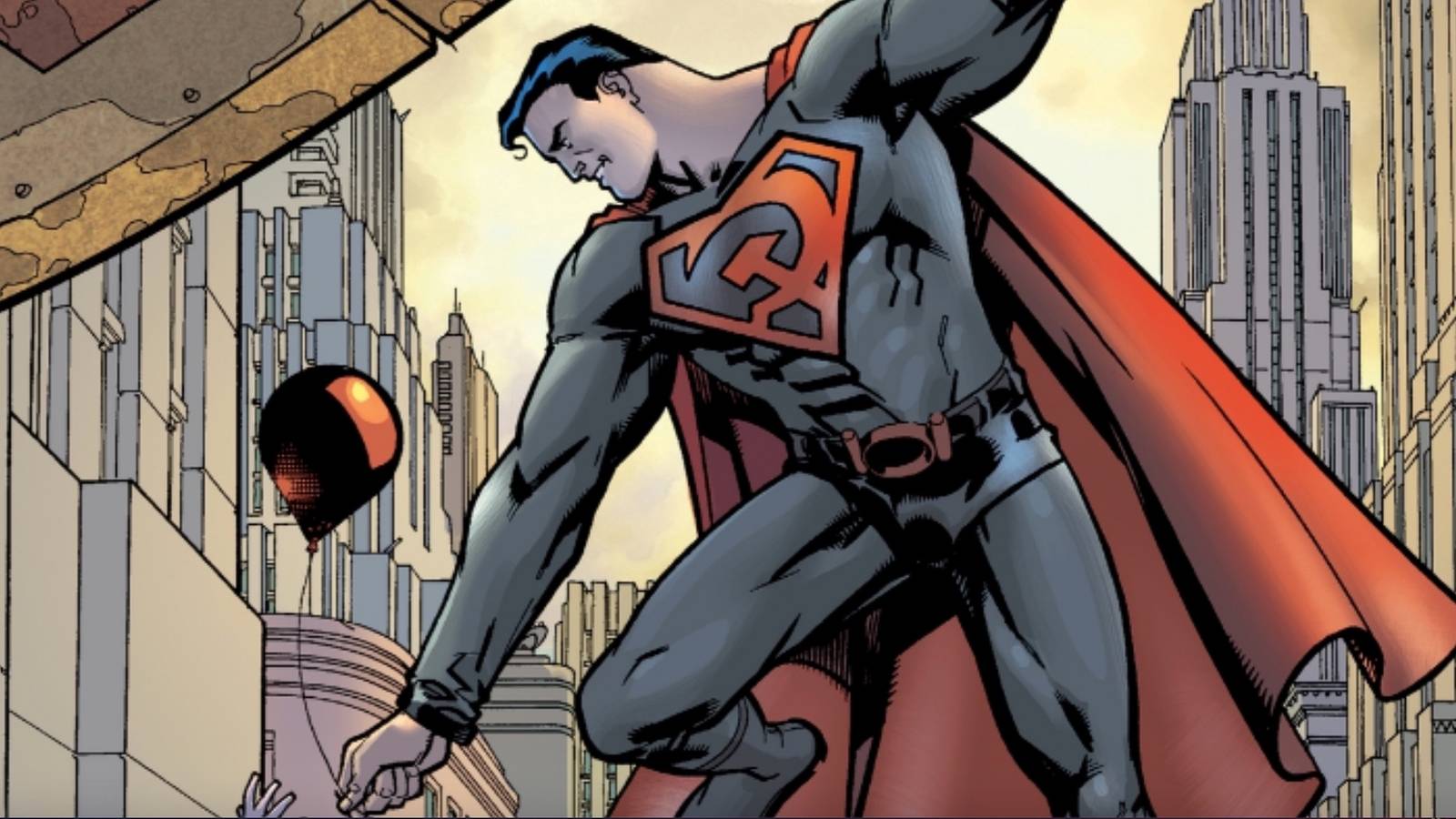
DC Comics Published Aug 11, 2026, 8:00 AM EDT Adam has been writing in the entertainment news space for over a decade. Beginning his career of covering film and TV at CinemaBlend, he has also appeared on The Flash Podcast and done several radio spots. Sign in to your ScreenRant account Although DC Comics has a primary continuity that the majority of its titles take place in, the company has also played around with stories set in alternate realities for decades. This kicked into high gear in 1989 when DC started its Elseworlds imprint, which is dedicated exclusively to such stories. In 2024, the imprint returned following a 14-year hiatus, delivering new hits like Dark Knights of Steel and Green Lantern: Dark. In its nearly 40 years of existence, Elseworlds has allowed writers and artists to put their own spin on DC’s iconic characters that are free from the restrictions imposed by the main canon. Some take place in historical settings, others in the far future, and some have simply reinvented what the present day DC Universe looks like. 10 Elseworlds stories in particular stand out as masterpieces that best exemplify what makes this imprint special. 10 Batman & Dracula: Red Rain DC Comics Bram Stoker’s terrifying vampire creation clashes with DC Comics’ Caped Crusader in Batman & Dracula: Red Rain. Written by Doug Moench, with art by Kelley Jones, this Elseworlds story depicts Bruce Wayne discovering that Dracula and his minions have come to Gotham City to feed on its homeless. In order to defeat this supernatural threat, Bruce becomes a vampire himself and vanquishes the blood-sucking foe. This proves to be a lateral move for Gotham’s citizens. Batman slowly succumbs to his new vampiric nature, ruthlessly kills many of his adversaries, and begins his own reign of terror in the city, prompting his former allies to take drastic measures. Red Rain remains is one of DC’s most frightening and goriest stories, and along with spawning the sequels Batman: Bloodstorm and Batman: Crimson Mist, it also inspired the animated movie The Batman vs. Dracula. 9 Superman: Speeding Bullets DC Comics For those who’ve ever wondered what it would look like if Batman fought crime with Superman’s powers, Superman: Speeding Bullets is worth reading. Writer J. M. DeMatteis and artist Eduardo Barreto team up for this one-shot issue that sees Thomas and Martha Wayne finding the crashed Kryptonian ship containing the baby Kal-El, and they adopt him and name him Bruce. Unfortunately, just like in the main DC Universe, Bruce witnesses his parents being killed when he was a boy. Upon reaching adulthood, this version of Bruce also embraces the shadowy persona of Batman, only he uses his Kryptonian powers rather than gadgets and martial arts. The result is a Batman whose strength matches his obsessive drive to fight crime in Gotham City, but that in turn produces a classic case of absolute power corrupting absolutely. Lois Lane, Perry White, and Lex Luthor are subsequently looped into this Batman’s world in Superman: Speeding Bullets, while Alfred continues on as Bruce’s butler. 8 Green Lantern: Evil’s Might DC Comics Taking part of its title from the Green Lantern Corps oath, Green Lantern: Evil’s Might places Kyle Rayner in 1888 New York City. However, this three-issue miniseries written by Howard Chaykin and David Tischman, and illustrated by Marshall Rogers, does not simply adapt Kyle’s traditional origin story for the Gilded Age. Instead, he fills in for Alan Scott, the Golden Age Green Lantern, whose ring is magic-based rather than the standard Green Lantern Corps-issued ones. Upon discovering the same kind of magic ring and lantern that the original Alan did in 1940, Green Lantern: Evil’s Might’s Kyle uses his newfound power to fight against crime lords and corrupt politicians, including Boss Tweed and Tammany Hall. An antagonistic take on Alan does appear, as do Hal Jordan and Carol Ferris, but this Elseworlds tale still chiefly stands out for giving readers a more socially conscious Green Lantern working to enact positive change for New York’s underprivileged immigrants. 7 Wonder Woman: Amazonia DC Comics In the world of Wonder Woman: Amazonia (Earth-19), Diana is kidnapped from Themyscira by Steve Trevor and his Royal Marines squadron in 1888. She’s taken back to England, which is now under the rule of the mysterious King John II, a.k.a. King Jack, who inherited the throne following the assassination of Queen Victoria and nearly all of her immediate family. The king is, in fact, Jack the Ripper. This Elseworlds story, written by William Messner-Loebs, with art by Phil Winslade, follows Diana across four decades, where she spends most of that time as a stage actress. However, Wonder Woman: Amazonia ultimately takes an inspiring turn when she uses her powers to lead a resistance to topple King Jack’s reign. Amazonia also gets bonus points for romantically pairing Diana with Jack’s benevolent son, Prince Charles, which provides a pub worthy of the late 1990s. 6 Batman: The Doom That Came To Gotham DC Comics Hellboy creator Mike Mignola brought his love of horror and monsters to the three-issue miniseries Batman: The Doom That Came To Gotham, which he co-wrote with Richard Pace, while Troy Nixey handled artwork duties. Set in the 1920s, this Elseworlds story sees Bruce Wayne returning to Gotham City after 20 years away to investigate the origins of Gotham City. However, rather than battling his traditional rogues' gallery, he instead collides with a horde of supernatural creatures. Batman: The Doom That Came To Gotham is a treat for fans who like both DC’s Dark Knight and the works of H.P. Lovecraft, as these creatures are directly inspired by the author’s mythology. That includes Batman accidentally awakening The Lurker on the Threshold, which originates from the same-named novel by August Derleth, who based the story off notes written by Lovecraft before he died. This also leads to Lovecraftian takes on characters like Two-Face, Etrigan the Demon, and Ra’s al Ghul. 5 The Golden Age Writer James Robinson and artist Paul Smith’s four-issue miniseries The Golden Age delves into a world where DC’s superheroes from the Golden Age of Comics must adjust to life after World War II. For some, this means retiring from fighting the forces of evil to pursue new paths of personal fulfillment. For others, it leads to mental health struggles or even becoming supervillains. Things only become further complicated by the rise of McCarthyism in the 1950s. The Golden Age does a stellar job of using historical events and politics to influence the narrative direction of these characters in a more mature way than would have actually been allowed in the late 1940s and 1950s. Fans of Justice Scciety stories in particular would benefit from reading the miniseries, as Robinson later incorporated elements from it into his Starman series, and it also influenced Geoff Johns’ JSA run. 4 JLA: The Nail JLA: The Nail is arguably the best example of the butterfly effect under the Elseworlds label. By driving over a nail that pops their tire, Jonathan and Martha Kent never discover the spaceship containing the infant Kal-El in this Alan Davis-written and illustrated story. Because the Kryptonian survivor never became Superman, this ignites a chain reaction of events that produces one of the darkest interpretations of the DC Universe. JLA: The Nail sees superheroes like Batman, Wonder Woman, Flash, and Green Lantern exist in a world where distrust and hatred against metahumans is at an all-time high without Superman’s presence. Allies become enemies, fan-favorites die, and the world is turned upside down, all by just one nail. This continuity was revisited years later in JLA: Another Nail. 3 Superman: Red Son DC Comics Published across three issues, Superman: Red Son hails from writer Mark Millar, with artwork by Dave Johnson, Andrew Robinson, Walden Wong, and Killian Plunkett. It’s one of the best explorations about whether Superman is Superman because of nature or nurture. In this universe (Earth-30), Kal-El landed on Earth in 1938, only in the Soviet Union rather than Smallville, Kansas. Although Red Son’s Superman shares similarities with his main universe counterpart, being raised on Communist ideology and influenced by Joseph Stalin leads to him accomplishing this in different ways. More importantly, Superman, being the Soviet Union’s state-sponsored superhero, turns the tide of the Cold War. In response, the United States government relies on Lex Luthor to find ways to destroy the Kryptonian. 2 Gotham By Gaslight DC Comics Written by Brian Augustyn, and illustrated by Mike Mignola, Gotham by Gaslight was the first Elseworlds story published, albeit retroactively. The one-shot introduces readers to a Bruce Wayne returning to Gotham City in 1889, and donning the cape and cowl for the first time. Unfortunately, this happens right as Jack the Ripper travels to the United States to continue his killing spree in Gotham. Effortlessly balancing the Batman lore with steampunk and historical elements, Gotham by Gaslight is an enjoyable read and an outstanding example of why Elseworlds, and by extension alternate reality stories, are so important to DC’s publishing line. This reality (known as Earth-19) has since been expanded in three sequels, allowing for numerous non-Batman characters to get the Gaslight treatment. It was also featured in the limited series Countdown to Final Crisis. 1 Kingdom Come DC Comics Team writer Mark Waid with artist Alex Ross, and the result is Kingdom Come, one of DC’s most critically-acclaimed Elseworlds stories. Kingdom Come depicts an alternate future for the main DC Universe where new superheroes are emerging that are more violent and reckless than their predecessors. A devastating tragedy in Kansas leads Superman and Wonder Woman to a new superhero group after being absent for 10 years to deal with this new generation, while Batman and Lex Luthor form their own factions. Kingdom Come shines brightest as a tale laying out the importance of heroes to have principles and a moral compass in difficult and cynical times. Other testaments to Kingdom Come’s popularity include spawning the sequel The Kingdom (albeit without Ross’ involvement), being adapted into a novelization and audio play, characters from this universe (Earth-22) appearing in mainstream DC Comics continuity, and aspects of Kingdom Come being incorporated into the DCEU, DCU, and Arrowverse franchises. First Film Man of Steel First TV Show Peacemaker Cast Henry Cavill, Ben Affleck, Gal Gadot, Ezra Miller, Ray Fisher, Jason Momoa, Amy Adams, Jesse Eisenberg, Laurence Fishburne, Jeremy Irons, Will Smith, Jared Leto, Margot Robbie, Joel Kinnaman, Viola Davis, Jai Courtney, Jay Hernandez, Adewale Akinnuoye-Agbaje, Cara Delevingne, Chris Pine, Robin Wright, Zachary Levi, Dwayne Johnson, Amber Heard, Patrick Wilson, Yahya Abdul-Mateen II, Mark Strong, Asher Angel, Jack Dylan Grazer, Djimon Hounsou, Mary Elizabeth Winstead, Jurnee Smollett, Rosie Perez, Ella Jay Basco, Ali Wong, Ewan McGregor, Idris Elba, John Cena, Michael Keaton, George Clooney, Xolo Mariduena Created by Malcolm Wheeler-Nicholson Character(s) Superman, Batman, Wonder Woman, Aquaman, The Flash, Cyborg, Harley Quinn, The Joker, Shazam, Darkseid, Amanda Waller, Lex Luthor, Doomsday, Deadshot, Deathstroke, Black Canary, Black Adam Movie(s) Man of Steel, Batman v Superman: Dawn of Justice, Suicide Squad, Wonder Woman, Justice League, Aquaman, Shazam!, Birds of Prey, Wonder Woman 1984, Zack Snyder's Justice League, The Suicide Squad, Black Adam, Shazam! The Fury of the Gods, The Flash, Blue Beetle, Superman, The Brave and the Bold
10 Greatest DC Elseworlds Stories Considered Masterpieces
Full Article
Original Source
Read the full article at Screenrant →KhanList aggregates and links to publicly available news content. We do not host full articles from third-party sources. Always verify important information with original sources.