
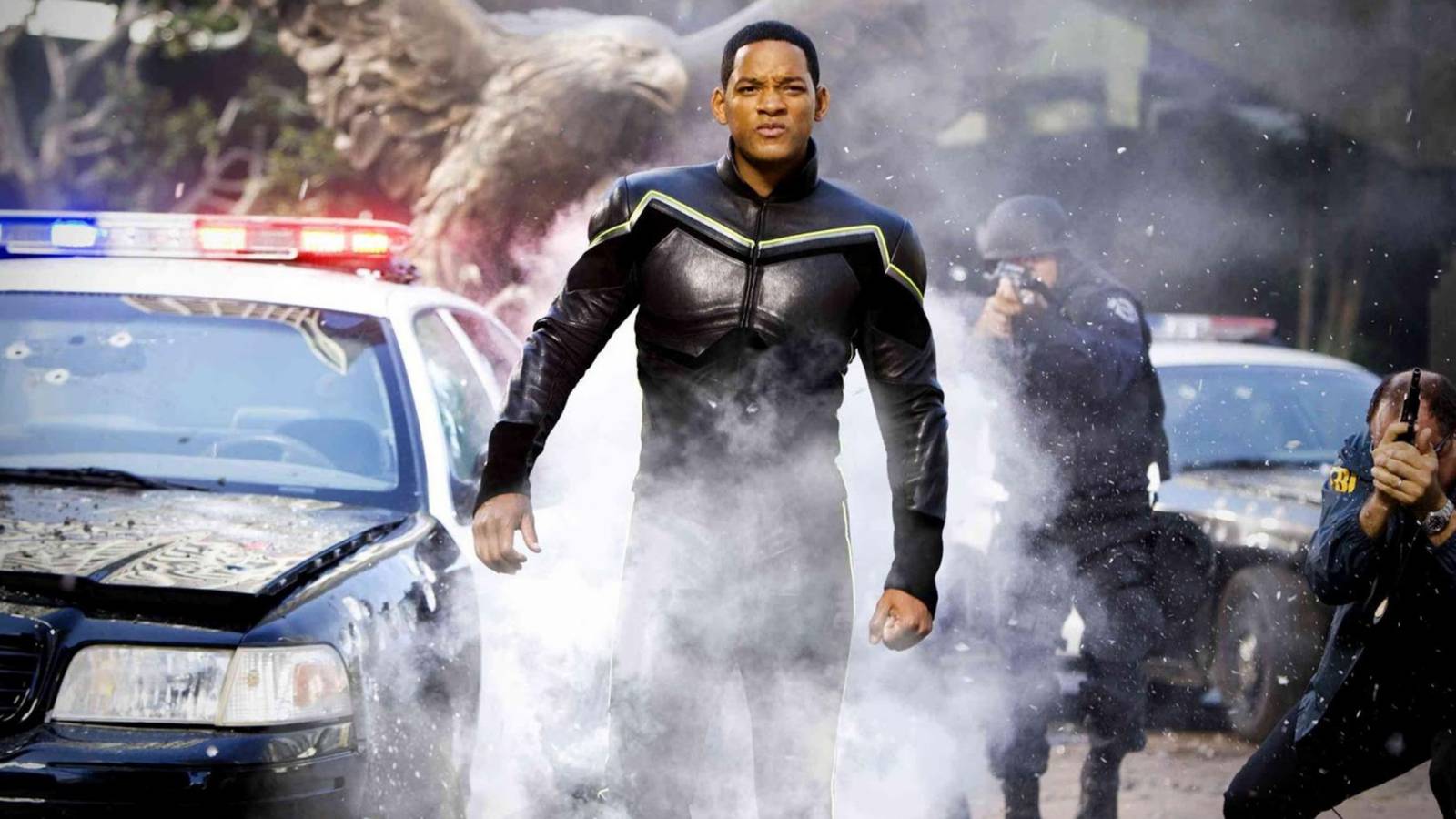
Image via Sony Pictures Releasing Published Nov 12, 2026, 3:33 PM EST Diego Pineda has been a devout storyteller his whole life. He has self-published a fantasy novel and a book of short stories, and is actively working on publishing his second novel. A lifelong fan of watching movies and talking about them endlessly, he writes reviews and analyses on his Instagram page dedicated to cinema, and occasionally on his blog. His favorite filmmakers are Andrei Tarkovsky and Charlie Chaplin. He loves modern Mexican cinema and thinks it's tragically underappreciated. Other interests of Diego's include reading, gaming, roller coasters, writing reviews on his Letterboxd account (username: DPP_reviews), and going down rabbit holes of whatever topic he's interested in at any given point. Sign in to your Collider account Even though several of the greatest films of all time have achieved greatness with a premise that may not seem all that special on paper, a great premise goes a long way in helping a movie be incredible. Thankfully, many things can make a premise great (usually depending on the genre), but there's one element that all great story premises share: creativity and originality. However, a great premise does not a great movie make. Over the years, disasterpieces as notorious as Disney's Tomorrowland or Will Smith's Hancock have demonstrated that it's perfectly possible for an excellent premise to be completely squandered. These movies are bad to varying degrees, but they're all almost undeniable wastes of set-ups that could have otherwise provided the material for an excellent movie. 'Upside Down' (2012) Image via Millennium Entertainment Directed by Juan Diego Solanas and starring Kirsten Dunst and Jim Sturgess, Upside Down is one of the most disappointing romantic science fiction movies in modern history. The potential was all there, as this is a story set in an alternate universe composed of two touching, oppositely-gravitating worlds. In that undeniably creative setting, a man from the impoverished lower planet infiltrates the wealthy upper planet to reunite with his star-crossed childhood love. With a softer, more magical approach to its gravitational rules, Upside Down could perhaps have worked a lot better. However, the movie goes so overboard in explaining its strict scientific laws that it inevitably ends up falling victim to several plot holes. As if that weren't bad enough, it takes its melodramatic romantic story and its heavy-handed socioeconomic allegory so seriously that it's hard to have any fun with the otherwise lovely premise. 'Self/less' (2015) Image via Focus Features The legendary The Fall was more than enough to cement Tarsem Singh as an exciting cult auteur, but outside of that cult classic, his filmography has rarely been anything less than polarizing. Case in point: Self/less, a sci-fi action thriller where a terminally ill billionaire played by Sir Ben Kingsley transfers his consciousness into the healthier, younger body of Ryan Reynolds, only to discover that the vessel belongs to a real person whose memories begin to override his own. It's a naturally compelling premise for an action thriller, and with talent like Kingsley, Reynolds, and Singh himself attached, Self/less absolutely should have been a riveting blockbuster. Alas, due to the movie's generic action scenes, myriad of predictable clichés, and Kingsley and Reynold's performances being so dramatically different that it's hard to believe they're playing the same man, Self/less ends up disappointing. 'The Box' (2009) Image via Warner Bros. Pictures People who watch Self/less and start craving another forgettable sci-fi action thriller with a squandered premise should watch The Box, starring Cameron Diaz and James Marsden. Directed and written by Richard Kelly of Donnie Darko fame, this adaptation of Richard Matheson's short story Button Button follows a couple who are presented with a mysterious wooden box and a moral dilemma: pressing its button will grant them one million dollars, but also kill a stranger somewhere in the world. It's a thought experiment and moral test that many people have thought about, but with such a great cast and the mind of the man who made Donnie Darko, The Box's premise made it sound like it was going to be incredible. It isn't. It takes a perfectly simple and self-contained moral dilemma and overburdens it with such bizarre and nonsensical mythology that the film ends up feeling absurd rather than emotionally compelling. 'Bright' (2017) Image via Netflix Netflix's first original feature film came near the end of 2015, and after that, the streaming giant kept proving that they were perfectly capable of making absolute bangers — but also absolute disasters of David Ayer's Bright's caliber. Set in an alternate LA where humans and mythological creatures co-exist, it follows a human officer (Will Smith) and his orc partner (Joel Edgerton) having to protect a young elf and a powerful magic wand. Approached with enough camp and self-awareness, it's a potentially brilliant premise that could have provided some irresistible silly fun. Unfortunately, though, Bright takes itself so seriously that it forgets to have any fun at all with its story. The worldbuilding feels half-baked, the plot is nothing but a trite MacGuffin chase, and the social allegory feels as heavy-handed as it does tone-deaf. 'Downsizing' (2017) Image via Paramount Pictures Coming off of the heavily award-winning Nebraska, audiences were more than ready for whatever Alexander Payne had in the oven next. Tragically, that ended up being Downsizing, a satire that's now almost universally recognized as his worst movie. In it, a struggling man (Matt Damon) decides to shrink himself down to five inches tall to help save the planet, only to find that the miniature world carries the exact same economic and social flaws as the normal one. There are many movies that try to be about important issues but end up falling flat, and Downsizing is one of those movies. Much like the premise itself, the trailer promised a hilarious, clever satire about consumerism and financial anxiety, but the film seems to lose any interest in the premise of miniature living about halfway through. After that, the whole plot is driven by tonal unevenness, heavy-handed social commentary, and a boring protagonist. 'In Time' (2011) Image via 20th Century Studios Well-known for directing movies like Gattaca and writing movies like The Truman Show, Andrew Niccol had a resume that presented him as one of the greatest minds in modern Hollywood sci-fi going into 2011. Enter In Time, about a poor factory worker (Justin Timberlake) living in a dystopian future where people stop aging at 25 and time is the literal currency used to stay alive. After inheriting a century of life, he goes on the run with a wealthy heiress (Amanda Seyfried) to try to dismantle the corrupt system. With a decent 6.7/10, it's one of Seyfried's highest-rated movies on IMDb, but that appears to be the only online space with any real respect for it. Despite its undeniably gripping premise, the plot is so repetitive, and the worldbuilding makes so little sense that it's impossible to ever truly care about anything going on. Surely, Niccol was capable of doing far better work with such a fascinating set-up. 'Hancock' (2008) Image via Sony Pictures Releasing The conversation of films that start out solid but spiral out of control halfway through can never be complete without talking about Peter Berg's Hancock. It stars Will Smith as the titular character, a reckless, hard-drinking, widely unpopular Los Angeles superhero who agrees to a public relations makeover from a grateful executive whose life he saves. The first 45 minutes of the movie actually do plenty of cool stuff with that satirical premise, but that's about as far as it goes. After a jarring midpoint twist that completely shifts not only the tone of the film, but the genre as a whole, what at first seemed to be a fresh spin on the not-yet-oversaturated superhero genre transforms into an absolute cinematic mess. Hancock reels audiences in with its intriguing premise, only to pull the rug from under their feet halfway through and never pick steam back up after that point. 'Tomorrowland' (2015) Image via Walt Disney Studios Motion Pictures The Iron Giant, The Incredibles, Ratatouille, and Mission: Impossible — Ghost Protocol. Throughout the first four outings of his career, it seemed like Brad Bird could do no wrong. Then came Tomorrowland, based on the themed land from the Disney parks, following a former boy-genius (George Clooney) and a gifted teenager (Britt Robertson) who embark on a dangerous mission to unearth the secrets of a technologically advanced alternate dimension. This is one of the House of Mouse's most infamous and expensive misfires, one of those terrible movies that tried to appeal to everyone and ended up pleasing nobody as a result. The concept was electric on paper, but we never actually get to spend much time in the titular Tomorrowland; the film instead goes for preachy lectures and exposition dumps. 'Alien vs. Predator' (2004) Image via 20th Century Studios Back in 1979, Ridley Scott completely revolutionized sci-fi horror with Alien. Just eight years later, John McTiernan did the same for sci-fi action thrillers with Predator. After a brainstorming session between Dark Horse Comics executives, the idea for the comic book series Alien vs. Predator came up, successfully combining both franchises. In 2004 came Paul W. S. Anderson's film adaptation of the crossover, pitting the Xenomorphs against the Predator hunters. The potential was all there for this to be one of the coolest, most badass crossover events in the history of cinema up to that point. Instead, Alien vs. Predator turned out to be one of the worst action movies in film history, a title it arguably still holds. Due to a hyper-sanitized PG-13 rating, boring human characters, and a complete misunderstanding of both franchises, the film ended up satisfying neither fanbase. 'Passengers' (2016) Image via Sony Pictures Releasing Rarely has history seen a more unintentionally creepy major Hollywood production than Morten Tyldum's Passengers, one of the worst romantic movies in film history. It's about Jim (Chris Pratt), a man who accidentally wakes up from cryosleep 90 years earlier on an interstellar voyage, choosing to wake up a fellow passenger (Jennifer Lawrence) after he starts yearning for companionship. It's the perfect setup for a terrifying psychological thriller, one that could have made some far-ahead-of-their-time comments on toxic masculinity and the so-called "male loneliness epidemic." Instead, Passengers plays its premise straight, never subjecting Jim to any real consequences for his actions and instead allowing him to "get the girl" by the end. Simply due to being told from the wrong perspective, Passengers is the biggest waste of a solid premise in film history. Passengers Release Date December 21, 2016 Cast Chris Pratt, Jennifer Lawrence, Michael Sheen, Laurence Fishburne, Andy García, Vince Foster, Kara Flowers, Conor Brophy, Julee Cerda, Aurora Perrineau, Lauren Farmer, Emerald Mayne, Kristin Brock, Tom Ferrari, Quansae Rutledge, Desmond Reid, Emma Clarke, Chris Edgerly, Fred Melamed, Matt Corboy, Jesus Mendoza, Alpha Takahashi, Matthew Wolf, Jean-Michel Richaud, Jon Spaihts Runtime 116 minutes Director Morten Tyldum Writers Jon Spaihts
10 Bad Movies With Great Premises
Full Article
Original Source
Read the full article at Collider →KhanList aggregates and links to publicly available news content. We do not host full articles from third-party sources. Always verify important information with original sources.