
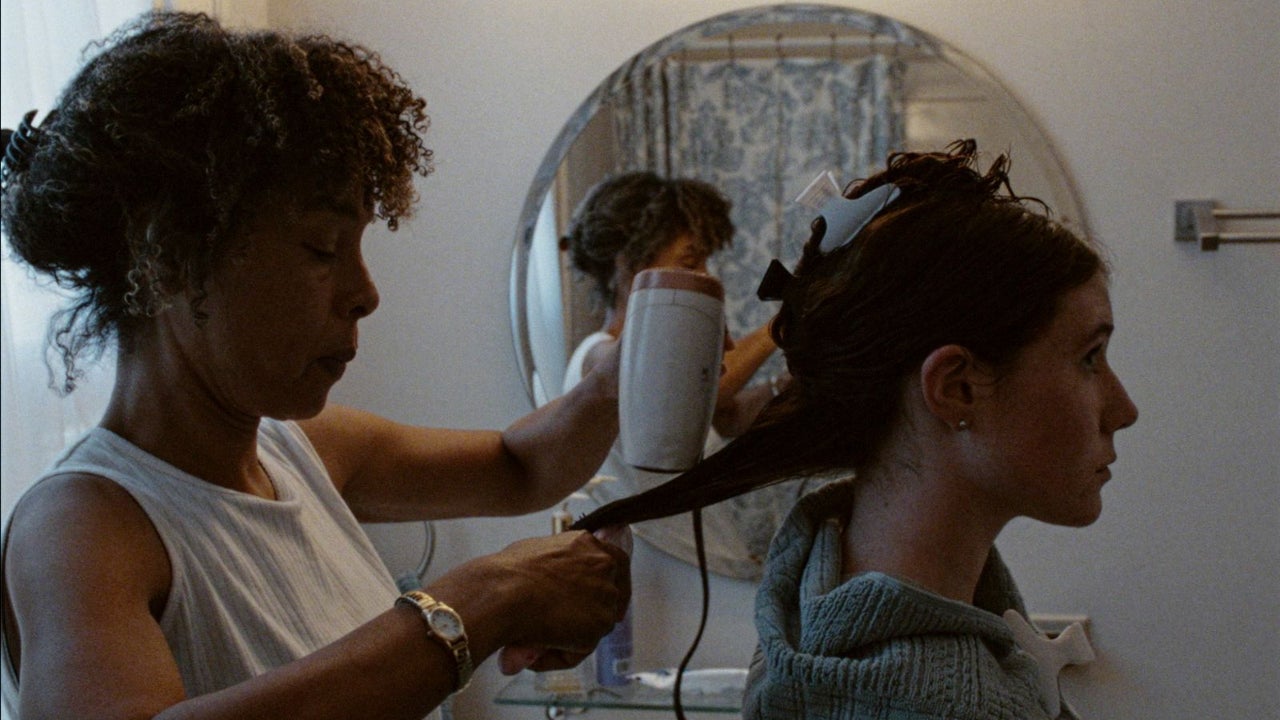
Thank goodness for “Mouse.” Kelly O’Sullivan and Alex Thompson’s new drama is, like their previous collaboration “Ghostlight,” an unassuming, compassionate triumph. “Mouse” is a quiet, small town drama about the unexpected death of a teenaged girl, and the emotionally complicated relationship that develops between her best friend and her mother in the aftermath. There are no neon signs pointing at the film’s greatness. O’Sullivan and Thompson employ no dizzying camerawork to spruce up the earthy simplicity of their story. “Mouse” is content to be real, and it’s produced with such skill and sensitivity that reality itself starts looking like a special effect. Katherine Mallen Kupferer stars as Minnie, a teenaged wallflower whose best friend, Callie (Chloe Coleman), is the most popular girl in school. Callie takes up a lot of oxygen but she’s a nice person, and in the brief time we get to know her, she reveals the insecurities that fuel her, and the depth of her connection to Minnie. It’s the last day of their junior year and, after a sleepover at Callie’s house, with the everyday humiliations that come part and parcel with all sleepovers, Minnie leaves early to go to work. Callie’s family has money, Minnie’s doesn’t. Callie’s mother Helen (Sophie Okonedo) is fully present and involved in her daughter’s life, Minnie’s mother Barbara (Tara Mallen) is overworked and distracted by an infant foster child and multiple rescue dogs. There’s a little jealousy in their relationship but no competition, and nothing resembling a rift. It’s a wholesome relationship that ends, suddenly, while Minnie is cleaning out the ball pit in a playroom. She’s walking home when a jogger races by, saying he’s “Sorry, or whatever,” and it’s an eerie, casual omen that Minnie picks up on immediately, causing her instinctively sprint to Callie’s house. Callie died in a car crash, and no one will ever know how it happened. They just know a teenaged girl in a small town is gone and everyone is devastated. Minnie has no one to talk to. Certainly not her own mother. Minnie harbors a growing resentment towards Barbara that ignores the many, retrospectively obvious signs that her mom is trying to be compassionate but is out of her depth. Meanwhile, Helen’s marriage falls apart. She resorts to psychic charlatans for closure. When she sees Minnie shopping for school supplies, she buys them. She invites Minnie over for dinner. Helen feels a little bit like a mother and Minnie feels more like a daughter than ever before, which is understandable yet potentially unhealthy for both of them. Their relationship gets muddled as Minnie starts spending more and more time at Helen’s house, as though she could switch parents through common-law co-habitation, without ever actually saying it out loud. It’s easy to imagine a Lifetime Original Movie emerging out of this concept, where Minnie and/or Helen’s grip on reality weakens and their relationship devolves into tawdry, Hitchcockian obsession. O’Sullivan and Thompson have no interest in pulpy thrills. The drama in “Mouse” emerges organically and develops the same way, with sloppy emotional outbursts, awkward teenage mistakes and the selfish decisions we make, sometimes more sympathetically than others, throughout the mourning process. It’s also easy to gravitate towards Sophie Okonedo’s intense, loving performance as a grieving mother, but that’s no reason to let her incredible work go unheralded. Grief is a license for many actors to indulge in emotional extremity, since rarely in real life is emotional extremity more justified. But Okonedo avoids the clichés frequently associated with her role. Helen’s feelings stem not just from sadness but an intelligent, conflicted mind, who understands how wonderful her daughter is and also that she wasn’t perfect, a fact the rest of her community is eager to forget. Helen cherishes her time with Minnie but it’s a trap, and she knows it’s bound to snap shut eventually, whether she’s in it or not. But Okonedo isn’t the only world class performer in “Mouse.” Katherine Mallen Kupferer turned heads with her standout supporting turn in “Ghostlight,” another earnest and contemplative film by O’Sullivan and Thompson about families processing the death of a child, and she’s outstanding in the follow-up. Minnie is a multifaceted, fascinating person before tragedy strikes, and although nothing about her is particularly unique, when all is said and done, she deals with her strife in profoundly personal, specific ways. There’s a moment in “Mouse” where Minnie wants to take a Sharpie to a wall that breaks the heart. Subtle, powerful storytelling that speaks volumes without raising its voice. Kupferer builds profound relationships with all her co-stars. Her mother-daughter dynamic with Tara Mallen could, perhaps, be the natural result of the fact that Kupferer is Mallen’s real-life daughter. But it would be presumptuous to assume there are real-life parallels, and even if there are, the actors plumb the depths of their characters like few others in recent memory. Iman Vellani (“Ms. Marvel”) co-stars as Kat, Minnie’s first girlfriend, and their scenes together are impressively natural, and sometimes beautifully uncomfortable. In her short scenes Vellani proves, once again, to be a rare talent, just like Kupferer. It’s heartbreaking to live through turbulent times, regardless of the source of that turbulence, and a film like “Mouse” is a special reminder that we are not alone, and we are not expected to handle our plight without making a mess of it. What a lovely thing it is to watch a film this sensitive and real, and remember that great art, by and about actual human beings, is still getting made and still has this much power. “Mouse” opens in wide release on Nov. 13.
‘Mouse’ Review: Unassuming, Earnest, Must-See Filmmaking
Full Article
Original Source
Read the full article at Thewrap →KhanList aggregates and links to publicly available news content. We do not host full articles from third-party sources. Always verify important information with original sources.