
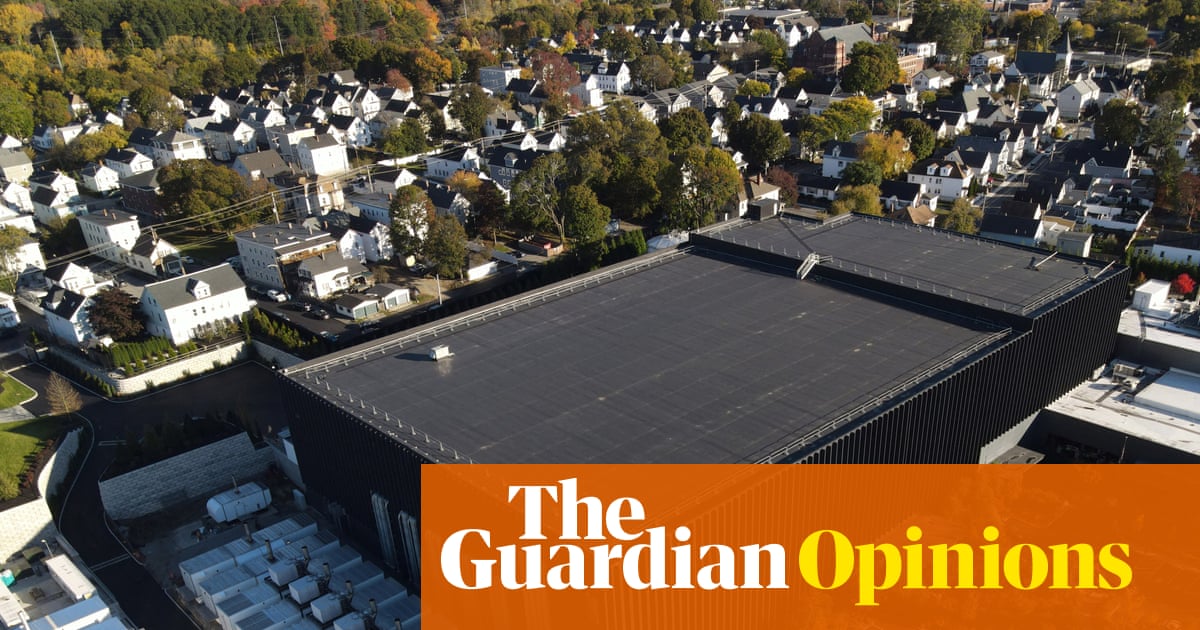
Last week’s midterms may not have cowed Donald Trump, but they should be a wake-up call for the grinning tech broligarchs who lined up at his inauguration two chaotic years ago.Clearly, the cost of living squeeze unleashed by Trump’s war in Iran was a big driver of the Democrat wave. But AI was also on the ballot – in many places, literally.Dozens of measures calling for limits on datacentre expansion were passed. And elsewhere, reining in the unchecked expansion of the power-hungry mega-sheds was a rallying cry.At a campaign event, the Texas senator-elect James Talarico recalled meeting a mother who told him the lights from the neighbouring datacentre were so bright, her son thought it was daytime in the middle of the night.Whether the tech sell-off resumes this week remains to be seen; but the anti-AI sentiment evident in last week’s results appears to have punctured at least one narrative that was sustaining the market boom.Every bubble needs a story, and for AI, one chapter involves carpeting the US in debt-funded datacentres, which will become necessary – and viable – as demand for the technology increases.That looks a lot less feasible after last week. It turns out, chucking up hundreds of these humming warehouses, while simultaneously warning workers they may be superseded by an army of superhuman bots, is not great PR.The public were meant to set aside their qualms, for the greater good that AI would bring the economy. But the positive benefits many people may derive from interacting with chatbots – the shopfront of AI for most of us – coexist with very obvious downsides.Just to name a few: the sea of online slop; those pervert glasses; and tech firms’ insistence on shoehorning the technology unbidden into every app, platform and device – the latest example of what tech writer Cory Doctorow calls “enshittification”.At the same time, voters have watched the leaders of the big tech firms become obscenely rich, while average consumers continue to be hammered by inflation. So perhaps it should not be surprising that the US electorate seems to have decided: enough.Opinion Saturday cartoon by Steve Jones. Illustration: Steve Jones/The GuardianUltimately, all businesses in a democracy – even those embraced by the US president – have to operate within the bounds set by society. And the tech bros have done a terrible job of winning over the public.Elon Musk’s approach in Texas, where he poured billions of dollars into trying to buy the electorate, just became a selling point for the Democrats.It remains to be seen whether objections to datacentres are the start of a more radical shift in opinion that will eventually tame the tech companies, redolent of when Teddy Roosevelt swept into the White House at the turn of the 20th century to set about breaking up the oil and railway monopolies.However, at the very least, the opposition seems likely to put the brakes on the hectic pace of investment in building out AI’s physical infrastructure.And this shift seems to have accelerated a market rethink that was already under way. As Joe Maher of Capital Economics put it last week: “Sentiment towards the AI trade was already looking fragile and the US equity market was showing many late-cycle signs. As such, this [the midterms] could plausibly become the catalyst that leads to a more long-lasting unwind of the AI equity boom.”skip past newsletter promotionafter newsletter promotionTwo things can both be true: AI is a transformative technology that will bring welcome productivity benefits; but they won’t be big enough to justify current market valuations.As the economist Dario Perkins, of TS Lombard, put it in a brilliant recent note, written in the past tense as if in the aftermath of a future AI crash: “What people who worked in tech and finance didn’t realise was that people outside the ecosystem – you know, regular people – just weren’t that interested in AI.“Yes, it made web search easier (sort of); but contrary to the assumption in Silicon Valley, regular people were never going to use AI to organise their lives or ‘run workflow’. Tech insiders were living in a bubble – in at least two senses of that phrase.”Perkins described the industry in late 2026 as essentially “$200bn in current revenues supporting more than $1tn in future commitments from just two companies [Anthropic and Open AI]”.A reckoning was already in the offing, even without the intervention of US voters. The tech-heavy Nasdaq peaked a month ago; and a growing number of voices were sounding the alarm.As just one example, the International Monetary Fund pointed last month to“growing evidence” that the successful rollout of AI “may not require investment on the massive scale being undertaken by ‘hyperscaler’ firms”, and that “potential economic gains may not be as large as expected”.The IMF highlighted the growing capabilities of lower-cost Chinese models and pointed to the circular financing that has become rife within the AI sector.More recent reports have also highlighted a string of corporate AI users either slapping limits on staff use of costly products such as Anthropic’s Claude, or turning to much cheaper models, hosted on their own servers.The datacentre backlash appears to have brought new focus to some of these pre-existing concerns. Whether the stock sell-off persists or not, opposition has thrown down the gauntlet for the AI lobby to prove what the tech can do for societies – including those well beyond the US – which are reluctant to accept the very obvious costs.
1-0 to humankind? US midterms vote puts AI, datacentres and the broligarchy back in their box | Heather Stewart
Full Article
Original Source
Read the full article at Theguardian →KhanList aggregates and links to publicly available news content. We do not host full articles from third-party sources. Always verify important information with original sources.