
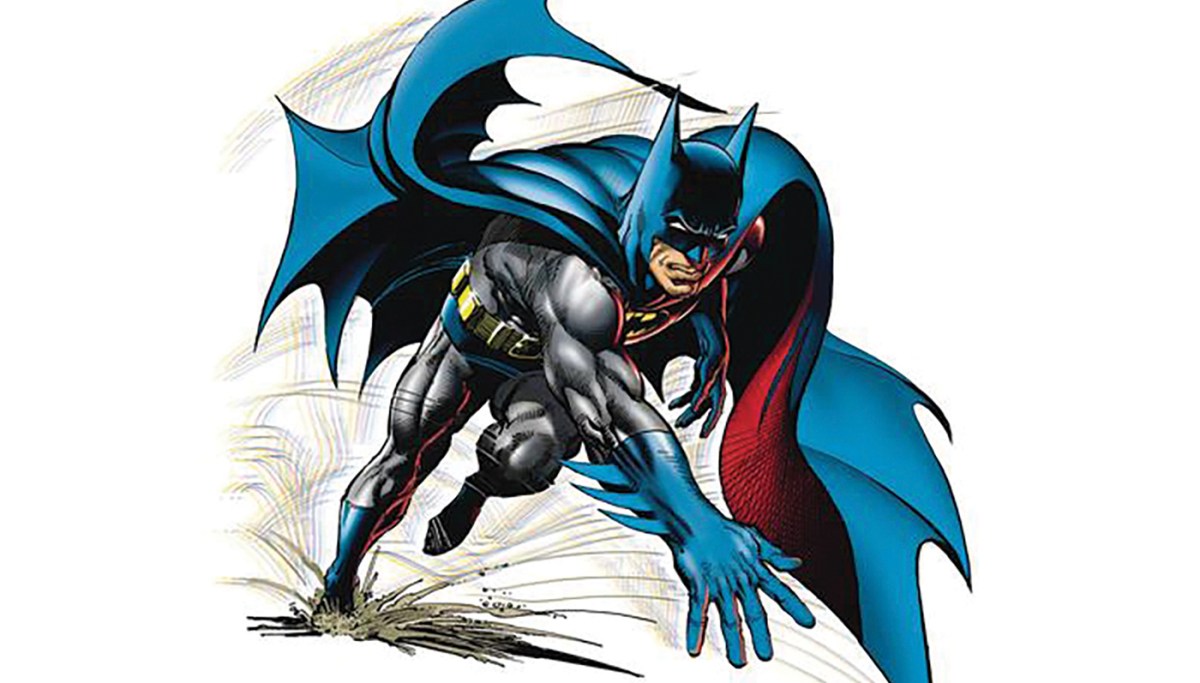
Nearly five years after his death in 2022 at age 80, Neal Adams is finally getting his due — or starting to. That he didn’t live to see this reflects elitist disdain for the artist’s chosen medium as well as the idiosyncratic decisions Adams made in the years when he enjoyed primary custodianship over his own legacy.The greatest comic book illustrator ever — one of the 10 most important artists in American history, in my judgment — Adams is now the subject of two expensive, oversized, lavishly illustrated slipcase editions featuring museum-quality reproductions of his iconic works as well as rare and unseen pages of original artwork: gorgeous in black-and-white, studded with glue, Wite-Out, Zip-A-Tone, and other details visible only through examination of the original pieces.Though Adams revolutionized comics in the 1960s and ’70s in many ways — including the look and impact of the printed pages comic book readers held in their hands, and the corporate practices that produced them — he remains best known for his work on Batman, the character that, with DC Comics writer Dennis O’Neil, Adams rescued from TV camp and returned to noirish menace. Batman by Neal Adams: Absolute Edition, 1967-1970; DC Comics; 408 pp.; $100.00 Coming on the heels of Neal Adams’ Classic DC Artist’s Edition, published in 2025, the newest slipcase edition, Batman by Neal Adams: Absolute Edition, 1967-1970, collects the first half of this skein of Adams’s multifaceted oeuvre, and does so more faithfully than the last time it was attempted — by Adams himself — nearly a quarter-century ago.Starting in October 2003, DC Comics published three hardcover volumes of Batman Illustrated, collecting all of Adams’s published works on the Caped Crusader. Around the same time, DC issued similar collections, also in slipcases, of Adams’s legendary runs on Green Lantern-Green Arrow, another early ’70s collaboration with O’Neil, renowned for introducing “relevance” into comics with explorations of contemporaneous social issues; and on the moody character Deadman.The excitement longtime fans felt in that turn-of-the-millennium moment, with DC finally collecting close to all of the prime-period works of the Master in handsome new editions with prose introductions and other cool features, swiftly yielded to disappointment: Adams redrew many interior panels in a looser, latter-day style ill-suited to the Madison Avenue-inspired realism of his peak years. He also recolored all of them, employing computer techniques unavailable in his heyday.Now, Adams maintained, his key works looked as he had always intended. This was impossible, of course, and the League of Neal Purists, of which I was and remain a member, cried blasphemy. I had known the legend personally since 1994, when I first interviewed him — opening a series of sessions, conducted over many years, that would ultimately yield over 20 hours of recordings — and felt free to pipe up. We had some testy exchanges, by phone and email, in which I argued that Neal’s tinkering with his iconic works three decades after their appearance was akin to Paul McCartney taking backing tracks from 1965, singing along to them in 2000, and claiming the result was what he had always intended when he was 23. Neal replied angrily that if I were like all the other “bald, fat men clinging to their childhoods,” I could always find the original comics on eBay. Arguments about the merits of these editions continue to this day on the Official Neal Adams Appreciation Page and other Adams-centric Facebook sites.For decades preceding the blasphemous slipcase editions, various trade-paperback reprints of the Adams-O’Neil catalog had come and gone, sometimes recolored by other artists in ways purists likewise found violative of the original works. The Adams collector thus faced the dismal choice of hunting down the originals on eBay, as Neal counseled, or putting up with anthologies that, in many eyes, marred them, whether by Adams’s hand or those of others.The tide turned about a year ago, when IDW, having issued “Artist’s Editions” for industry legends such as Will Eisner, Steve Ditko, John Romita, and Jack Kirby, published one on Adams. Designed by Randall Dahlk and edited by Scott Dunbier, the IDW tome weighed 10 pounds. It presented 288 pages of published stories and unseen drafts from different phases of Adams’s DC career, reproduced exclusively in black-and-white from original-art scans compiled in a yearslong dialogue with the private collectors, globally scattered, in whose hands the originals, some valued at half-a-million dollars, now reside.The result was incendiary: the best reproduction of Adams’s renderings ever collected in a single volume. Seeing Neal this way — every crosshatch and brushstroke of black spotting, the paste-up jobs and pencil roughs — is like listening to Pink Floyd on headsets for the first time: an immersion.Now we have DC’s Absolute Edition, focused on Batman and, weighing in at five pounds, offering a slight respite in heft. Edited by Alex Galer and designed by Steve Cook, leaders of a larger team, the 408 pages include Neal’s introduction from the 2003 book plus a new afterword by Kris Adams Stone, Neal’s daughter and sidekick at his Manhattan art studio, Continuity, since 1977. All of Adams’s Batman works from 1967-1970, including covers and interior stories from Detective Comics, Batman, The Brave and the Bold, and World’s Finest, are reproduced in their original formats, alongside discarded covers, rough sketches, and other rarities.Yet some in the League of Neal Purists remain displeased — and not without reason.Arlen Schumer — who worshipped Adams as a child, worked under him at Continuity, then co-edited Neal Adams: The Sketch Book (1999), collecting the pencil roughs on which some of the artist’s most famous pages were based — lamented on his Facebook site, Neal Adams Almanack, that Absolute Edition employed the “reprint style of hard-edged, flat color tones over black and white photostats of the original art.”This “reductive method,” Schumer wrote, “degenerates Adams’ fine-lined black and white original art and the original newsprint color into brightly-colored coloring-book flatness,” instead of “reproducing from the original newsprint, Ben-Day dotted color.” Foiled again, the Purists. For true reproductions of the peak-period comics, candy-dot colors and all, they will have to go crawling back to eBay, after all.The cover of Absolute Edition also undermines DC’s claims of fidelity. It features an iconic color image of the Dark Knight running, taken from inside Batman #251, the landmark issue in which O’Neil and Adams birthed the modern Joker. The rear cover shows the same image, shot from the original art. There is no doubting the drawing’s power. In the 1970s, it appeared on posters, puzzles, and dozens of other mass-produced items, so it was natural to imagine it could drive sales today. But Batman #251 debuted on newsstands on June 21, 1973, meaning it has no place on a volume that concludes in 1970.DC has already released the cover for next spring’s successor volume, a 504-page behemoth that will cover 1970 to 1998, and chronology poses no issue: It shows an early version of Adams’s mind-blowing multimedia cover for Batman Limited Collectors Edition #C-51, an anthology of prior stories first published in August 1977, in which an anguished Batman agonizes over Robin’s lifeless body, dwarfed by the specter of the villainous Ra’s al Ghul.Assuming DC will continue to republish Adams’s classics in this fashion, covering the other titles and characters he drew, and that other companies will follow suit — including Marvel, where Adams breathed new life into the X-Men, the Avengers, and others — we may wonder: What is the future of Adams legacy projects?REVIEW: ‘YOU CAN SEE EVERYTHING’ IS SPECTACULARLY STRANGEGiven how widely Adams’s images circulated and were marketed across multiple continents, it’s reasonable to infer that no other American artist outside of Charles Schulz of Peanuts, or perhaps Andy Warhol, has had so many eyeballs gaze upon his works.So, how should this towering legacy be explored and celebrated? The answer lies beyond high-end niche publishing, as satisfying as these latest slipcase editions are. It’s high time Neal Adams exhibits appeared in the finest museums of his native New York, with equally lavish catalogs accompanying them. Such treatment would represent not a lowering of elite standards, but an overdue appreciation for one of the most gifted and influential masters of the visual arts that America has ever produced.James Rosen is chief Washington correspondent at Newsmax and the author, most recently, of Scalia: Supreme Court Years, 1986-2001.
Comic book fans rejoice: The original artwork of Neal Adams returns
Full Article
Original Source
Read the full article at Washingtonexaminer →KhanList aggregates and links to publicly available news content. We do not host full articles from third-party sources. Always verify important information with original sources.