
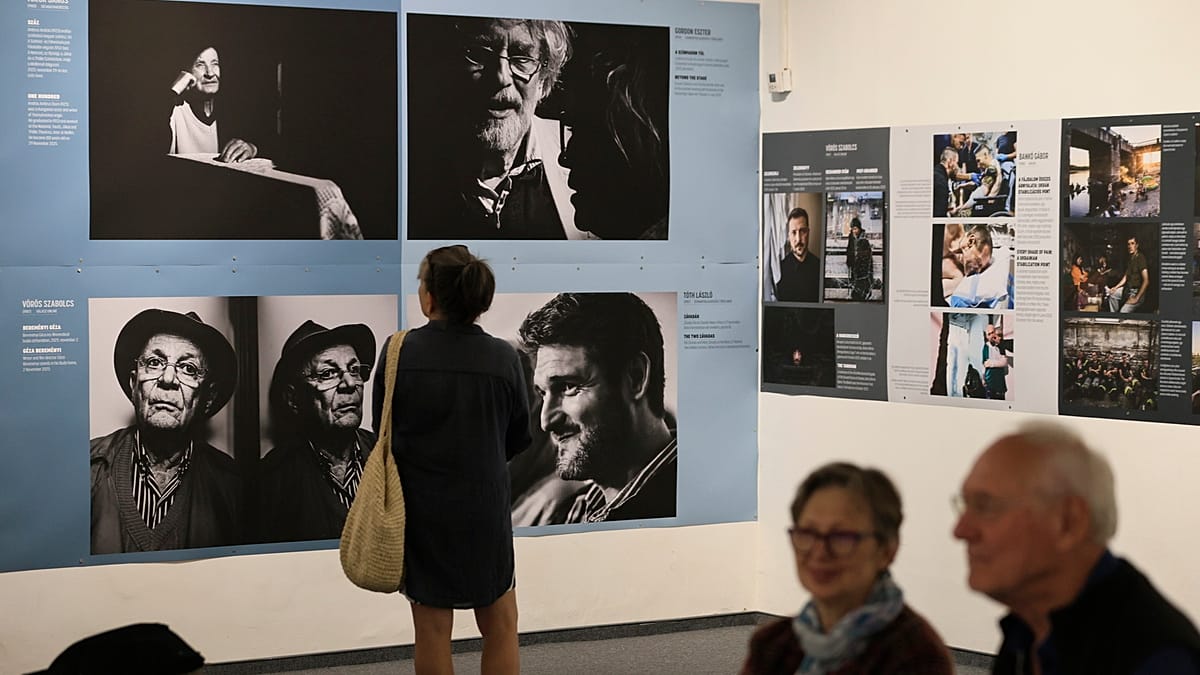
Published on 28 October 2026 - 7:14 GMT+1 If the themes of political change, ballerinas and parental care took pride of place at last year's Hungarian Press Photo exhibition, the show this is dedicated to imminent social revolution sparked by technology. ADVERTISEMENT ADVERTISEMENT At the opening of the 44th edition at the Robert Capa Contemporary Photography Center in Budapest, managing director Orsolya Kőrösi stressed that the work of photojournalists is becoming increasingly important: "The photojournalist does not just take pictures, but is present, bears witness, selects and interprets, while putting their own name to the claim that what they show is close to reality," Kőrösi pointed out that in the age of artificial intelligence, when it is increasingly difficult to distinguish the genuine from content created artificially, the role of a place where authentic photojournalistic work, assumed with a name and responsibility, is presented, protected and celebrated becomes particularly valuable. More than 6,200 works were submitted by 258 photographers. The exhibition showcases the top three entries and the special prize-winners in each of the sixteen categories. It also presents works considered by the jury to be exceptionally important or exciting, according to photographer András Bánkuti, who's also chair of the Hungarian Press Association (MÚOSZ) Photojournalists Section. "With us you cannot retouch a picture even if, say, a politician has a spot. The moment you do that, it counts as interference and the picture is immediately out of the competition," Bánkuti explained. "It can still be printed on any paper; that is not our responsibility. Our responsibility today, when the greatest value and credibility are attached to a picture being real, we have to be very careful about that." Prize-winning pictures This year the MÚOSZ Grand Prize went to freelance photographer Diana Nemeh for her series titled "Nimród", while the André Kertész Grand Prize was awarded to Telex photographer Noémi Napsugár Melegh. Napsugár Melegh has been constant recorder of almost all major protests but her greatest recognition has come from documenting her own personal tragedy. After the death of her 18-year-old younger brother, she spent years photographing her grieving family and his classmates. "It was very difficult to make these pictures, especially in situations where my brother should have been there. I actually went to the same secondary school as he did, and it was quite surreal that 15 years later I was in the same places, at the same freshers' camp where he should have been," said Napsugár Melegh. "On the one hand I had to force myself to be there so I could take these pictures; on the other, for a long time I was making them for the drawer, I did not show them to anyone. After a year and a half I began to show them to my closest professional friends, and that broke through something in my own process of mourning as well," she added. The 44th Hungarian Press Photo Exhibition is at the Robert Capa Center in Budapest until 8 November.
Zoom in, zoom out: Deeply personal and political pictures dominate Hungarian press photo exhibition
Full Article
Original Source
Read the full article at Euronews →KhanList aggregates and links to publicly available news content. We do not host full articles from third-party sources. Always verify important information with original sources.