
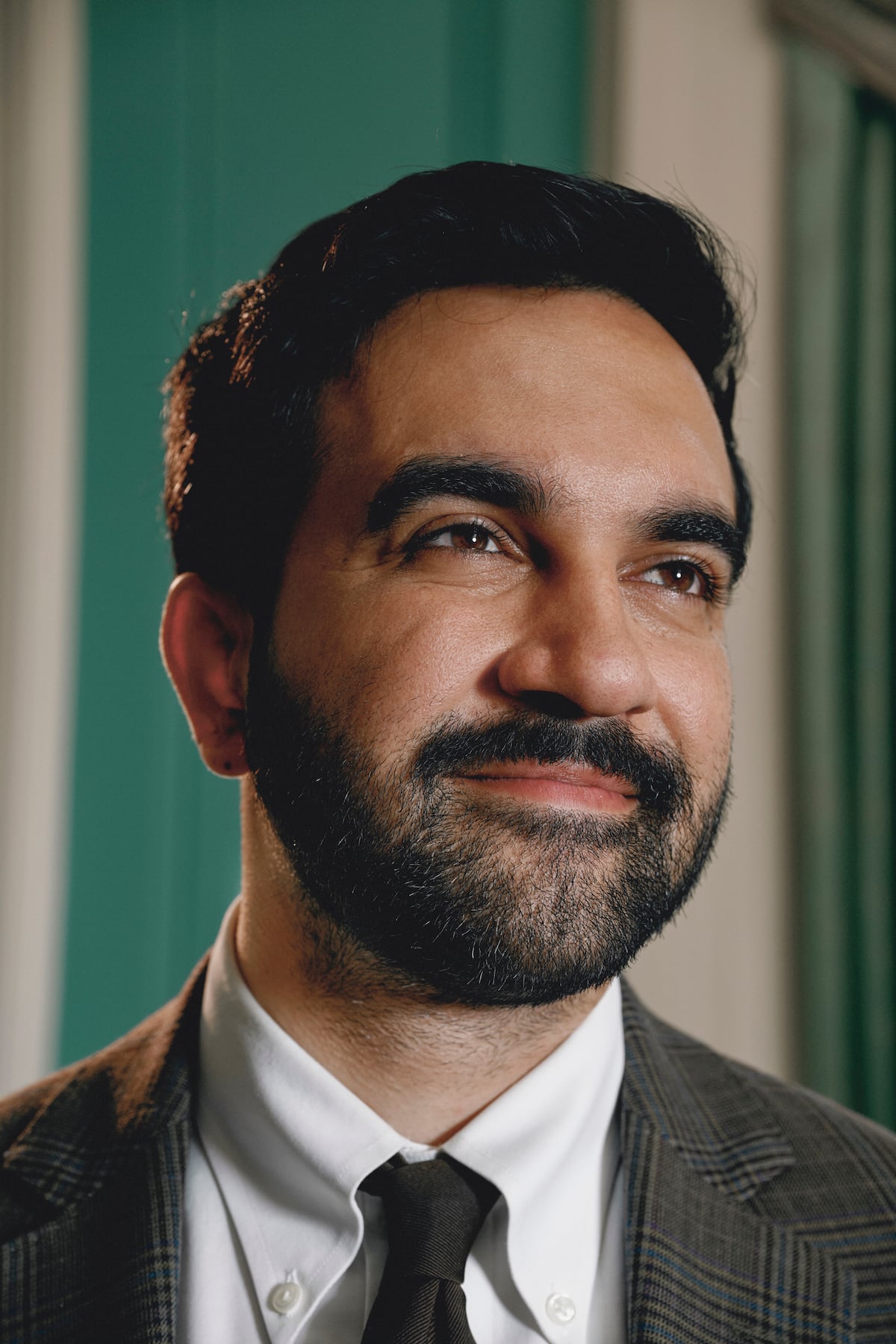
“All that’s standing between me and my vacation is you guys,” Zohran Kwame Mamdani jokes as he welcomes EL PAÍS on a Friday afternoon. He is about to take a week off, his first break since becoming mayor of New York at the beginning of the year.The break is much needed. Not only because he has kept a relentless pace since January, with a public schedule packed and timed down to the last second, but also because the life of this 34-year-old millennial has been transformed in a remarkably short time. A year ago, he lived with his wife in a one-bedroom rent-stabilized apartment in Queens that he had rented since 2018. Now he resides in a mansion built in 1799 on the other side of the East River in Manhattan and is one of the most influential politicians in the United States.Mamdani retains a relatable air despite governing a city of 8.5 million people. Speaking with him today, eight months into his term, feels much the same as talking to the little-known candidate who launched his campaign in 2024. He is charismatic and constantly smiling, a trait that has drawn criticism from those who see it as performative. He says his optimism is something his parents instilled in him.Sitting in City Hall’s Governor’s Room, surrounded by 18th- and 19th-century portraits and with president George Washington’s desk in the background, he answers questions without hesitation. In his first extensive interview with a Spanish-language newspaper, the mayor deftly sidesteps topics he would rather avoid, offering polished responses while staying within the terrain where he feels most at ease: the need to speak to New York’s working class.05:17Interview with Zohran MamdaniOnly when asked a personal question does he seem to hesitate for a moment and venture into more vulnerable territory. Since taking office, the media have devoted endless attention to his wife, the artist and illustrator Rama Duwaji. Mamdani admits that the hardest part of his new life is the hateful messages directed at him and those closest to him.“She is more important to me than anything,” he says. “When you work in politics, it gives meaning to things that otherwise seem like clichés. Growing up, you hear politicians say their families didn’t sign up for this life, and don’t quite understand it. But when you’re living it, you realize that you made the choice to do this work. And they did not; they only made a choice to love you. And that doesn’t mean that they should have their lives transformed.”Asked whether that makes him see politics as a temporary chapter, something he might leave behind sooner rather than later in favor of a more private life, Mamdani falls silent for a moment.“I hadn’t thought about it that way,” he admits. After a pause, he adds: “I’m incredibly lucky that she’s a part of my life. And I will also continue to try and make it as easy as possible for her to live hers.”Mamdani’s rise has been meteoric. He went from serving in the New York State Assembly, with little support for his mayoral bid, to stunning the country by becoming the first socialist mayor of the capitalist capital of the world. In Donald Trump’s hometown, last November’s election was widely seen as a referendum on the Republican’s victory a year earlier. And the triumph of this Ugandan-born Muslim immigrant, who promised to be the president’s “worst nightmare,” offered a glimmer of hope to progressives in a country staring into the abyss of a second Trump term.Even so, he prefers not to define himself as “anti-Trump.”“I will leave it to others to label me,” he says, aware that the president himself has called him everything from a “communist lunatic” to worse. Nor does he seem particularly eager to embrace that label alongside Spanish Prime Minister Pedro Sánchez, who on issues such as defense spending and support for Palestine has led Europe’s opposition to Trump.“It’s the question of why it is that we always seem to have money for war, but not to feed the poor, to quote Tupac,” he says. “And when it comes to Palestine, there should no longer be an exception for Palestinian rights when we speak about our belief in universal human rights. So on those two issues, I would join Sánchez.”— How comfortable do you feel with the anti-Trump label?— I’ve been very clear that I have a wide range of disagreements with the president. On immigration, for example. I’ve told him directly that ICE is an agency that operates with cruelty and inhumanity. It should be abolished. Much has been made of my youth, but I am older than ICE, and yet we continue to see others who cannot even envision a future without them as part of it.Given his own background, it is hardly surprising that he is particularly affected by the Republican administration’s immigration raids and the unrestrained actions of the U.S. Immigration and Customs Enforcement agency, whose acronym — ICE — is internationally recognized at this point and its agents — hooded men who pursue and kill people, some of them U.S. citizens — feared.Born in Kampala in 1991, Mamdani’s family history is itself a story of migration spanning several generations. “There’s no question in my mind that I’m Ugandan. There’s no question in my mind that I’m Indian. And there’s no question in my mind that I’m a New Yorker,” he once said.His father, the academic Mahmood Mamdani, comes from a family of Indian Muslims who migrated to Africa in the late 19th century. During Idi Amin’s dictatorship in Uganda in the 1970s, Mahmood and his relatives were forced into exile and spent time in refugee centers in London. His mother is the renowned Indian filmmaker Mira Nair.Zohran moved to the United States in 1999 after his father accepted a professorship at Columbia University. The future mayor of New York became a U.S. citizen at 26, after completing his university studies. Being born abroad bars him from running for president or vice president, but not from feeling deeply American or from presenting his political convictions as part of the country’s own tradition.New York’s first Muslim mayor is also the man who has just taken part in ceremonies marking the 25th anniversary of the September 11, 2001 terrorist attacks. A campaign launched by some relatives of victims, which gathered around 100,000 signatures, had urged him not to attend, accusing him of using rhetoric that was hostile to the shared values embodied by the commemoration.Trump’s immigration policy was a significant part of his campaign. In the final months of the mayoral race, the president threatened to deploy National Guard troops to New York, as he had done in other Democratic-run cities, to bolster his anti-immigration crackdown. Mamdani rejected that threat, along with all other measures directed by the White House against New York’s immigrant communities, which make up 38% of the city’s population.On the night of his victory, the mayor-elect addressed the president directly: “Donald Trump, since I know you’re watching, I have four words for you: turn the volume up.” He then reminded him: “New York will remain a city of immigrants, a city built by immigrants, powered by immigrants — and as of tonight, led by an immigrant.”“Too much of this horror has been built into daily life,” Mamdani now says of Trump’s mass deportation campaign. “Images of ICE’s extrajudicial killings have come to be seen as an expectation for what it is that they do. And frankly, that’s a reflection of the fact that this is a feature of ICE’s existence, not an aberration in their operations.”“In New York City,” he adds, “we are talking about the consequences not just on individuals, not just on their families, but frankly on entire neighborhoods. There are neighborhoods today that have fewer people on the street because people are terrified of leaving their homes. And that is a terror that is not even just specific to those without status. It is a fear that extends to those who have every degree of status because they know that ICE profiles oftentimes on the basis of race.”Mamdani never mentions Trump by name during the 40-minute interview. The combative politician who campaigned for office has given way to a more pragmatic figure. One of the first things he did after being elected was to visit Trump at the White House.“I’m the mayor of New York City. And that means that I have a responsibility to engage with anyone who has the power to make life better for those who call the city home, and that includes the president. And so in the times that I’ve met with the president or spoken with the president, the conversation always comes back to the city.”That first meeting, which took place before Mamdani took office, was followed by a surreal press conference in which a reporter asked the socialist whether he still considered Trump a “fascist,” as he had previously described him. Before he could answer, the president responded for him. “You can just say yes. I don’t mind,” Trump said, giving him a pat on the arm.— You have not been the only person to call the president a fascist. Political scientists disagree on how to classify his ideology. But regardless of labels, do you believe he poses a threat to U.S. democracy?— When I think about threats to democracy, I return to the words of Mayor Fiorello La Guardia and President Franklin Delano Roosevelt in their analysis of the demise of democracy in Europe. I’m paraphrasing, but their point was that democracy did not die because people grew tired of it as an ideal. It died because people were exhausted of not being able to feed their families. We often speak of democracy as a value. Yet, what use is that value if people can’t afford their basic needs? Many people work in New York and still cannot afford to live here. To me, that is as much a threat to democracy as anything else that we speak of across this country, because democracy has to have a resonance for working people.The working class. It is a theme the mayor returns to again and again throughout the interview. He defines working people as those who strive for a decent life but are unable to attain one. That message was the cornerstone of his campaign and remains central to his agenda at City Hall. Despite a few setbacks, Mamdani has managed to advance several of his campaign promises, all focused on the cost of living in one of the world’s most expensive cities. His biggest achievement so far has been freezing rents for nearly one million rent-stabilized apartments, home to more than two million New Yorkers.His political rise has inspired other candidates across the country ahead of the November 3 midterm elections, in which control of Congress will be at stake. Several come from Mamdani’s own organization, the Democratic Socialists of America, and, like him, won Democratic primaries with the backing of younger voters, who have shown that the fear of words like “socialism” that shaped their parents’ and grandparents’ generations does not define their own.Many of those candidates and their voters cite Bernie Sanders as an inspiration. The Brooklyn-born Vermont senator launched his 2016 presidential bid to challenge Trump in the election that first brought the businessman to power, but ultimately lost the Democratic nomination to Hillary Clinton. That contest left a wound that still divides the Democratic Party’s progressive wing and its establishment.For Mamdani, it was a formative moment. At just 24, he realized that he, too, had a place in U.S. politics. “Sanders showed me that my politics was actually at home in the city that I knew as my home. And that I didn’t have to give up any part of myself in engaging in the politics of this place. I remember in 2016 believing in the promise that the future could be different,” he says. “The thing about these kinds of campaigns is that they lay the groundwork for so many more to believe. In that campaign, so many of us found a sense of belonging. And I’m hopeful that the work that we do at City Hall here today can have a similar impact on others,” he adds, though he likely knows it already has.Claire Valdez first met the future mayor in 2023, when she was considering a run for the New York State Assembly. At the time, Mamdani was serving in the state legislature, and the two moved in the same activist circles. “A lot of what we talked about was the ability to use our offices to do organizing outside of the legislature. It’s not only about passing legislation, but about using these offices to organize the working class in New York City. And that was, for me, a real inspiration,” she recalls in a phone interview.Two years later, after winning a seat in Albany, Valdez says Mamdani inspired her once again, this time to run for the U.S. House of Representatives. Encouraged by what her colleague and friend had achieved through a campaign powered by 100,000 volunteers, and convinced that they shared “a shared vision” and that there was “real appetite for democratic socialism,” she entered the Democratic primary in her district.She won, as did the two other congressional candidates backed by Mamdani. In the November 3 midterm elections, all three are widely considered favorites against their Republican opponents. Like Mamdani, they ran grassroots campaigns, rejected the private donations that dominate U.S. politics and prioritized knocking on hundreds of thousands of doors.Those victories have helped cement what has become known as the “Mamdani effect.” During this election cycle, the mayor has increasingly been described as a political kingmaker.— Another label: kingmaker. What do you make of it? Trump calls himself a king.— There’s only one king in New York, and that’s Jalen Brunson [the Knicks captain] — he says with a laugh.The political outlook, however, extends well beyond November’s elections. All roads lead to 2028, when Trump, if he adheres to the Constitution, will have to leave the White House. The most important question Democrats have yet to answer is who will be the next person to take on the Republican Party. And they need to answer it soon. The problem is that, before they can do so, the party must first resolve an ideological battle that has been simmering for a decade.If Mamdani’s victory, along with those of like-minded candidates in places such as Colorado, Minnesota and Michigan, is any indication, progressives appear to be gaining ground. For Mamdani, that should shape the choice of a left-leaning presidential candidate in the next election cycle. “2028 should reflect where we are today,” he says.Asked whether that amounts to an endorsement of Alexandria Ocasio-Cortez for president, he is careful not to go that far. “Congresswoman Ocasio-Cortez would make a good anything, and I’m excited to see whatever decision that she makes.” He is more direct about the message he believes Democratic voters are sending: “They’re hungry for a different kind of politics, one that puts working people at the heart of it. In 2028, we’ll have to answer a question: where does the party go after this administration?”— And what’s the answer to that question?— I want us to not just stand up to this administration wherever we disagree, but to stand for something as well. And I think the answer is working people. We have to be building a party around clear ways that we will materially make life better for working people. That was the Democratic Party in Franklin Delano Roosevelt’s era, with ideas such as the Four Freedoms: freedom from want, freedom from fear, freedom of worship and freedom of speech. These are the things that, if they were articulated today, might be described as unrealistic, and yet they were the backbone of a party that galvanized this entire country in a time of incredible inequality, and we are in a similar time today. I speak to you as the mayor of, yes, the wealthiest city in the wealthiest country in the history of the world, and I’m also the mayor of a city where one in four are living in poverty.— You often cite Roosevelt’s legacy. Do policies you support, such as universal healthcare, point toward a more European United States, one more akin to the social democratic model that took hold in Europe after World War II? — In fact, it would be a very American America. I would invite people to look at the history of our country. Public goods like Social Security, when they were first introduced, it was alleged that they were trying to sovietize the economy. Much that we accept today as part of our day-to-day life was maligned at its moment of introduction, much like what we see today. I refuse to accept the premise that to deliver on these things is to somehow make our nation different than what it is.— But returning to the 2028 election, how do you persuade a country that voted for Trump twice to now support the Democrats, a party with different and sometimes contradictory currents, such as the one you represent versus the party establishment?— By delivering on our promises. In New York, we have had eight months of showing what it can look like to put working people at the heart of our focus. That means universal childcare, faster buses, setting up a network to deliver cheaper groceries. For too long, politics has felt like it’s a hobby that only some can afford when, in fact, it is a way to help people who are struggling in this country to build a life that is better than the one they have today. — Do you worry that words like “socialism” or “communism” could alienate part of the electorate? Republicans are already using them to argue that you are the greatest threat facing the country.— Republicans have described Democrats as socialists and communists for longer than I can remember. I’m honest about the fact that, yes, I am a socialist. And what I’ve found is that most New Yorkers don’t ask me how I describe my politics, but whether or not there’s room for them within it. There has always been a debate about what socialism would look like. Over these past months, we’ve shown what it looks like: it looks like a city that is working for those who build it every single day.— Since returning to power, Trump has been enriching himself at a staggering pace, using the White House to do so. How did politics reach this level of corruption?— When people see things like that, it’s no wonder they lose faith in politics. They come to believe that politics is about the advancement of self, as opposed to the advancement of solidarity. The only way to win back their trust is by delivering a very different kind of politics. That’s why, here in New York City, our goal has been to show that Washington doesn’t have to be a representation of all that this country could be.New York feels as if it is enjoying a moment of collective joy. There is a sense that optimism has returned to a city deeply scarred by the coronavirus pandemic and the housing crisis. This summer was euphoric: the Knicks won their first NBA championship in 53 years and celebrated with a historic parade attended by more than two million people. The city also hosted eight World Cup matches, including the final between Spain and Argentina.As Trump’s popularity declines, polls show the mayor’s approval is on the rise. In August, 69% of New Yorkers approved of his performance, 20 points higher than at the beginning of the year. It seems as though Mamdani has been enjoying an extended honeymoon over these past eight months, one that could end at any moment; although he prefers not to dwell on the subject: “I will leave it to New Yorkers to judge how we are doing. This is not an exercise in patting ourselves on the back. It has to be one in making life better for working people.” Mamdani has many supporters. But he also has many critics. From the right, detractors argue that policies such as a tax on billionaire mansions and publicly run grocery stores offering affordable prices will ultimately impoverish the city. Critics also point to his support for the Palestinian people and his call for the arrest of Israeli Prime Minister Benjamin Netanyahu, whom he has described as a war criminal and the architect of a “horrific genocide” in Gaza.Some voices accuse him of fueling a form of antisemitism and endangering social cohesion in the city with the largest Jewish population outside Israel. He rejects that criticism: “My responsibility is to keep Jewish New Yorkers safe and to ensure that the threshold is not simply safety, but celebrating and cherishing Jewish life.” At the same time, he stands by his position: “It is immensely possible to do that while also being honest in critiques about the conduct of Prime Minister Benjamin Netanyahu and making clear that the responsibility for his conduct is with him and him alone, and not with Jewish New Yorkers here in New York City.” He adds: “Revulsion with the prime minister’s actions extends across many different New Yorkers, including a number of Jewish New Yorkers.”From the other side of the political spectrum, some on the left fault him for leaving institutions such as the militarized New York Police Department untouched. One criticism raised by journalist Theodore Hamm, author of the biography Meet Mayor Mamdani, is that after joining calls to reduce police funding, Mamdani retained Jessica Tisch, who had overseen the department under the previous administration, once he took office.Asked to identify a defining trait of Mamdani, Hamm, who followed him throughout the campaign, recalls an incident he witnessed when a man approached the candidate at an event and shouted “antisemite” and other insults. “What struck me was that, amid all that chaos, Mamdani calmly sat there smiling and talking with volunteers,” he recalls. Hamm was impressed by the then-mayoral hopeful’s composure under pressure. He sees it as evidence that the young politician was already prepared for political combat, and as a preview of how he would handle future crises: “By absorbing attacks, keeping his composure and good spirits, and sticking to his message.”Interacting with voters may be the arena in which Mamdani seems most comfortable and at ease. While he can appear shy or even reserved with the press (during the photo shoot for EL PAÍS, he remained silent throughout), he seems most animated on the city’s streets. Whether attending Puerto Rican and Dominican community parades this summer or simply riding a bike home, this is where he appears most alive. Until recently, he rode without a helmet. After facing criticism over safety, however, he posted a video on social media acknowledging the concerns. “You’re right. I’ve got to do better,” he said, with the Bee Gees’ Stayin’ Alive playing in the background as he pulled a helmet out of a cardboard box labeled: “For mayor.”His social media accounts remain his primary means of communication, not only with New York voters but also with people across the United States and abroad. He has more than 30 million followers and shares highly produced videos in a modern style. One day he may speak Mandarin; another, he may film himself outside the entrance to billionaire Ken Griffin’s $238 million penthouse to announce a property tax on the ultra-rich.One recent trend illustrates the effectiveness of his social media team. A few weeks ago, New Yorkers began posting videos about everyday problems, tagging the mayor and asking for help with everything from crumbling streets to missing drinking fountains. Some of those complaints started receiving attention and were addressed by City Hall. In one viral video, a young man pointed out two potholes before leaving for work and asked Mamdani to take care of them. By the time he returned home that evening, the holes had been filled.Mamdani also launched a WhatsApp channel this summer to connect with Spanish-speaking New Yorkers under the name El chisme oficial de NYC (The Official NYC Gossip). Through it, he sends all kinds of updates to keep the Latino community informed about what is happening in his administration, entirely in Spanish. He even records some voice messages in the language. Yet for the interview with EL PAÍS, the mayor doesn’t dare speak in Spanish. He apologizes and admits, in English: “I still have a long way to go before I reach fluency.”Sign up for our weekly newsletter to get more English-language news coverage from EL PAÍS USA Edition
Zohran Mamdani: ‘Democracy doesn’t work if people can’t afford their basic needs’
Full Article
Original Source
Read the full article at English →KhanList aggregates and links to publicly available news content. We do not host full articles from third-party sources. Always verify important information with original sources.