
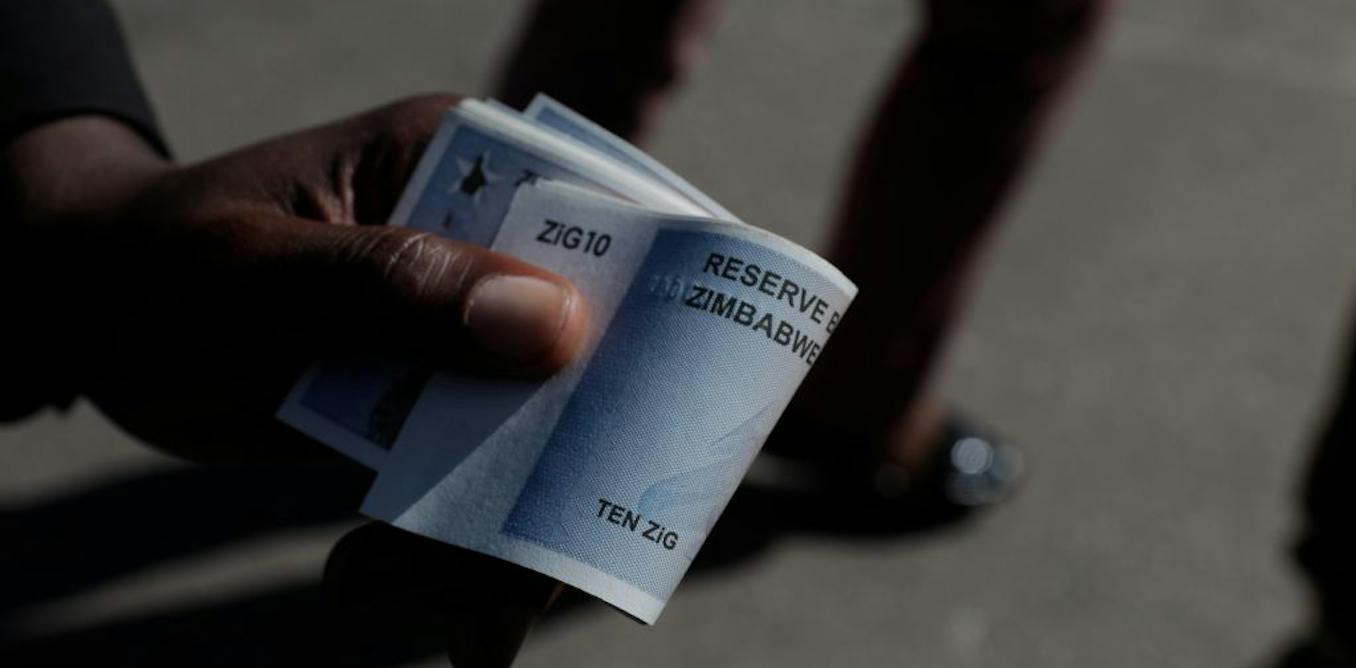
Zimbabwe’s central bank wants people to use the ZiG, a gold-backed local currency launched in April 2024, alongside the US dollar. A proposed real-time payment system based on Indian technology could help make the ZiG easier and cheaper to use. But digital payments will strengthen the currency only if people have good reasons to trust it. The Reserve Bank of Zimbabwe is negotiating with NPCI International Payments, the overseas arm of the body that runs the instant-payment system behind most digital payments in India. The proposed system is intended to lower payment costs, speed up transfers between bank and mobile-money accounts, and let people pay for small purchases directly from their accounts instead of using cards. Cross-border payments and remittance links could follow. I study trade and development policies in Africa and have written about Zimbabwe’s currency troubles since 2022. In my opinion, the central question is not simply whether the technology works. It is whether the government can use it to make the ZiG more attractive. The proposed instant-payment system could help the ZiG by making everyday transactions faster, cheaper and more accessible. But the goal should be to promote wider adoption of the local currency, not to use technology to force it. Three conditions matter. First, Zimbabwean institutions must retain control of the system. As I have warned before, supply chains, energy, minerals, and payment systems are increasingly vulnerable to deliberate weaponisation by other nations for geopolitical reasons. This warning applies to any country importing another’s payment technology. Licensing payment technology from abroad is not unusual. Namibia, Peru and Trinidad and Tobago have all partnered with India’s NPCI International to develop payment systems. What matters is who controls the system once it is running. Read more: When global trade becomes a weapon, how can African economies protect themselves? Second, people must remain free to choose between the ZiG and the dollar, so that those who use the ZiG do so because it is convenient and stable, not because they are forced to. Third, the central bank’s management of money and interest rates must remain credible to build trust in the ZiG nationwide. Public trust matters, given Zimbabwe’s long history of currency instability, marked by repeated episodes in which the local currency lost value rapidly, prices rose sharply, and people’s savings were wiped out. Why trust in the ZiG remains fragile Zimbabwe’s currency crisis developed over several years as falling production, funding shortfalls and the creation of money to finance government spending contributed to rising prices and a loss of confidence in the local currency. The government struggled to maintain the currency’s value. The crisis culminated in hyperinflation when inflation reached 231 million percent in 2008, and the Zimbabwe dollar was abandoned the following year. Bond notes introduced in 2016 were presented as equivalent to US dollars but failed to maintain that exchange rate. In 2019, foreign-currency bank balances were converted into a new local currency which subsequently lost value as inflation exceeded 500% in 2020. The launch of the ZiG was the latest in a series of attempts to establish a stable national currency. Read more: Zimbabwe’s ZiG: devaluations won’t fix a currency that’s in trouble because of government overspending These episodes had a common thread: the government spent far more than it collected in taxes and covered the gap by printing money. This undermined confidence in the currency and the central bank. For many people and businesses, holding US dollars became a way to protect their savings and plan transactions. The ZiG itself had a difficult start. On 27 September 2024, the Reserve Bank devalued it by 43%, from 13.9 to 24.4 ZiG per US dollar. At the time, the currency was required for some company taxes and most government services, and traders who refused it faced fines. These requirements did not produce widespread voluntary use because people remained concerned that the government could create more ZiG than the economy needed to pay for its spending, causing the currency to lose value. There have been signs of greater price stability, although inflation trends have diverged across currencies. Annual ZiG inflation fell to 2.9% in August 2026 before rising to 3.7% in September, while annual US-dollar inflation edged up from 3.1% to 3.46% over the same period. However, several months of low inflation are not enough to establish lasting confidence in the currency. Foreign reserves were about US$2 billion at the end of September – roughly two months of import cover, below the Reserve Bank’s target of three to six months. And most deposits are still held in US dollars. Policy has also moved away from a fixed timetable for replacing the dollar. The Reserve Bank has since abandoned its target of moving to a single currency by 2030 in favour of a conditions-based approach. In July 2026, the governor said the transition to exclusive use of the ZiG for domestic transactions is not date-based but is dependent on the achievement of the conditions precedent. The Bank has also ruled out forcibly converting US dollar savings into ZiG. Meanwhile, the 2026 budget reduced the tax on electronic ZiG transfers from 2% to 1.5%, while keeping the rate on foreign-currency transfers at 2%. Building trust in the ZiG requires more than technology Against that background, the Reserve Bank is negotiating with NPCI International to license the technology behind India’s shared, real-time payment system. The terms of the proposed agreement have not yet been made public. But experiences elsewhere offer useful lessons for Zimbabwe. Cambodia shows how a payment system can encourage use of the local currency while leaving people free to use dollars. Its Bakong payment system, launched in 2020 by the National Bank of Cambodia with a Japanese technology partner, supports transactions in both US dollars and the Khmer riel. The central bank’s 2024 annual report recorded a rising share of local-currency transfers and payments through Bakong, at roughly 49%. The lesson is not that Zimbabwe can copy Cambodia directly. It is that payment design can make local money easier to use while giving consumers and businesses a clear choice between currencies. Namibia, meanwhile, offers an early example of how the Indian payment technology is being introduced in another African country. Its instant-payment platform is operated by Instant Payment Namibia under the Bank of Namibia, with NPCI International as technology partner. Pilot testing was completed in June 2026, and a phased rollout is under way, beginning with government payments such as social grants. It is not yet a nationwide consumer service, so its longer-term effects remain to be seen. Both examples point to the same lesson: payment infrastructure can make a currency that people trust more convenient to use, but it cannot create that trust on its own. Three ways digital payments could support the ZiG Achieving greater adoption of the ZiG will depend on three things: First, the agreement should give Zimbabwean institutions control over the system’s operations and transaction data. It should also: allow Zimbabwe to change technology providers without having to rebuild the infrastructure require fair access for all banks, mobile-money operators and fintech companies. establish transparent fees and prevent any provider from blocking competitors or imposing excessive charges. These measures would protect Zimbabwe’s control over its payment infrastructure and reduce dependence on a single foreign technology provider. Second, Zimbabwe needs to maintain meaningful currency choice. The agreement should: clearly explain how users can make and receive payments in both ZiG and US dollars prohibit automatic or hidden conversion of dollar balances into ZiG without the account holder’s consent publish all fees and exchange rates upfront so users can compare the cost of payments in each currency make small ZiG payments cheaper through lower fees, while allowing people to continue using dollars. These measures would encourage households and businesses to choose the ZiG voluntarily. Third, monetary policy must sustain confidence. This means: maintaining fiscal discipline by avoiding central-bank financing of fiscal deficits rebuilding foreign-exchange reserves towards the three- to six-month import-cover target strengthening central-bank independence from the Treasury. The Reserve Bank should also publish regular data on digital payments. This would show whether digital payments are making the local currency more useful in everyday life and help rebuild trust in the institution. If Zimbabwe gets these three things right, digital payments can reinforce progress towards a more trusted ZiG.
Zimbabwe wants digital payments to build trust in its newest currency. Why technology alone won’t be enough to save the ZiG
Full Article
Original Source
Read the full article at Theconversation →KhanList aggregates and links to publicly available news content. We do not host full articles from third-party sources. Always verify important information with original sources.