
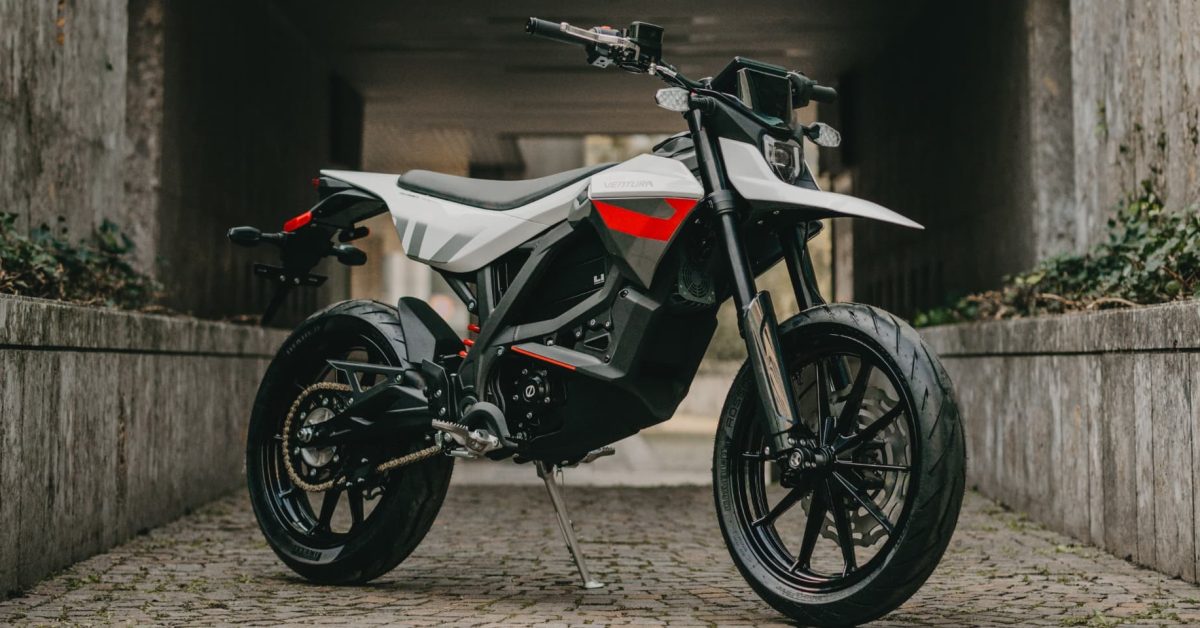
Zero Motorcycles is celebrating its 20th anniversary with a major wave of announcements at EICMA 2026, unveiling several new electric two-wheelers alongside some important technology upgrades that could make its existing motorcycles even more appealing. The biggest news is an entirely new lightweight electric street motorcycle known as Project Ventura, designed to bridge the gap between the increasingly popular world of electric bikes plus lightweight e-motos and the full-size electric motorcycle market. But that’s far from the only news coming out of Zero’s booth in Milan. The electric motorcycle maker is also announcing a new street-legal version of its XE electric dirt bike that was previously only street-legal in Europe, introducing its LS3 electric scooter to Europe, introducing a redesigned smartphone app, and sharing more details about its upcoming DC fast-charging system. There’s quite a bit to unpack here, so let’s get into it. Zero Project Ventura: A new electric motorcycle for under $8,000 Perhaps the most exciting announcement is Project Ventura, a new lightweight electric motorcycle that Zero hopes will attract an entirely new generation of riders. With supermoto-inspired styling, 17-inch wheels, and a more approachable design than the company’s larger street motorcycles, Ventura appears aimed squarely at riders who want something more substantial than a typical lightweight e-moto but aren’t necessarily looking for a full-size, high-performance motorcycle. And with a targeted price of less than US $8,000, it could be one of Zero’s most accessible street motorcycles yet. The bike features a new electric powertrain producing over 20 kW (27 hp) of peak power, delivering a sustained top speed of 65 mph (105 km/h) and a momentary maximum speed of 81 mph (130 km/h). That’s a particularly interesting distinction, as it positions the bike as being able to briefly reach highway-capable speeds with the occasional burst of extra performance, but perhaps not for longer sustained highway stretches. Importantly, we don’t yet know the battery capacity, though Zero is giving us a hint by publishing a range estimate. The company is quoting an estimated real-world range of 93 miles (150 km), but without a real battery capacity figure to parse, it’s hard to take that range estimate at face value. We do know that the bike will feature onboard Level 2 charging, allowing riders to plug into public AC charging stations without carrying around a separate external charger – something more common on the smallest of electric motorcycles that attempt to cut down on weight and cost by using an off-board charger. Other features include standard ABS, Bluetooth connectivity, integration with Zero’s upcoming smartphone app, and a chassis designed to accommodate a passenger. The riding position is upright, and the bike’s supermoto-inspired geometry is intended to deliver agile handling and a playful riding experience. Perhaps most interestingly, Zero isn’t hiding the fact that it sees the explosion of e-bikes and smaller electric motos as a potential gateway to motorcycle ownership. “When we set out to build Project Ventura, we had three guiding principles: first, build a bike so good-looking you’d want its poster above your bed. Second, make it a proper electric motorcycle that feels like a natural next step for the millions of riders who’ve spent the last four or five years on e-bikes and e-motos. And third, make it ridiculously fun to ride,” explained Jim Callahan, Zero’s Chief Product and Partnerships Officer. That’s a notable strategy for a company that has historically focused heavily on higher-performance electric motorcycles. However, the launch of Zero’s smaller Sur Ron-style electric dirt bikes last summer showed that the motorcycle maker did see the writing on the wall in terms of the success of the e-moto market compared to larger flagship bikes. Instead of trying to convince existing gasoline motorcycle riders to make the electric switch, Zero is increasingly looking toward younger riders who may have already fallen in love with electric two-wheelers and are ready for something faster and more capable. But for those interested in the new Ventura, they’ll have to wait just a bit longer. The motorcycle is expected to become available in summer 2027. Zero XE electric dirt bike is finally going street-legal Another major announcement is a new street-legal version of Zero’s XE electric dirt bike. The original XE was introduced as part of Zero’s more affordable X Line of lightweight electric off-road motorcycles, offering a more accessible entry point to the brand than its traditional street and dual-sport models. While the model was available in street-legal format in Europe, the US versions were purely off-road affairs. Now Zero is taking that same general concept and making it legal for public roads, opening up significantly more riding possibilities. The new XE is fully homologated and features the necessary street equipment, including a headlight, taillight, and centrally mounted dashboard. A small integrated flyscreen and black bodywork give the motorcycle a more refined appearance, while wide dual-sport tires help it transition between pavement and dirt. Zero has also revised the gearing, using a rear sprocket designed to balance off-road performance with the higher speeds required for street riding. The result is a claimed top speed of 60 mph (97 km/h), making the XE capable of considerably more than simply putting around the neighborhood, though with a slight torque sacrifice. For riders who live near off-road riding areas, the appeal is obvious. Instead of loading a dirt bike into a truck or trailer to reach the trails, owners could potentially ride directly from home to the trailhead, provided local regulations allow it. That’s a particularly useful capability for a lightweight electric dirt bike, where much of the appeal comes from its simplicity, low maintenance, and ability to explore places that larger motorcycles might struggle to reach. The new street-legal XE is expected to launch in spring 2027, with pricing starting at US $6,295. Zero LS3 electric scooter makes its European debut Zero is also expanding its electric scooter offerings with the European debut of the LS3, a faster and more capable scooter designed for urban transportation and longer commutes. While Zero has traditionally been associated with electric motorcycles, its growing interest in scooters represents another effort to reach riders who prioritize everyday transportation over outright performance. The LS3 offers a top speed of 75 mph (121 km/h), which puts it well beyond the typical low-speed urban electric scooter category. Zero also quotes a range of up to 93 miles (150 km), powered by a battery system consisting of three onboard batteries with a combined capacity of 5.6 kWh. Interestingly, one of those batteries is removable and located beneath the seat. Riders can remove it to free up additional storage space, offering some flexibility between maximum battery capacity and cargo-carrying convenience. That could prove useful for commuters who don’t always need the scooter’s full range but would appreciate extra room for everyday items. The LS3 also comes equipped with heated grips and a heated seat, features that should be particularly welcome to European riders commuting through colder months. Connected technology rounds out the package, including compatibility with Zero’s upcoming smartphone app. The LS3 is expected to become available in Europe in spring 2027. Zero is developing a completely new smartphone app Beyond the new vehicles, Zero is also working on a redesigned smartphone application that promises to give riders considerably more control over their motorcycles. The new app is being developed for the LS3, 2027 Street and Dual Sport motorcycles, and Project Ventura. One of the more interesting features is the ability to customize riding modes. In addition to preset modes that adjust power delivery and regenerative braking, riders will be able to create a custom mode and individually tune parameters including speed, power, torque, and regeneration. The app will also include a charging-station finder, allowing riders to search for nearby chargers and filter them by charging speed, network, and availability. Apple Maps integration will provide route guidance to selected charging locations. An optional ride-history feature can automatically record trips, including their distance, duration, and route previews. Riders will also be able to customize their motorcycle’s dashboard layout, choosing which information appears in each quadrant of the display. Battery management is getting some attention, too. The app will provide controls for scheduled charging, target charge levels, charging limits, and long-term battery storage settings. Zero is also adding integrated feedback and support tools that allow owners to report problems or suggest improvements directly through the app, including photos and diagnostic logs. The redesigned app is expected to arrive in 2027. DC fast charging is finally coming to more Zero motorcycles Perhaps the most consequential technology announcement, at least for riders who want to take their electric motorcycles beyond short commutes and weekend rides, is Zero’s continued development of DC fast charging. Zero says it is targeting a 2027 launch for its new fast-charging system, which will support compatible Street and Dual Sport motorcycles. The system is being designed to charge compatible batteries from 20% to 80% in less than 30 minutes. That’s a major improvement in convenience compared to the longer AC charging stops that have traditionally been associated with Zero motorcycles. Importantly, the company is developing the system for both North America and Europe, with different charging connectors for each market. European motorcycles will use the CCS standard, while North American models will feature NACS connectors. The latter is particularly interesting given the growing adoption of NACS charging infrastructure across North America, potentially making it easier for electric motorcycle riders to access a wider range of charging locations. Zero is also developing a retrofit option for eligible existing motorcycles, meaning some current owners may eventually be able to upgrade their bikes rather than purchasing entirely new models to take advantage of the technology. The company hasn’t yet announced pricing or a complete list of compatible motorcycles, and the retrofit option remains under development. Still, the prospect of adding significantly faster charging to existing electric motorcycles could be an important development for the brand. Electrek’s Take There are several exciting announcements here, but I think the biggest takeaway is that Zero seems to be increasingly focused on making electric motorcycling more accessible through smaller and more affordable options. For much of its 20-year history, Zero has been a pioneer in the electric motorcycle industry, often offering impressive performance and technology, but at prices that made its motorcycles difficult for many riders to justify. The bikes have long won acclaim, but $20k was a big ask. Now we’re seeing a different approach. The company’s more affordable X Line bikes have already demonstrated that Zero is interested in attracting riders who might never have considered one of its larger electric motorcycles. The street-legal XE takes that concept a step further, and Project Ventura could be an even more important addition. I’m particularly intrigued by Zero’s explicit acknowledgment that millions of people have spent the last several years riding e-bikes and smaller electric motos, and that many of those riders may be ready to graduate to something bigger. That’s an audience I’ve been watching grow for years. These are riders who are already comfortable with electric drivetrains, who appreciate the simplicity of twist-and-go riding, and who don’t necessarily have any attachment to gasoline engines or traditional motorcycle culture. For those riders, a lightweight, fun electric motorcycle capable of 81 mph and priced below $8,000 could be an awfully compelling next step. The new street-legal XE is similarly exciting, especially for riders who want to combine urban transportation with off-road adventures without needing a truck to haul their bike around. And while the new motorcycles are likely to get most of the attention, I wouldn’t overlook the DC fast-charging announcement. Charging speed has long been one of the biggest limitations facing electric motorcycles, particularly for riders interested in longer trips. A sub-30-minute charging stop isn’t quite gasoline-level convenience, but it’s getting much closer to something that can work for real motorcycle touring. Of course, several important details remain unknown, and we’ll have to wait until 2027 to see how these products and technologies perform in the real world. But taken together, these announcements suggest Zero is making a serious effort to expand beyond its traditional audience and build electric motorcycles for a much broader range of riders. And after two decades of helping pioneer the electric motorcycle industry, that’s exactly the kind of evolution I’d like to see. FTC: We use income earning auto affiliate links. More.
Zero Motorcycles unveils $8K electric motorcycle, street-legal dirt bike, and much more
Full Article
Original Source
Read the full article at Electrek →KhanList aggregates and links to publicly available news content. We do not host full articles from third-party sources. Always verify important information with original sources.