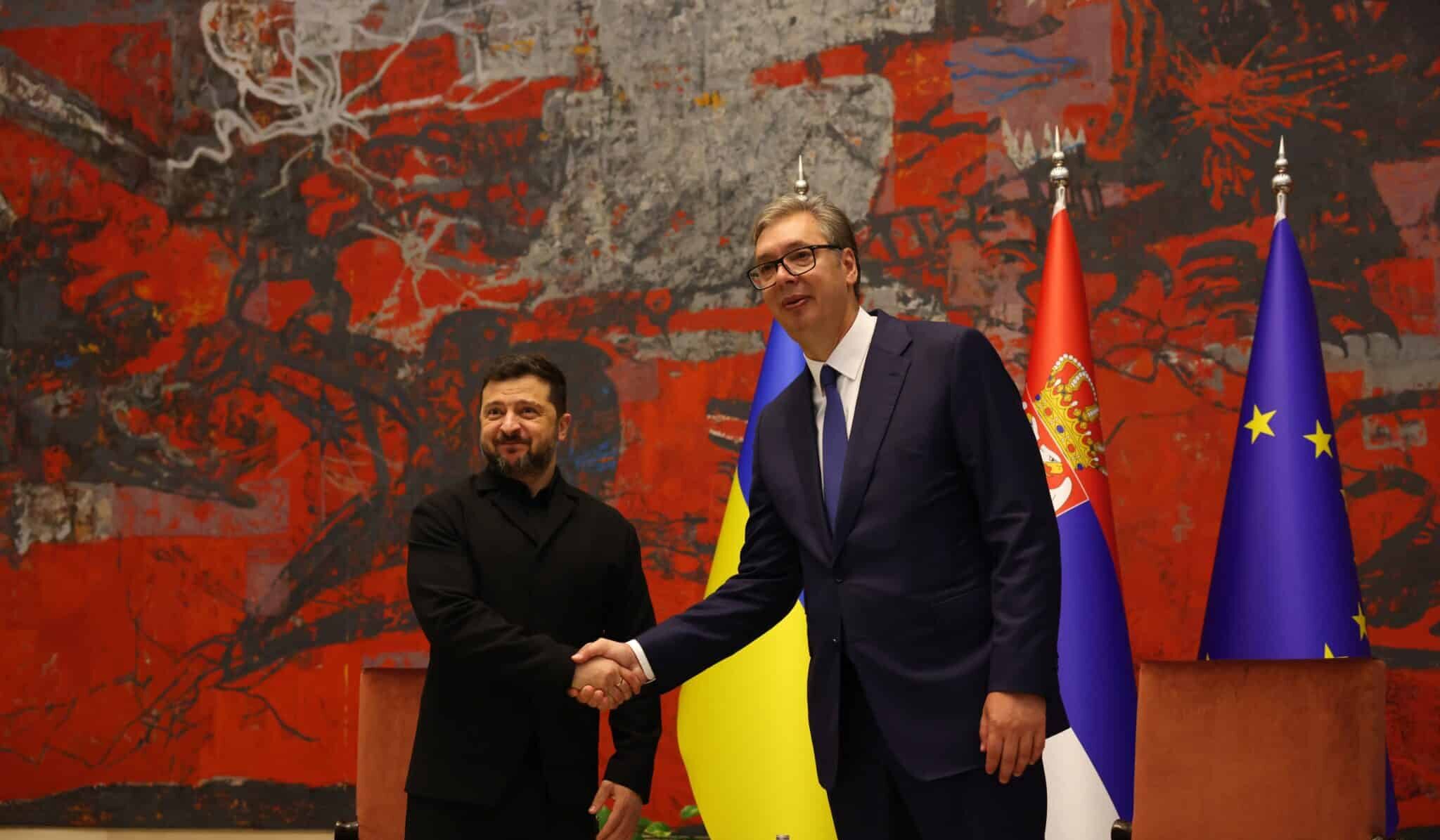
Serbia and Ukraine have maintained a more functional relationship since Russia’s full-scale invasion than Serbia’s domestic media environment might suggest. From the beginning of the war, Belgrade has formally supported Ukraine’s territorial integrity while refusing to impose sanctions on the Kremlin. Serbia has backed UN resolutions affirming Ukrainian sovereignty, accepted Ukrainian refugees and provided financial, humanitarian and energy assistance. Kyiv, meanwhile, has not recognised Kosovo’s independence, enabling both governments to emphasise reciprocal respect for territorial integrity. Political contacts have steadily intensified. This has included meetings between Vucic and Zelensky on the margins of international summits, visits by senior Ukrainian officials such as Foreign Minister Dmytro Kuleba’s trip to Belgrade in 2024, and Vucic’s two visits to Ukraine in just over a year. Yet Serbia’s foreign policy abroad and its political communication at home tell different stories. While the government formally describes EU membership as a strategic objective, much of the pro-government media ecosystem continues to cultivate anti-Western, anti-EU and pro-Russian narratives. A 2026 Belgrade Centre for Security Policy study found that the narrative presenting Ukraine as a proxy in a wider Russia-West war was dominant in the Serbian pro-government press between early 2022 and mid-2025. Echoing Kremlin rhetoric, pro-government media portrayed Zelensky as Ukraine’s illegitimate president, while repeatedly depicting the country as subordinate to NATO and the West. Corruption scandals involving Zelensky’s inner circle have likewise been amplified by tabloids to portray the Ukrainian leadership as compromised. The ruling party also echoed “colour revolution” rhetoric – that Serbia is being subjected to foreign subversion – through loyal media outlets, to delegitimise and justify the crackdown on mass protests against corruption, growing autocracy and political repression. There have been repeated warnings that the authorities would not allow another “Euromaidan in Belgrade”. Zelensky’s visit creates a domestic communications challenge for Serbia’s president, particularly with his pro-Russian electoral base. The same media ecosystem that has spent years cultivating suspicion of Ukraine and hostility towards the West must now explain why Zelensky is being formally welcomed in Belgrade. For tabloids such as Informer, the crucial message is not what the visit changes, but what it does not. Closer ties with Ukraine, and Zelensky’s visit to Belgrade, do not necessarily signal a shift in Serbia’s policy toward Russia, nor do they imply the introduction of sanctions. Vucic has already stated that Serbia defined its sanctions policy years ago and that this position will remain unchanged. That is also a reason not to read too much into the visit. Just weeks earlier, Vucic was the only leader at a Ukraine-South East Europe summit in Kyiv who refused to sign the joint declaration calling for continued support for Ukraine and greater pressure on Russia. He also did not attend a ceremony honouring Ukrainians killed in Russia’s aggression. At the same time, Serbia is seeking to deepen economic ties with Kyiv to advance its bid for membership in the World Trade Organization, while continuing arms exports, exploring possible security and defence cooperation, and publicly reaffirming its support for Ukraine’s territorial integrity. This is not necessarily a contradiction, but rather the essence of Vucic’s foreign policy: cultivating relationships with competing powers while avoiding commitments that would foreclose other options. Zelensky’s visit therefore demonstrates to Moscow that Serbia is not exclusively Russia’s partner, while signalling to Brussels and Washington that Belgrade wants to remain geopolitically useful. But unless it is followed by sanctions, substantially greater alignment with EU foreign policy or a structural reduction of Serbia’s dependence on Russia, the visit looks less like a Serbian pivot to the West than another attempt by Vucic to continue his balancing act. Maja Bjelos is a senior researcher at the Belgrade Centre for Security Policy. The opinions expressed are those of the author and do not necessarily reflect the views of BIRN.
Zelensky’s Belgrade Visit Tests Serbia’s EU-Russia Balancing Act
Full Article
Original Source
Read the full article at Balkaninsight →KhanList aggregates and links to publicly available news content. We do not host full articles from third-party sources. Always verify important information with original sources.