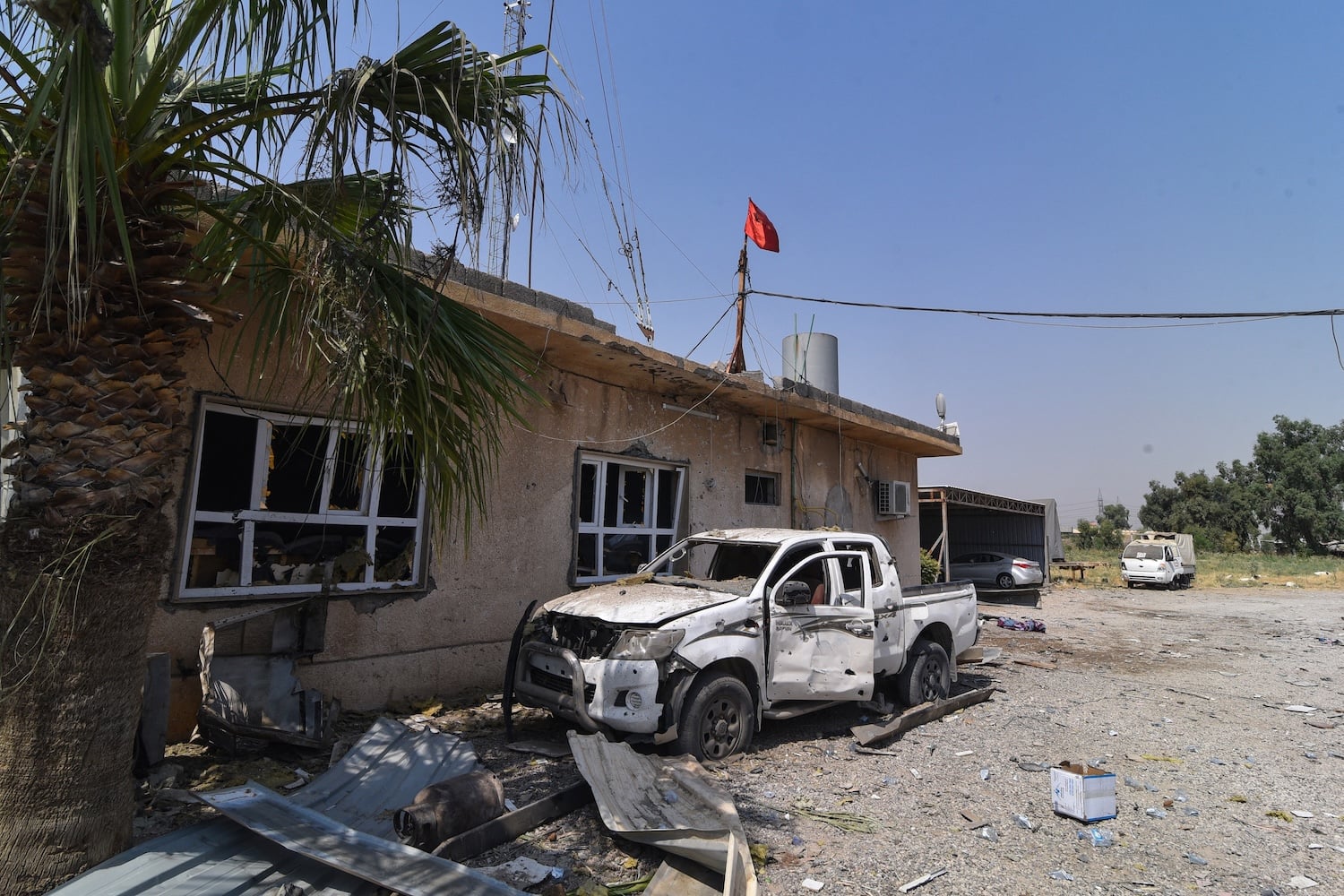
Upon taking office in May, Iraqi Prime Minister Ali al-Zaidi knew he would face the challenge of dealing with Iran-backed armed groups in the country. He might not have known how quickly or how intensely: On July 27, drones reportedly launched from Iraq targeted oil facilities in Saudi Arabia’s Eastern province. Although Iraqi armed groups denied responsibility, two days later Saudi Arabia and the United States carried out coordinated strikes against Iran-backed factions, reportedly killing at least 20 militia members. Whether the exchange remains contained is unclear. But it has already demonstrated Zaidi’s predicament: how to restrain armed groups capable of drawing Iraq into a regional conflict while balancing Baghdad’s relationships with the United States and Iran. The escalation came not long after Zaidi had traveled to Washington for his first state visit. On the surface, the trip was a success. Zaidi and his delegation signed some 50 memoranda of understanding, while U.S. President Donald Trump said he expected him to become a “great leader in the Middle East.” But the flattering reception could not alter the conditions awaiting Zaidi upon his return to Baghdad: an oil-dependent economy, a fragmented political system, powerful armed factions, and the inescapable rivalry between Washington and Tehran. Upon taking office in May, Iraqi Prime Minister Ali al-Zaidi knew he would face the challenge of dealing with Iran-backed armed groups in the country. He might not have known how quickly or how intensely: On July 27, drones reportedly launched from Iraq targeted oil facilities in Saudi Arabia’s Eastern province. Although Iraqi armed groups denied responsibility, two days later Saudi Arabia and the United States carried out coordinated strikes against Iran-backed factions, reportedly killing at least 20 militia members. Whether the exchange remains contained is unclear. But it has already demonstrated Zaidi’s predicament: how to restrain armed groups capable of drawing Iraq into a regional conflict while balancing Baghdad’s relationships with the United States and Iran. The escalation came not long after Zaidi had traveled to Washington for his first state visit. On the surface, the trip was a success. Zaidi and his delegation signed some 50 memoranda of understanding, while U.S. President Donald Trump said he expected him to become a “great leader in the Middle East.” But the flattering reception could not alter the conditions awaiting Zaidi upon his return to Baghdad: an oil-dependent economy, a fragmented political system, powerful armed factions, and the inescapable rivalry between Washington and Tehran. Whether the immediate crisis escalates will depend on myriad factors beyond Zaidi’s control. Over time, however, Zaidi has an opportunity that was not afforded his predecessors: The U.S.-led global coalition against the Islamic State is ending its mission. As a result, the multilateral security relationship that has defined U.S.-Iraqi ties for more than a decade is giving way to a bilateral one. That shift should allow Baghdad to negotiate the scope and terms of security cooperation with Washington—as opposed to a broader framework involving multiple countries—tailoring it more closely to Iraqi priorities, making the government more clearly accountable for the arrangement at home, and giving it a chance to better manage the regional quandary it faces. Zaidi has presented himself as a break with the past. A young businessman with no established political track record, he is unlike the veteran politicians who have dominated Iraq’s post-2003 order. That appears to be one reason the Trump administration preferred him over other contenders for the premiership. Yet changing the occupant of the prime minister’s office does not change the system over which he presides. Every elected Iraqi prime minister since 2005 has faced the same basic challenge: how to maintain productive relations with both the United States and neighboring Iran without allowing Iraq to become an arena for their competition. Baghdad’s close, if complex, ties to both powers have occasionally enabled it to act as an intermediary. Those diplomatic opportunities, however, have repeatedly been outweighed by the costs of regional confrontation—costs that have grown as rivalry between Washington and Tehran has escalated into open warfare across much of the region. Zaidi cannot escape Iraq’s geography or its political economy, which may take decades to transform. Nor can he simply command a state fragmented by party patronage, corruption, and competing centers of coercive power. His more realistic opportunity is to reduce the force of these constraints: strengthen state institutions, widen Iraq’s regional relationships, and create greater room for an independent foreign policy. Doing so will require gradual gains rather than a dramatic break with the past. It will also require Washington to adjust its expectations of what any Iraqi prime minister can achieve. The changing security relationship illustrates both the opportunity and the danger. During Zaidi’s visit to Washington, U.S. Defense Secretary Pete Hegseth confirmed that the coalition against the Islamic State would conclude its mission on Sept. 30, resulting in the withdrawal of some 2,500 troops currently stationed in Iraq. Most are from the United States, although other coalition members have also deployed dozens of personnel in training and advisory roles. Zaidi and his predecessor Mohammed Shia al-Sudani have argued that the transition will improve the state’s leverage over Iran-backed armed groups, which have long invoked the presence of foreign troops to justify retaining independent command structures and weapons. There is some logic to that claim, but it should not be overstated. U.S. forces are unlikely to leave Iraq entirely: Baghdad is expected to retain a limited number of U.S. military advisors under the new bilateral security framework. More fundamentally, the most powerful Iran-aligned factions are not merely endogenous armed groups responding to the presence of U.S. forces in Iraq. They are tied ideologically and operationally to Iran’s so-called Axis of Resistance. Iraqi groups fought alongside the Assad regime in Syria for more than a decade. After the January 2020 U.S. strike on Baghdad that killed Qassem Suleimani, the commander of Iran’s Quds Force, and Abu Mahdi al-Muhandis, the deputy chairman of the Popular Mobilization Forces (PMF)—the umbrella of voluntary militia groups that mobilized in 2014 to fight the Islamic State—their affiliated parties in the Iraqi parliament demanded not only the coalition’s withdrawal from Iraq but the end of the wider U.S. military presence across the region. The recent U.S.-Israeli war with Iran underscored the transnational character of these groups. Iraq’s self-described “resistance” factions targeted not only U.S. assets inside Iraq but also U.S. bases and civilian infrastructure in Jordan, Syria, and the Gulf. So long as conflict between Washington and Tehran continues, these factions are unlikely to surrender either their military capabilities or what they regard as their legitimate right to fight the United States, whether on Iraqi territory or beyond it. The end of the coalition will therefore not end Iraq’s militia problem. Nor will it resolve the contradiction at the heart of the Iraqi state: armed groups formally incorporated into the security apparatus but that retain varying degrees of political, military, and ideological autonomy—and maybe at cross purposes with each other. Zaidi will inherit the same dilemma that frustrated his predecessors. Moving too slowly risks entrenching parallel chains of command. Moving too aggressively risks provoking an intra-Shiite conflict that the Iraqi state may be unable to contain. The government’s emerging approach is not a conventional disarmament, demobilization, and reintegration process. These groups are not a defeated insurgency, and there is no comprehensive plan to dismantle them. What Baghdad is attempting instead is incremental integration through negotiations with individual factions. Muqtada al-Sadr’s Saraya al-Salam was the first to hand control of its PMF brigades to Zaidi, who is also Iraq’s commander in chief, in June. Qais al-Khazali’s Asaib Ahl al-Haq and Shibl al-Zaidi’s Kataib al-Imam Ali have pledged to follow, although the details and timetable remain unclear. The factions most closely identified with the resistance—including Kataib Hezbollah, Harakat al-Nujaba, Kataib Sayyid al-Shuhada, and Harakat Ansar Allah al-Awfiya—have publicly rejected the idea, even as some appear to be in discussions with the government. Total disarmament ought not be the sole measure of progress. Baghdad can restructure PMF brigades and integrate commanders and rank-and-file personnel into other state security institutions. The Joint Operations Command, Iraq’s central authority over the armed forces, can inventory formal capabilities and establish clearer chains of command, as it is now doing with Saraya al-Salam. The immediate goal should be straightforward: Units that receive state salaries and formally belong to the security apparatus should answer to the commander in chief, not to factional leaders. The government is far less likely, at least in the short term, to gain control over the militias’ equipment. The strongest resistance factions retain missiles, drones, and other advanced weapons supplied by Iran and stored in facilities beyond government access, including bases such as Jurf al-Sakhar. Bringing these arsenals under state authority would probably require direct confrontation with groups that successive governments have avoided provoking. Attempting it while the United States and Iran remain locked in open hostilities could strengthen the factions, weaken the government, and ultimately fracture the state. Baghdad’s most plausible course over the short and medium term is to bring more personnel under state command, increase its visibility over the PMF’s formal capabilities, and separate state-linked brigades from factions that will continue to pursue an independent regional agenda, at least for the time being. Even without dismantling the resistance groups, those steps would reduce their institutional cover and gradually strengthen the authority of the Iraqi state. A clearer separation would also help Baghdad manage the next regional escalation. During the previous round of fighting in March and April, fear of a domestic backlash made the government reluctant to identify the groups that directly attacked U.S. targets and distinguish them from the broader network of forces formally or loosely affiliated with the PMF. When U.S. retaliatory strikes killed Iraqi personnel, including members of the regular armed forces who had not participated in the attacks, Baghdad was left in the politically untenable position of appearing to accept U.S. military action against its own security institutions. Clearer command structures would give the government more room to isolate perpetrators, protect uninvolved units, and respond without treating the entire PMF as a single hostile bloc. If the United States wishes to strengthen the Iraqi state, the wiser course is therefore not to press Zaidi into a military showdown with armed groups that he is unlikely to win. Instead, Washington should reinforce his efforts by preserving bilateral security cooperation with the Iraqi military, including both federal forces and those of the Kurdistan Regional Government. Training, military assistance, and intelligence cooperation remain valuable because they strengthen the very institutions on which the United States ultimately wants Iraq to rely. Ultimatums demanding immediate disarmament would do the reverse: expose the state’s weakness, limit the political space available to Zaidi, and make confrontation more likely before state institutions are capable of prevailing. The United States should also recognize that Iraq’s vulnerability to Iranian influence is reinforced by regional isolation and economic codependence. Relations between Iraq and the Gulf states have deteriorated as Iran-backed groups have attacked Gulf countries during the war. Yet Zaidi’s response to the recent Saudi-U.S. retaliatory strikes was more measured than that of his predecessor, who routinely defended the PMF in public statements. And although Zaidi canceled a planned visit to Riyadh, he refrained from summoning the Saudi ambassador—perhaps reflecting an acknowledgement of Riyadh’s claim that it acted in self-defense. While some Gulf capitals increasingly view Iraq as irretrievably embedded in an Iranian sphere of influence, others continue to believe that Iraq is too large and strategically important to abandon. Washington should encourage the latter view. Once the war subsides, the United States can help Iraq reconnect with its Gulf Arab neighbors, much as it has used its relationships with Turkey and Arab states to support Syria’s rehabilitation. It has already encouraged greater connectivity between Iraq and Syria, including efforts surrounding the reconstruction of the Kirkuk-Baniyas oil pipeline. Similar diplomatic energy should be directed toward Iraq’s relations with the Gulf states, with an emphasis on investment, energy links, trade, and infrastructure. The aim should not be to turn Iraq into an anti-Iranian state. That is neither realistic nor desirable. Iran will remain a neighbor, a major trading partner, and an influential political actor. The better objective is to expand Iraq’s strategic autonomy by ensuring that it is not overwhelmingly dependent on any one external partner. A country economically and diplomatically connected to all its neighbors has more room to maneuver. Greater Gulf investment and regional connectivity would give Baghdad stronger foundations for maintaining stability, restraining armed groups, and reducing the economic channels through which Tehran exercises influence. Zaidi has already signaled an intention to rebalance Iraq’s foreign relations—a task that confronted many of his predecessors whenever Bagdad tilted toward either Washington or Tehran. He spent a week in Washington with a large delegation and then visited Tehran for only a day, which his opponents among the Iran-aligned parties have criticized. But the success of his premiership should not be measured by the number of agreements signed or a promise to impose order from above. Successive Iraqi leaders have made similar promises, only to discover that the country’s political system, armed factions, and external relationships were stronger than any individual executive. His opportunity is more modest but potentially more consequential. He can strengthen state authority by separating the PMF’s formal security structures from factions that retain independent strategic agendas, integrating the former more fully into state institutions and reducing government cover for the latter. He can also widen Iraq’s regional relationships so that balancing between Washington and Tehran becomes less precarious. None of this will be quick, and none of it will produce the black-and-white outcome that some in Washington may prefer. It would make little sense to judge Zaidi by whether he can accomplish in months what Iraq’s political system has failed to accomplish in two decades. The United States cannot dictate the nature of Iraq’s relationship with Iran any more than Iran can dictate the nature of its relations with the United States. Pressure alone will not disarm the resistance factions. If it is interested in a more stable, independent Iraq, Washington can, however, support Iraqi institutions while giving the government the political space to pursue change at a pace it can sustain.
Zaidi’s Militia Dilemma
Full Article
Original Source
Read the full article at Foreignpolicy →KhanList aggregates and links to publicly available news content. We do not host full articles from third-party sources. Always verify important information with original sources.