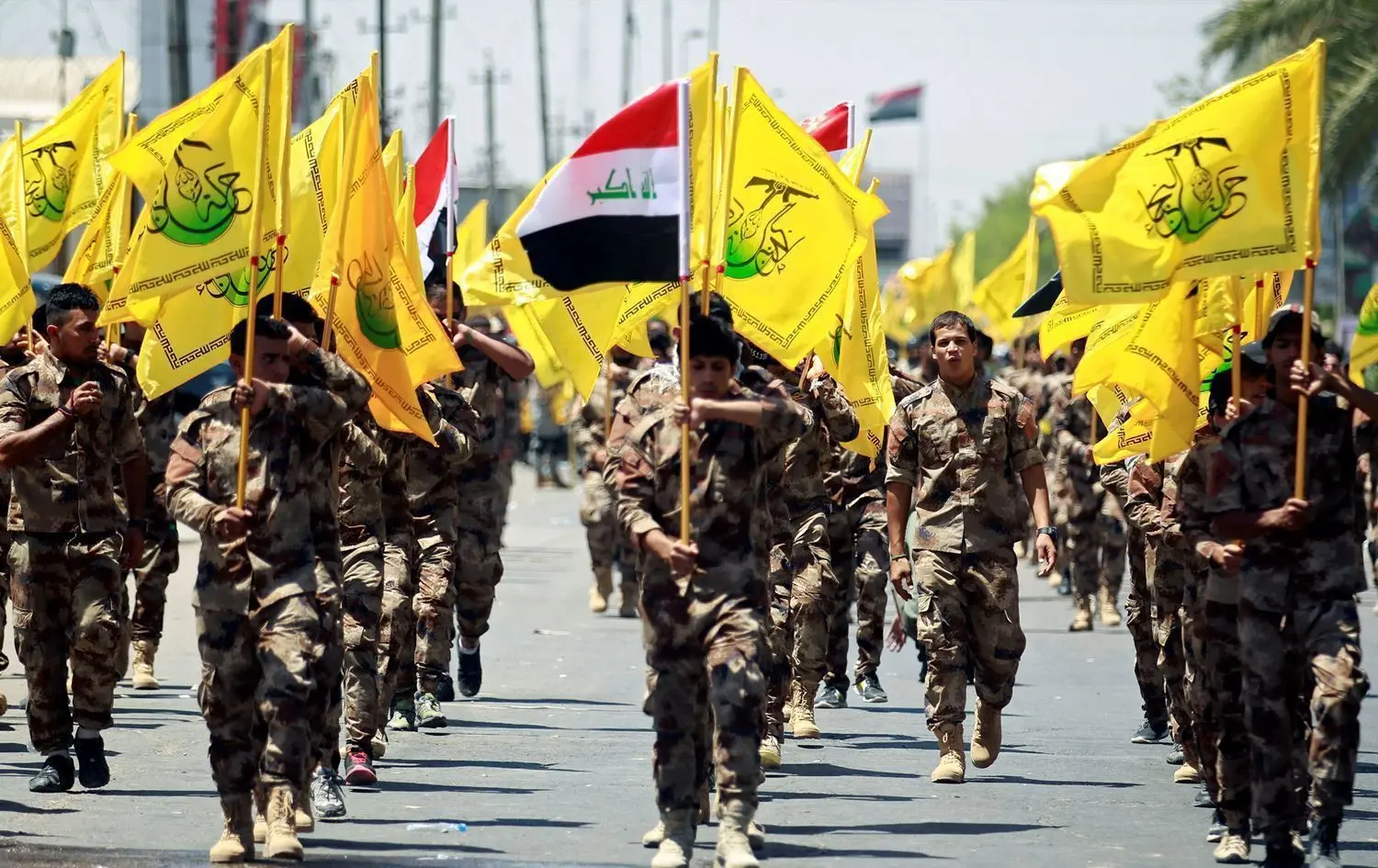
Baghdad (IraqiNews.com) — A failed security operation targeting a facility belonging to the Iran-aligned Harakat al-Nujaba movement has underscored the challenges facing the Iraqi government as it seeks to bring all armed groups under state control before the end of September. According to a report published by Al-Monitor, a joint Iraqi force attempted to search a Harakat al-Nujaba compound in Baghdad’s Jurf al-Naddaf district on July 24 after receiving intelligence suggesting the site contained missiles and drones. However, the operation ended without the facility being searched after armed members of the group confronted government forces. The report, citing Iraqi security officials, said the operation involved Baghdad Operations Command, the Federal Police, and the Popular Mobilization Forces (PMF) Security Directorate. Shortly after arriving at the compound, commanders affiliated with Harakat al-Nujaba reportedly ordered their fighters to prevent security personnel from entering. Armed members of the group then surrounded the government force and fired warning shots into the air, forcing the operation to halt. According to the officials, the PMF leadership subsequently instructed its personnel to withdraw, stating they had not been informed that the target was a facility affiliated with Harakat al-Nujaba. Army units involved in the operation later received similar withdrawal orders. No casualties were reported, and neither the government nor the armed group publicly disclosed details of the incident at the time. The incident comes as Prime Minister Ali al-Zaidi has pledged to ensure that all weapons in Iraq are brought under state control by September 30, the scheduled end of the U.S.-led coalition’s military mission in the country. Al-Monitor described the failed operation as the first significant field test of the government’s commitment to enforcing that pledge. While previous administrations also announced plans to limit weapons to state institutions, implementation has remained difficult due to the political and military influence of several armed factions. Hayder al-Shakeri, a researcher with Chatham House’s Middle East and North Africa Programme, told Al-Monitor that although Baghdad has increasingly relied on restructuring security institutions and applying political and financial pressure on armed groups, the Jurf al-Naddaf operation demonstrated the limits of the state’s authority when confronted directly. “If the government cannot enforce its decisions against a single armed faction, or fails to follow through with legal and political accountability, it suggests that these groups still retain an effective veto over certain state actions,” Al-Shakeri was quoted as saying. The report noted that not all Iran-aligned factions share the same position regarding government efforts to centralize weapons under state control. Some groups, including Asaib Ahl al-Haq, have become increasingly integrated into Iraq’s political and economic systems, potentially reducing their willingness to engage in direct confrontation. Others—including Kataib Hezbollah, Harakat al-Nujaba, and Kataib Sayyid al-Shuhada—continue to oppose any move that would place their military capabilities under full government authority. Political analyst Muhannad al-Ghazi told Al-Monitor that these factions view their weapons through an ideological lens, making voluntary disarmament highly unlikely. He argued that targeting isolated weapons caches without addressing broader military infrastructure would have only a limited impact. The reported confrontation occurred amid heightened regional tensions following Prime Minister al-Zaidi’s recent visit to Washington, where Iraq and the United States announced a strategic economic partnership. According to Al-Monitor, several Iran-backed factions criticized the visit, warning against what they described as replacing “military occupation” with “economic occupation” through expanded U.S. investment in Iraq. The report also linked the incident to broader regional developments, including recent drone attacks and cross-border military operations that have intensified pressure on Baghdad’s efforts to assert control over its territory. Al-Monitor concluded that the government’s September 30 target for fully disarming armed factions appears increasingly difficult to achieve given current realities. Instead, analysts cited by the publication believe Baghdad may focus on more gradual measures, including relocating some weapons, closing selected facilities, and increasing political and financial pressure on groups willing to cooperate, while avoiding direct confrontation with the most heavily armed factions. The report suggested that the ultimate success of Iraq’s disarmament strategy may depend not only on domestic enforcement but also on broader regional dynamics, particularly relations between the United States and Iran.
Zaidi’s failed raid on Nujaba base exposes challenges in disarmament push
Full Article
Original Source
Read the full article at Iraqinews →KhanList aggregates and links to publicly available news content. We do not host full articles from third-party sources. Always verify important information with original sources.