
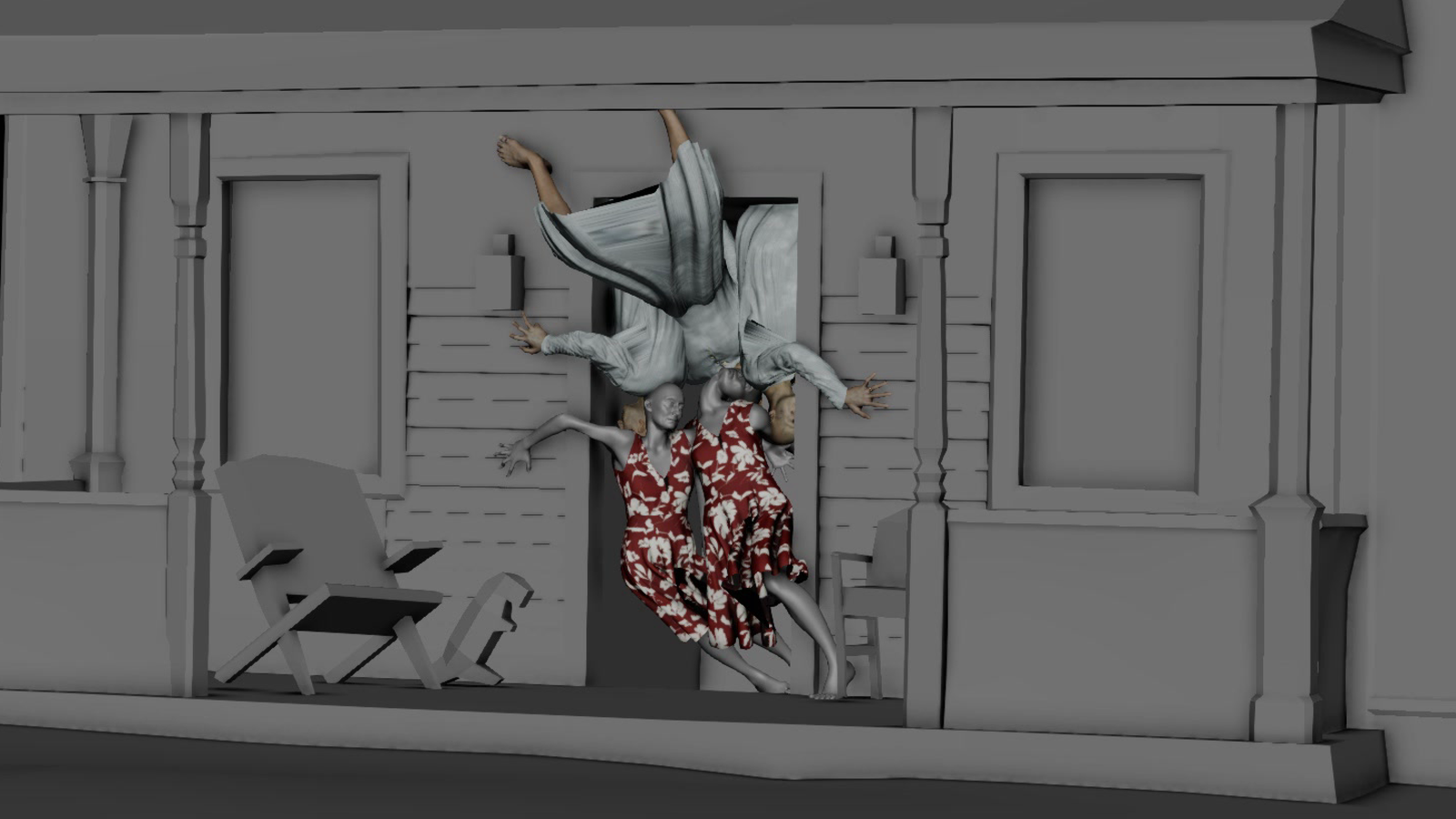
Published Nov 3, 2026, 11:00 AM EST Polygon speaks to a trio of Wētā Workshop artists about Zach Cregger's latest movie Resident Evil's VFX team reveals the secrets behind the Pedestrian and Mutant Bryan: 'We cheated a bit' Image: Weta Kevin Smith would like to set the record straight. (Not that Kevin Smith, the Wētā Workshop visual effects veteran who served as VFX Supervisor on Zach Cregger's Resident Evil.) In the weeks after the release of Resident Evil, a viral clip showed several acrobatic performers tied together at the waist and practicing the movements of the mutated, cartwheeling mass of limbs known as the "Pedestrian" in Cregger's adaptation of the horror video game franchise. This has led some people online to assume that the creature in the film was actually a practical effect, with a bit of CGI on top. But as Smith explains, that is an incorrect assumption. "We've all seen that motion test," Smith tells Polygon. "That's an exploration of an idea. It's kind of cool that you can strap people together and roll around, but obviously, you can look at those tests and understand what the limitations are. You're never gonna put that in the movie." "For us, it's really just the idea that, if you didn't have all the limitations of trying to strap circus performers together to do this, what would it look like?" Smith first joined Wētā in 2000 to work on The Lord of the Rings: The Fellowship of the Ring, a film that helped establish the New Zealand studio as a VFX powerhouse. In the decades since, that simple question — What would it look like? — has defined the visuals of iconic films from James Cameron's Avatar franchise to M3GAN and Resident Evil. To discover the process behind bringing that latest movie to life, Polygon caught up with Smith along with two of his Wētā coworkers — animation supervisor Eric Reynolds and VFX producer Janet Walters — to learn more about the Pedestrian and the various other horrors of Raccoon City. The Pedestrian: 'You start losing track of limbs' The Pedestrian appears early in Resident Evil after the film's protagonist Bryan (Austin Abrams) comes across a dead couple in a remote farmhouse who become infected and fused together by the T-Virus. Throughout the course of the movie, more mutated bodies become attached to the creature, resulting in a terrifying zombie-like monster with arms, legs, and heads pointing in every possible direction. The biggest issue with the practical, Cirque du Soleil-style version of the Pedestrian was that it simply looked too normal with all the legs facing down and all the heads pointed up. Enter, Wētā. "In those videos, it was pretty symmetrical how they hooked everybody up," Reynolds says. "The monster needed to look messier. So when we stuck our bodies together, we didn't have them all lined up. They're all coming in at different angles to make it seem a little more unnatural." It just looks creepier if it's more bodies. This change also helped explain the most unique aspect of the Pedestrian: the way it hypnotically rolls across the landscape thanks to a cluster of limbs pointed in every direction. "Zach had a very specific idea about how this thing should move," Smith says. "He really did mean that it's gonna roll," Reynolds adds. "There was no guesswork. This is really what he wants." Wētā also made one big change to the Pedestrian for its first appearance. When the creature reveals itself as it exits the farmhouse and chases Bryan down the road, it's already somehow fused with a third body. This was an intentional choice to make it look even scarier and more unnatural. "The first time we saw the Pedestrian, it was gonna just be the two bodies: the farmer and the original woman," Reynolds says. "We did some tests, and it just looks creepier if it's more bodies, so we added the girl. Now you start losing track of limbs." The Fat Man: 'That thing was huge' Image: Weta One of Resident Evil's most memorable monsters never actually moves a muscle. Bryan discovers the "Fat Man," as Wētā calls him, sitting quietly in a sewer. The giant, bald monster doesn't even seem to notice Bryan. Then, a moment later, its stomach explodes, revealing hundreds of mutant rats who come racing out toward our hero. While the Fat Man himself was a massive, 2,000-pound prop created by Legacy Effects and creature designer Shane Mahan, the rats inside were purely CGI. To create the sequence, Wētā took tons of photos of the set and a digital scan of the Fat Man. Then they added in the vermin. "We can animate the rats and have the skin tear and stuff comes out and the blood and guts that splatter down onto his legs," Walters says. "It's a lot easier to do if that's all digital." Smith recalls being in awe of the creature's massive scale. "That thing was huge," he says. "I'm about six feet tall, and when I was standing next to that thing, our heads were basically at the same height — and that guy was sitting down. If you stood the Fat Man up, he's like eight and a half feet tall. There's four people under there puppeteering him." Mutant Bryan: 'We cheated a bit' Image: Weta After getting bit by an infected girl earlier in the movie, Bryan slowly begins to mutate. By the end of the movie, which takes place in a secret lab where Umbrella Corporation scientists are working on an antidote, he's fully transformed into a monster with tentacle arms, one giant, bloodshot eye, and a large mouth full of sharp teeth where his stomach should be. "It's kind of a final monster, but it's built off the framework of Austin, the actor," Reynolds says. As Bryan transforms, there's also a moment where it seems like he's fighting the monster version of himself — especially as they grapple over control of a syringe containing the antidote that the scientists just completed. "He's always pulling one way, the monster's pulling the other," Reynolds says. "We worked through some stuff with Zach about how he's always grabbing for the syringe and the monster's essentially trying to swat it away. It doesn't want the cure. So he's almost trapped by his own body. He's getting pulled away from the cure by his own legs because he doesn't have control over any of that anymore." Image: Weta To turn Bryan into a monster, Wētā also had to get a little tricky. That's because while Abrams the actor is 5 foot 8 inches tall, the monster had to be a lot bigger for the final scene to be effective. "I think our Bryan monster is about eight and a half feet tall," Walters says. "He's pretty big." "Austin's head that's on the monster is quite a bit bigger than it probably should be because everything scales up kind of uniformly," Reynolds adds. "He's not a tall actor, and the guy he was fighting was taller. So we scaled up the Bryan monster because he had to seem imposing. We cheated a bit." Resident Evil is available now on digital to rent or own.
Zach Cregger's Sci-Fi Masterpiece Made One Brilliant Change to Its Monster: 'It Just Looks Creepier'
Full Article
Original Source
Read the full article at Polygon →KhanList aggregates and links to publicly available news content. We do not host full articles from third-party sources. Always verify important information with original sources.