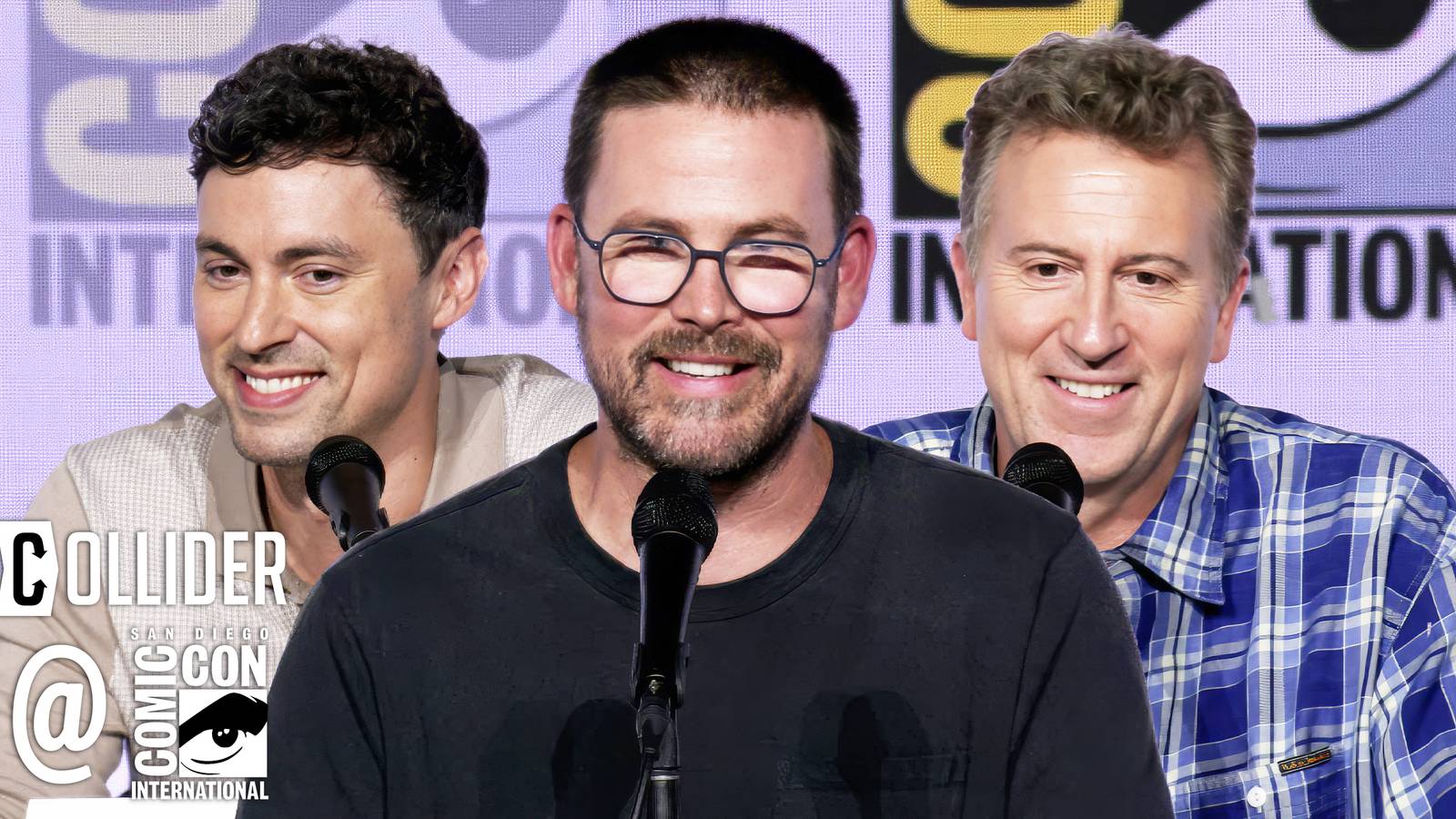
Image via SDCC Published Aug 3, 2026, 11:12 AM EDT Sign in to your Collider account Summary Collider's Steven Weintraub talks with Zach Cregger, Jonathan Goldstein, and John Francis Daley for our Directors on Directing panel at SDCC 2026. The trio chat about moments throughout their careers and the lessons they've learned. They also share exclusive footage and discuss their upcoming projects, Resident Evil and Apple TV's Mayday. When talking about all things movies, who better to hear explain the artistic process and vision that goes into filmmaking than the directors themselves? At a convention filled with major A-listers and signature companies with historic brands, some of the biggest stars at San Diego Comic-Con are Hollywood filmmakers. Three of them, including Barbarian and Weapons' Zach Cregger and the pair of Jonathan Goldstein and John Francis Daley, the duo behind Game Night and Dungeons & Dragons: Honor Among Thieves, participated in the Directors on Directing Panel at SDCC 2026, moderated by Collider's Steven Weintraub. Along with questions from Weintraub, the panel featured star-studded contributor questions by fellow filmmakers such as David Leitch, Phil Lord, Chris Miller, television showrunner and producer Eric Kripke, and actors Jason Statham and Josh Brolin. This action-packed panel was headlined by the reveal of a trailer for Mayday, the new action-comedy by Goldstein and Daley starring Ryan Reynolds and Kenneth Branagh for Apple TV. The writer-director duo also teased their new Star Trek movie, currently in progress. Plus, audience members at the panel witnessed an exclusive new look at Cregger's highly anticipated feature film adaptation of Resident Evil. Here is what the director said about working off such beloved source material. Additionally, Cregger looks back on the filming and massive success of Weapons and discusses his future projects, including a prequel following Amy Madigan's Aunt Gladys from Weapons and a promising original science fiction script. In case things weren't crazy enough, Johnny Depp shows up at the end dressed up as Ebenezer Scrooge to debut the first trailer for his A Christmas Carol adaptation, Ebenezer. Watch the full video or the full transcript below of the Directors on Directing panel to hear Cregger, Goldstein, and Daley talk about important lessons they learned on sets, challenges making their movies, and their professional inspirations. Zach Cregger Was Already Filming 'Resident Evil' Amid the Unprecedented Success of 'Weapons' Cregger also gives an update on the 'Gladys' prequel and his upcoming sci-fi movie. Image via Warner Bros. COLLIDER: If you three were forced by a studio to co-direct a movie together, what would the genre be, and how would you divide the labor? Who takes the action, who takes the scares, and who handles the actors? JONATHAN GOLDSTEIN: I'd say a rom-com. ZACH CREGGER: A rom-com? Yes. I'll take over the scares of said rom-com. GOLDSTEIN: I'll do the emotional scenes. JOHN FRANCIS DALEY: I'll do the crafty. CREGGER: Done! Solved. We did it. Zach, when did you realize Weapons was going to be this huge commercial and critical hit? CREGGER: Oh my God, I don't know. When Weapons came out, I was already in Prague, in the middle of making Resident Evil, and so I just wasn't around for the party. So I was getting some nice texts from people, but when you're in the throes of making a movie, you have one gigantic emergency after another right in front of your face. So, I sort of had to just skip the whole thing. So, it felt like watching people having a good time on the other side of, like, a giant gap. It was just a weird thing, so that realization was kind of creeping in over time after it happened. But it was weird, by the time I came back to America, the fanfare had subsided, and I was like, “Anybody? No?” So, yeah, I don't know. Terrible answer to your question. There was no moment. No, it’s honest. I think a lot of people are curious: What's the status of the Gladys prequel? CREGGER: First of all, I'm really excited about the Gladys movie, and I loved working with Amy [Madigan]. I love that character. For the movie, Weapons, it really made a lot of sense not to dive into her backstory, because the device of Weapons was to keep her very opaque and very mysterious. However, I think there's an amazing story to be told about where Gladys comes from and how she became what we know her as. It's got a lot of twists and turns and mysteries and crazy things, kind of like Weapons does. I think it's going to be great. So, the script is in process now. We're taking it super seriously and it's moving. It's moving in the right direction. So, yeah, it's being written is the short answer. I hate to put you on the spot, but do you think it's something that could be your next project, or is it something that is hopefully in the next project or two? CREGGER: My next project is going to be a science fiction movie called Flood that I wrote. After Barbarian, I wrote Weapons, Flood, and Resident Evil kind of in the same sort of blast. I had a year-and-a-half hiatus between Barbarian and starting Weapons. I didn't know what movie was going to go, and so it ended up being Weapons, and then Resident Evil, and then Flood will be next. Then after that, we will see. John Francis Daley and Jonathan Goldstein Tease Their Upcoming 'Star Trek' Reboot "It'll probably be a little further into the future than we've been before." John and Jonathan, I don't know if everyone's aware, but you guys are currently writing the new Star Trek movie with plans to direct. I know you're not going to tell me much, but what can you say about what's going on with the script and what was it about Star Trek that said, “We're very interested in this?” DALEY: Well, I think we can say the script is in progress and that we're very excited about it. I think people will be surprised. I really can't say anything other than that. GOLDSTEIN: Well, I think we've said in the past, it's been reported, that it won't be the characters that you've seen previously in your Star Trek movies. So there'll be a new sort of take on that, and I think it'll probably be a little further into the future than we've been before. Everything we take on, what draws us to it is the opportunity to do a different spin on something that you've seen done before, and that's our hope with this is to satisfy the fans, but also bring people in who may not consider themselves lovers of Star Trek, and surprise them. You've all reached the point where studios trust you with big movies. If someone is sitting in Hall H today hoping to direct their first feature someday, what's one lesson you wish someone had told you before you stepped onto your first set? CREGGER: Oh, man. I'll jump in because I said “oh, man” right away. For me, I would say make your favorite movie. Don't try and make a movie that you think is going to get you a result or that you think is going to be a stepping stone to your big thing. Make your first movie the thing that you love the most. Make your secret, personal, most favorite thing right away. I made that mistake. I made a movie many years ago that I thought, “If I just do this, then I'll get to have the career I want,” and I didn't respect it enough. It ended up being a really painful lesson. It took me over 12 years before I was able to make another movie. I made a movie that I really cared about, and it had a completely different result. So, I would just say be authentic to your own tastes first and foremost. Don't aim for any other sort of result other than the making of this is the fulfillment that I'm going to get. That would be my advice. GOLDSTEIN: I'll give the opposite answer, just insofar as, of course, you have to love what you're going to spend a year or two or three years working on. It has to be a passion project every time. But also, if it's a movie of any scale, because that's what you asked about, you have to give the people who are giving you the money confidence that you are responsible. It's that simple. Yes, you're an artist, but you're also being handed millions and millions of dollars, and you have to make them feel like, “Alright, I'm going to do it in a way that is responsible.” Those two things, the creative and the business side, can find a home in you without selling out what you believe in. DALEY: I also think that there is a way to get pretty much exactly what you want as a filmmaker out of your film without compromising your integrity, but also keeping people happy and thinking that you are a collaborator. It's kind of a mind trick. It's a little bit of manipulation, I would say. But mostly, I think very often if you're getting notes from a studio or whoever that you don't necessarily agree with, there's a reason why they're giving you that note. There's a note, they call it the note behind the note, and if you can figure out what it is that is bumping for them, because clearly something's bumping, and it doesn't make them wrong, and you right, necessarily, it's being able to figure out what that is without having to change or significantly alter what it is that you're excited about. How Zach Cregger, John Francis Daley, and Jonathan Goldstein Use Comedy to Their Advantage Plus, a special appearance from 'The Boys' creator Eric Kripke As you guys know, if you've been to the director panels before, I like to get some fan questions. This first fan question comes from someone named Eric. ERIC KRIPKE: Hey, Comic-Con, I'm Eric Kripke, showrunner of The Boys and Supernatural, and I have a question for the three directors. You all have your backgrounds in comedy, and you all bring so much humor to your work. I'm curious how you balance that tone. What are the rules you use when you're writing and when you're directing to have something be sometimes very scary or exciting, but also quite funny? GOLDSTEIN: For John and myself, we have kind of hard and fast rules that the bad guys, maybe they make you laugh occasionally, but they shouldn't be funny in and of themselves. The world of danger has to be real and scary so that the stakes for the characters who are funny feel scary and that the audience cares about them in advance. Because as soon as your bad guys start being really funny… DALEY: Or goofy, right? Because they think they can be funny. I’m just going to disagree with him right here on stage. GOLDSTEIN: I spoke for you, though. DALEY: [Laughs] I think it's the goofiness, right? You don't want to feel like they don't have a level of gravitas behind whatever it is that they are doing that's sinister. But I also feel like there is a way, in the same way that you're juggling humor with horror, with thrills, all of it's kind of coming from the same place. It's evoking a very visceral reaction, and I think that you can only get out of shooting it and then watching it, and watching other people watch it. If you get that emotional reaction that you're looking for, whether it's a laugh or a jump scare, or making them cry, it's all kind of the same language that you're speaking. CREGGER: I don't know if I have this one cornered. I feel like I'm still trying to figure out how to weigh that ratio between funny and scary, or serious, or whatever it is. I think I've often been accused of leaning too funny or goofy, and I think that's a fair accusation. What I always do is I kind of let all the jokes in when I'm writing or when I'm shooting, and then in the edit, I do my best to chop them out as much as possible, and what's left over is my final product. So, I don't know, I just tend to go with my gut and hope. Then, I'm a big believer of testing. We were talking about this backstage. I like to show my movies to an audience because that is the surest way for me to figure out if I'm right or wrong about whether something is funny. If people don’t laugh, it's not funny, no matter how convinced I am that it works. Like, if the room doesn't laugh, I am wrong and they are right. You can't argue with it. So, I like to take advantage of that. GOLDSTEIN: Yeah, and I think you're a master of that. Because the thing that makes a joke work or the thing that makes a scare work is the same. It's surprise. It's leading the audience to expect one thing and then turning it on them. I think that's the DNA. CREGGER: Somebody told me once, I was in college, and I was taking a comedy writing class, and my professor said, “Everything you've ever found funny follows the exact same equation, which is an action with an expected outcome yields an unexpected result.” And I spent a lot of time trying to think of an example that would prove him wrong. That was over 20 years ago, and I have never been able to think of one thing that is funny that violates that rule. If anyone here can think of one, please come find me and tell me what the fuck it is. You're all movie fans. If you could shadow one director for one day at the peak of their career, who would it be? DALEY: Oh, man. Spielberg. He's the reason why I got into this. I think that his ability to speak, truly, to all audiences is a magic trick. There's something so artful in what he does, and yet it's also so commercial. You can just see all of the stuff that I drew inspiration from in him in our work, because I can't help myself. GOLDSTEIN: I'd say Billy Wilder between 1950 and 1960. You think about that run from Sunset Boulevard to The Apartment and Stalag 17, and how many movies he did in that time, and how many different tones there are, and how he balanced that. That's one of the hardest things for a director to do is to achieve the tone that you need to do for a complex movie like The Apartment, which is tragic and funny at the same time. CREGGER: God, that’s such a good question. I'm going to come up with a better answer as soon as I leave, but I think that what comes to mind would be, probably, Stanley Kubrick when he was… God, any movie, but maybe Barry Lyndon, just to see him tackle something that feels so impossibly… I don't know, that just seems like such a daunting movie to make. And not just because he makes amazing things, but the more I read about him, the more I realize how bizarre his process seems by the standards that we've all kind of entrenched ourselves in. He had just such a different process of working and thinking, and I'd love to be a fly on the wall there. Also, Barry Lyndon, if people don't realize, there's so much shot with candlelight, which was unheard of at the time, using these like NASA lenses. It's crazy. Jason Statham and David Leitch Ask the Panel About Their Toughest Sequences To Film "The fact that it worked was miraculous to us." Image via PA Images/INSTARimages We have another fan question. This one is from David, and he is directing what will be the best title of 2027. I'm calling it now. DAVID LEITCH: Hello, Comic-Con. David Leitch here from the set of Jason Statham Stole My Bike, in Malta. My question for the panel is in regard to early screenings. We've all shown our work to friends and colleagues. Film is such a collaborative art form. You can see here we have 300 people helping us shoot the film. But in post, is there anyone who helped you rethink a sequence or a scene that made it so much better that you’ve gotta give them a shout-out? CREGGER: When I was doing Weapons, I was very fortunate to be able to show the movie to David Fincher and have him sit with me and talk about a lot of different scenes. One of the lessons I learned from him was, first, stabilize everything — don't shoot in anamorphic, shoot in spherical, stabilized, which I learned that kind of the hard way. But another one was he taught me a lot about audio. There's a scene in Weapons where — he kind of blew my mind with this one — Julia Garner's getting out of a car, and she's walking from the car to her house, and we're focused on her. Then, she looks to her left, and we rack focus down the block because she's worried someone's going to be attacking her, and then we rack back to her, and we kind of follow her to the house. Dave's idea was: Rack the audio, don't just rack the visual. We had all these cicadas in the street, and so when we rack to the distance, we drop down a certain frequency of cicadas, and we turned up a distant, more verbed, slightly different tone of cicada, and it suddenly had this incredible effect of, for me, just making me feel like I was really, really there. It was such a simple tool, and it just taught me you're never done. When you're in the edit, there's always more to explore, and there are so many more tools at your disposal than I was even letting myself think about using. So, it helped me. The lesson I got from that was to take every scene that you think you're done with, and then just keep going, just keep pushing and keep exploring. That was a lesson I learned. DALEY: It's so weird that you say cicadas because my answer was exactly the same subject. In Game Night, every time we showed Jesse Plemons, we used cicadas as his soundtrack to create this sense of unease. CREGGER: That's great. DALEY: It came from our editor, Jamie Gross, who's fantastic and has done some of your favorite comedies, but also can tap into thriller and heart, and everything. She was the one that was like, “I don't think we should do a score for this. I think we should maybe have a sound effect of some sort.” We were trying things. We were trying a sprinkler system. We were trying all sorts of things, and cicadas became our sort of soundtrack for him. GOLDSTEIN: I was thinking the same thing when you said cicadas. DALEY: It's so weird. GOLDSTEIN: It’s all about cicadas. CREGGER: They're great. GOLDSTEIN: Put cicadas in your movies. We have another video question. This one is from a fan named Jason. JASON STATHAM: Jason Statham here. Hello, Comic-Con. I've got a question for the directors. Which sequence in any of your movies was the hardest to pull off and why? GOLDSTEIN: One of the most complex was in our Dungeons & Dragons movie. It involved using this portal staff to create a portal on a framed painting, which then they tried to get through to get into a carriage to steal something. Basically, it played out over, we had, I think, four different locations, two on stage, two out in the world, and nobody really knew what the hell we were doing except us. Somehow, we had to explain it to a hundred different people of what was going on because you would look through something, but it wasn't what should be on the other side of it, it should be what you see out of the thing, and it was just incredibly complicated. And the fact that it worked was miraculous to us. DALEY: The fact that you were even able to explain it… GOLDSTEIN: I didn't explain it well. Do we have a clip? Can we get a clip? That would have required prior planning. DALEY: I would say the other thing was the egg chase in our Game Night movie, which was a oner that was actually stitched together from eight shots, and a lot of the shots we did out of order. So, it was figuring out how to connect the camera in ways that sometimes we were kind of digging ourselves into a hole that we then had to figure out how to climb out of. I just remember that was a very stressful couple of days on set. CREGGER: I feel like I've had a lot, but the most difficult scene for me to make was in Resident Evil. There's a sequence in this movie where Austin [Abrams] is walking down a street — a little bit’s in the trailer — and there are these tall buildings on either side of him, and he looks up and sees this zombie on top of this building. The zombie jumps at him and just explodes on this bus stop and just dies. And he's like, “What was that about?” Then, he keeps walking, and then he hears another sound, looks up, and there's a bunch of zombies up there, and he starts running, and they're looking at him, and he looks over here and there's a bunch of zombies there, and they all start jumping. As he's running, they're just detonating all around him. It's like this really long gauntlet of him leaping over cars and bodies, exploding, and I didn't want to do it with VFX. I'm not afraid to use them, but I wanted to do as many practical detonations as possible because that was going to make it look tangible and real. So, what we did is we had to set up all these cranes and string all these 150-pound human sacks that were loaded with liquid blood, and dress the street with snow, and get the timing right. So all these things had to happen together. Austin had to run at a consistent speed. We had to have a camera truck follow him really close, and if he'd tripped, they would have run him over and killed him. And we had to time the dropping of these bodies, which are like six storeys up, and so that is a long drop, and these things are 150 pounds, and they're landing next to him and exploding, so we have to make sure, like, hopefully they don't coat the camera, which they did on many takes, or hopefully they don't kill my star — which, one of them dropped too soon, and it's in the movie. It goes like an inch from his head. If he'd been an inch to the right, he would have definitely died. I think it paid off. It's awesome because we got all these things, and I would do it 20 more times if I had to. So, it's cool! And then, we did end up supplementing some of the explosions with some VFX, but to do it practical, to get the real physics and see how everything really worked, made it so much better. So, it was dangerous. It took days, and it took a ton of rehearsal and planning, but I think it paid off. I'm really proud of that sequence. John Francis Daley and Jonathan Goldstein Break Down Working as a Directing Duo 'Project Hail Mary's Phil Lord and Chris Miller are looking for "pointers." Image via Warner Bros. We have some Resident Evil stuff coming up. We're just not there yet. I promise it's good. The next one is a fan question from two people. PHIL LORD: Hello, Comic-Con! I'm Phil Lord. CHRIS MILLER: I'm Chris Miller. This is a question for our pals, Goldstein and Daley. LORD: Whom we love. Hello, gentlemen. We have a question, which is: What's it like being a director duo? MILLER: How does that work exactly? LORD: Do you call action, like, do you take turns, or do you do it at the same time? MILLER: Or one says, “Ac,” and the other says, “Tion?” LORD: That's how we do it. We were just looking for any pointers. Like, when you give notes to an actor, we try to do, like, a sandwich maneuver, where one's on either side. MILLER: One says one thing and the other one says the opposite thing. LORD: And we let them figure it out. What's your technique? Also, what happens when one of you is right, and the other one is wrong? And then how do you get Chris to admit it? Don't make that face… MILLER: Thanks for your time. CREGGER: Those guys are delightful! DALEY: They are delightful. They're delightful. GOLDSTEIN: We do every other day. No, we don't. That wouldn’t work. Well, we let our ADs say action. That's the answer to that question. Because that would be weird if we were both trying to say it together. DALEY: We haven't tried it. I mean, we should. GOLDSTEIN: We could harmonize. DALEY: If we disagree on things, usually it's kind of a fun thing because we're able to then try it a couple different ways. I mean, most of our disagreements honestly come when we're writing. It's never fights, but it's always just kind of putting the other one in check. Smacking back, clapping back. GOLDSTEIN: It definitely helps in dealing with your cast because there are two of us. I don't know how you do one-on-one with an actor because you both have an opinion, but here we always win because it's two to one. CREGGER: That's good. DALEY: We use physical violence to get what we need. GOLDSTEIN: We have this move where I kneel down behind the actor, and John pushes them, and that's embarrassing for them because they always fall. DALEY: And then suddenly they're putty in our hands. They listen to everything we do. GOLDSTEIN: Because they know at any time we could knock them over. No, look, it's a relationship, almost like a marriage, in that we've been doing it for close to 20 years between writing and directing. DALEY: No more sex. GOLDSTEIN: At first there was some, but it's cooled off. So, yeah, that's our answer. CREGGER: A+. Zach Cregger on Navigating Actors to Get the Takes They Want "I want to make sure that we have the same sensibility." Image via Warner Bros. We do have another video question. This one is from someone named Josh. JOSH BROLIN: Zach, it's Josh. A question for you and the rest of the panel is: How do you navigate through different personalities and approaches of actors in order to ensure your vision in the end? If somebody comes in with an idea that's totally left-field from what you hope to see or hope them to do, how do you navigate that in order to still get what you want in the end? CREGGER: Thank you, Josh. I don't think I'm going to have a very satisfying answer for this because that is not something that I've had to really deal with. And I think the reason that hasn't been an issue is because I have a lot of conversations with people before they're cast in the movie, and I want to make sure that we have the same sensibility and that they see the role the way I see it, and that they see the final product we agree upon in advance. When that's the case, when you're working with talented people, you don't tend to get too… I hope I don't get back here in a year and be like, “Dude, I don't know,” after my next move, but so far, I haven't really had to lock horns too hard because I think we're all kind of oriented toward the same North Star. What about you guys? GOLDSTEIN: Well, I think it's always hard because it's like you've been living with the material a lot longer than the actor has. It's a bit like you've been living in a town for two or three years, and this handsome guy shows up, and he's like, “We should move the city hall to this side of town.” You're like, “What the…? This is my town.” But at the same time, I think the job of a director is to be open to the idea that these talented people that you're working with might once in a while have an idea that makes the movie better. That's a hard thing to do, but I think we've gotten to that place over time of sort of accepting that. DALEY: Look, every actor is different, and there's a reason why they're all good at what they do and successful at what they do, so you have to understand that they have this magic in them. Also, the fact that they all speak kind of different languages. It's sort of like the role of a therapist, really, because you're trying to get them to be as comfortable as they possibly can be. I know that wasn't the Kubrick approach. He did the opposite with some actors, and I guess that can work, too. But yeah, as a former actor myself, all I really wanted out of a director was to know that they knew what they wanted. As long as you know what you want as a director, I think they feel that, and it makes the job a lot easier. Zach Cregger's 'Resident Evil' Is a "Love Letter" to the Games "I have been a Resident Evil game fan for a really, really, really long time." Image via Columbia Pictures I think some people here at Comic-Con are big fans of seeing the world premiere of footage. So, I believe, Zach, you have something called Resident Evil. So, what do you want to tell people about the movie? CREGGER: Oh my God. Okay, so I really wanted to make this movie because I have been a Resident Evil game fan for a really, really, really long time. I love 2. I have played the hell out of 4 many, many, many, many times, and I think 7, 8, and 9 are just absolutely fantastic. I love them. I play them a lot. I still play them a lot. So, I went to Constantin, who had the rights, and I was like, “Listen, I have an idea for Resident Evil.” Bear in mind, I haven't seen the movies. I still have yet to see a Resident Evil movie. I only am really concerned with the games. So I went to Constantin. I was like, “I haven't watched the movies. Please don't be upset with me, but what I see in the advertisements for the movies is not what I love about the games.” What I love about the games is the survival horror aspect to them. I like the slow, creeping dread. I like the idea of one person moving on their feet from point A to point B, and they have to enter a gauntlet, and go deeper and deeper and deeper into hell. I like the idea of starting with a pistol, and you have to keep track of how many bullets you have, and then maybe you graduate to the shotgun, and then you get a machine gun. The world just seems hell-bent on destroying you, and you feel like you do not have enough resources to survive this, but you've got to figure out how to make it through. It just feels like there's a movie there that I have yet to see, and I want it so bad. So please let me make it.” They said yes, so that's the movie that I made. Now, what I didn't do is I didn't take a story from the games and turn that into a movie, because I'm not going to do better than the games do. I'm not going to tell Leon's story better than the games tell Leon's story. I feel like it would be kind of a losing endeavor for me to try and redo something that was already done so excellently. So, for me, to pay a love letter to these games is to make a story that feels like the experience I get when I play the games. So, that's my mission statement for this. John Francis Daley and Jonathan Goldstein's 'Mayday' Goes Full Jason Statham "It's a Cold War movie, which you don't see that many of anymore." Image via Apple TV John and Jonathan, I believe you also have a new movie coming out. Please tell people. GOLDSTEIN: Yes. DALEY: We have a movie, too. GOLDSTEIN: Zach, you're not the only one with a movie. DALEY: It's called Mayday, and it stars Ryan Reynolds and Sir Kenneth Branagh. GOLDSTEIN: It's sort of our homage to those wonderful two-hander action comedy movies of the ‘80s and ‘90s. It's also got a bit of Misery in it, for you Kathy Bates fans. The trailer kind of gives you a sense of it, so we'll talk after. What was it about this one that said, “We want to make it?” And also the fact that Sir Kenneth is sort of playing the kick-ass role while Ryan is not. DALEY: I think that was part of it, just kind of subverting what you expect from a Ryan Reynolds movie. And any opportunity to work with Kenneth Branagh, I would say take it because the guy is masterful at everything he does, and turns out he's an action star, too, so that’s pretty cool. GOLDSTEIN: He’s gonna start getting those Jason Statham offers now. It's going to be a whole different career. We're just excited for people to see it and hopefully to catch some of the fun of what we are after here. It's a Cold War movie, which you don't see that many of anymore. It's a little bit of a backdoor way into talking about things that are going on in our world now where we're kind of very divided, and this was a time where we were equally divided. So, we hope to have something to say about national identity and all of that. Can each of you describe a single shot you're especially proud of, not because it was expensive, but because it perfectly captured what you wanted the audience to feel? CREGGER: For me, there was a moment when I was shooting in Weapons. There was a scene with Amy Madigan sitting across the dining room table from little Cary Christopher, and the parents are stabbing themselves in the face, and then Amy basically has a little monologue where she threatens him. It's just a really simple thing. It's a locked-off shot. I shot on a long lens on her face, and just watching Amy take what I had written and then just elevate it to such an amazing degree, I remember I was kind of tearing up, sitting there watching her on the monitor. I was just thinking, “This is so much better than I could have hoped.” That was a moment of immense pride for me. So yeah, that's the shot that comes to my mind. DALEY: Well, in Mayday, which you guys haven't seen yet, so this won't mean much… GOLDSTEIN: Just remember this. DALEY: There's a shot about halfway in where we have these two characters that are kind of learning more about one another and learning that they aren't exactly what they appeared to be at first blush. There's a moment where it seems like Kenneth Branagh has kind of lost a little bit of faith in Ryan's character because he isn't this sort of movie trope of a Top Gun pilot who's super debonair and confident. He's just kind of at the mercy of Kenneth and the Soviet Union wilderness. He does something that is truly selfless, and Kenneth kind of looks at him, regards him. It was just a push-in on Kenneth, and at the time when we were shooting it, it was nearly magic hour, and the sun just kind of started peeking out from behind the clouds, and it just felt like one of those weird movie gods moments where it worked in a way that was very exciting. Zach, you told me in an interview something that I found so fascinating, which was how you will go to set before you're going to be shooting, with your camera person and people, and figure out all your shots in the location so when you get to set they’re sort of figured out, or am I misquoting you? CREGGER: No, that's it. In Barbarian and Weapons, my process was photoboarding, so I'd go with my DP, and you have to go with as many actors or stand-in bodies as are going to be actors in the scene, and we would go. On your phone, there are these apps, Artemis and Cadrage, and all these others. Basically, you can approximate the lenses, so that's the time when there's no producer tapping their watch, and there's no one stand around thinking, “This guy doesn't know what he's doing,” to just take all the time you want, figure out what would be cool, kind of cut the movie together in your head, pick the lenses, come up with a plan that you love in a no-pressure environment where it can be fun. Then, what I do on set is I have a big poster board, and I take every shot with the lens and everything, and I have it up on the board so the whole crew knows we’ve got this many shots. This is what we're going to see in every single shot. And I get to save my brainpower for putting out whatever unexpected emergency comes up on the day, and I'm not spending any bandwidth on, like, “Oh, would it be better here or here?” I've already had that sort of thing. Now, you have to be ready to pivot when an actor has a better idea, or something happens, and you lose time. You have to combine shots — happens all the time. But it's great to have a plan that was constructed out of fun and not constructed out of pressure. GOLDSTEIN: We do something similar because there are two of us. We have to be on the same page before we get to the set or location, and so we get the blueprints for every location, everything we're going to be shooting, and we sit there with it, and we figure out what's the blocking going to be, where are the camera's going to be, and how do we want to break this all down. Because I think it'd be much harder for the two of us to show up on the day and just sort of wing it. So, we're big fans of shot listing, as well, and putting it all on paper. DALEY: Just got to add to that, blocking is incredibly important to us and also something that you either have it all planned out and then you get there on the day, and like Zach said, the actor has a better idea of how to do it, and then it's a matter of having all of these ideas in your head, but also be willing to just throw it all out and try something new. But for whatever reason, having the plan gives you the confidence to be able to try new things and throw the plan out, if that makes sense. What was the last thing you cut from a movie, like a deleted scene, that you just were heartbroken to cut out, for whatever reason? CREGGER: I cut some scenes out of Weapons, but they needed to go. They just didn't move the story, so it was painless. It was like, “Oh, that didn't serve what I thought it was going to do. Out.” I wish I'd cut them before I shot them. In Barbarian, I cut a scene where the mother chews up a rat and forces Justin Long to eat it out of her mouth. GOLDSTEIN: You cut that? CREGGER: I cut it not because I wanted to. It was a bummer, because Justin had to eat stuff out of that guy's mouth, so he was also bummed. And in Resident Evil, there is nothing because that movie is 90 minutes, and if I cut any more out of it, I would be sued. Before you answer, with Resident Evil, I have not seen the movie, but I heard it's basically nonstop from the moment it starts to the moment it stops. CREGGER: Basically, what happens is, in the trailer, you see he hits this woman, and then that's the first domino. Then, my other movies, narratively, kind of fold back on themselves or have little gimmicks or tricks or whatever, and I wanted to just see if I could tell a straightforward story that was almost in real time. About five or six minutes in, he hits that woman in his car, and I wanted to see if I could just put my foot all the way down on the gas pedal and not let up until the end of the movie. That was the challenge, was like, can I just be completely unrelenting? So, you guys will tell me if that's the case, but that was the challenge. GOLDSTEIN: I would just quickly say, there's not much that we've cut that I wake up in the middle of the night wishing we had kept in. It was actually Chris and Phil who gave us a good piece of advice very early on in our career, which was if you cut the B jokes out, the A jokes will sing even more. You have to, I say “kill your babies,” which is a disgusting metaphor, but it is what you have to do as a director. CREGGER: That is such good advice. Cut the B jokes. Yeah, I love that. GOLDSTEIN: Agreed Johnny Depp Makes a Surprise Appearance at Hall H To Debut the Trailer for 'Ebenezer' The new take on 'A Christmas Carol' also stars Daisy Ridley. Paramount. Before Collider's Directors on Directing panel came to a close, Johnny Depp arrived on stage in full costume to address the crowd in character as Ebenezer Scrooge. After briefly addressing the crowd with insults, Depp debuted the first-ever trailer for Ti West's Ebenezer. The bold new take on Charles Dickens' A Christmas Carol promises to tell Scrooge's story like never before. Zach Cregger's Resident Evil premieres in theaters on September 18, 2026, John Francis-Daley and Jonathan Goldstein's Mayday premieres on Apple TV on September 4, 2026, and Johnny Depp's Ebenezer premieres in theaters on November 13, 2026. Stay tuned to Collider for more updates. Release Date September 18, 2026 Director Zach Cregger Writers Shay Hatten, Zach Cregger Producers Asad Qizilbash, Carter Swan, Miri Yoon, Robert Kulzer, Roy Lee Franchise(s) Resident Evil
Zach Cregger, Jonathan Goldstein, and John Francis Daley Tease 'Resident Evil', 'Star Trek', and 'Mayday'
Full Article
Original Source
Read the full article at Collider →KhanList aggregates and links to publicly available news content. We do not host full articles from third-party sources. Always verify important information with original sources.