
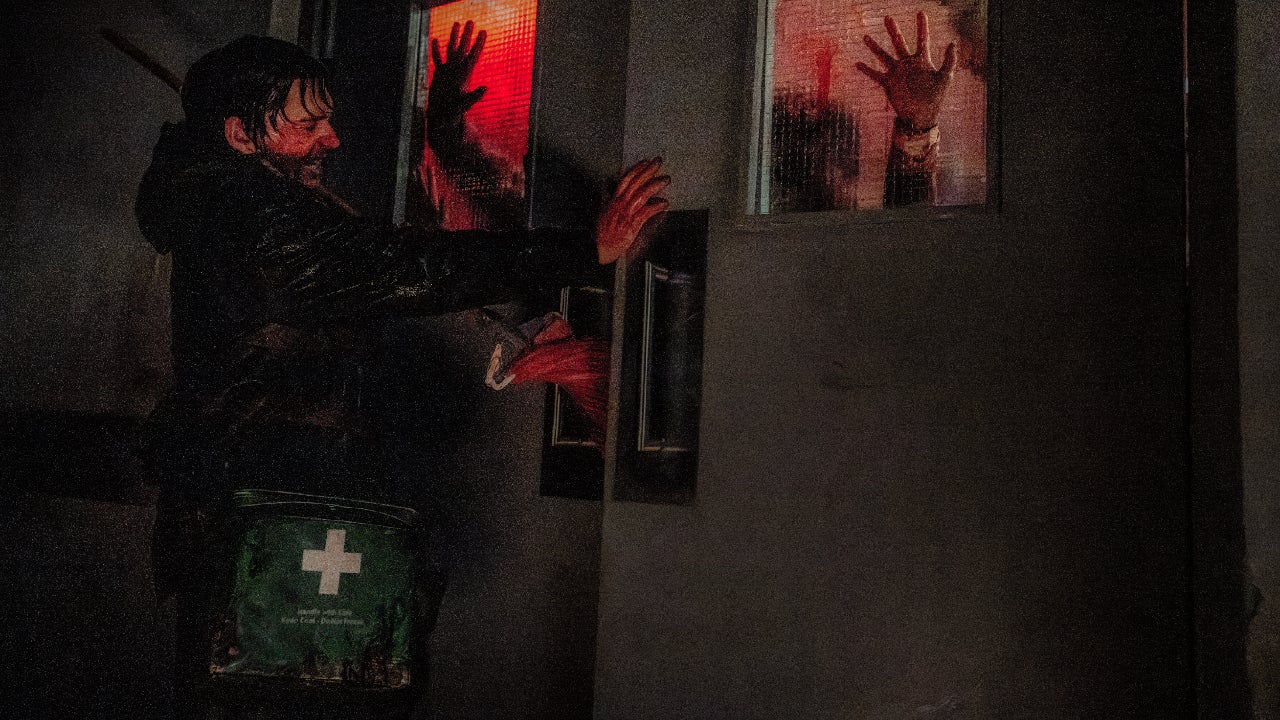
For a zombie apocalypse horror movie based on a genre-defining video game, the ending of Zach Cregger’s “Resident Evil” is actually pretty heartbreaking. And while there is a somber inevitability of where it takes our hero Bryan (Austin Abrams), now is a good time to offer a fair SPOILER ALERT: The following interview with Cregger and his star speaks candidly about that ending and exactly how it was made. Believe it or not, Cregger originally had an entirely different ending filmed and didn’t land on the berserk, gory, violent and, yes, sad conclusion that the critical and box office hit ended up with. The short of it is Bryan finally makes his way with the antidote to the top floor of the hospital, where a group of scientists is waiting for his delivery: a cure to the zombie virus wrecking havoc on their city. Little do they know that Bryan is infected after being bitten on his travels, and he’s increasingly evolving into one of the very beasts that have been tormenting him for the last 80 minutes. Losing control of the beastly tentacles growing off of him — and the chest-sized, fanged mouth devouring every living thing around him through his own torso — Bryan begins gruesomely killing all the scientists just as they’re putting the antidote into its syringe. In a conversation with Collider published over the weekend, Abrams said that it was “really important” for him to keep Bryan’s “humanity there right up until the end,” even while he’s on his killing spree. He’s begging for the antidote as the scientists helplessly meet their fate. It isn’t until the very end when, hanging off the exterior of the hospital, the last scientist succumbs to Bryan and the single vial of the antidote falls to the ground below. Cregger revealed that the scene originally had much less Bryan — his monstrous transformation was hidden in the shadows and fog of the destructed lab — and it showed the antidote getting destroyed in the very beginning of the scientists’ altercation. He realized after the fact that those two beats lost the audience’s emotional investment in their hero’s well-being and turned the end into just an excuse to kill the scientists. The movie that ended up on the big screen, meanwhile, holds out hope until the very end. So how did Cregger do it? “It’s crazy what we did — so we ended up pivoting well after wrap and kind of coming up with a new order of events,” the filmmaker said. “I felt like we weren’t seeing Austin enough in the fog. In the original version it’s just like, once he yanks that lady up into the ceiling, you really don’t see him again until he comes out. And I was like, ‘We miss our guy!’ And so we shot on this stage in L.A. called Scanline, and it’s basically a dome of a thousand cameras that render you in a 3D surface, and so he acted that whole scene out in there, like, where he’s transforming, and then we took that 3D rendering of him and I put the camera in post where I wanted it to be and we were able to build all the stuff coming out of him there. “So all of his monster stuff is just him with, like, a hairnet on in L.A. in Scanline kind of acting all that stuff out and then going in and turning him into the monster. So that was really cool. It’s new technology and it’s pretty great.” OK, so what about the vial of antidote? If Cregger originally filmed the syringe falling from the scientist’s grasp and shattering on the floor, how did he re-film around that moment — which he admitted was a “misstep” — to keep Bryan’s journey going until the last frame? “Thank god I shot for this as a contingency plan. It was, like, my Plan B,” Cregger said. “Originally in the script, that scientist pulls the needle out, and as soon as Austin grabs the woman’s face, he drops it and it shatters. And then the rest of the movie is just Austin killing the scientists. And people were just like, ‘No, it’s over!’ “But I shot that shot of the scientist putting the needle in his pocket just because I had a feeling. I was like, I feel like I’m going to need that,” he continued. “And so then we were able to build a new sequence of the end. And I shot a contingency of him going for the stab in Prague when we were doing our thing as just like, if I need it, I should just get it. And thank god, because that’s what we ended up using. It keeps the stakes all the way until the end. It’s like, ‘Save him! Save him!’ Whereas before it’s just like, ‘Kill them, I guess? Kill them all?’” Coming off its $60 million domestic opening this weekend, “Resident Evil” is now in theaters.
Zach Cregger Explains How He Changed the ‘Resident Evil’ Ending in Editing
Full Article
Original Source
Read the full article at Thewrap →KhanList aggregates and links to publicly available news content. We do not host full articles from third-party sources. Always verify important information with original sources.