
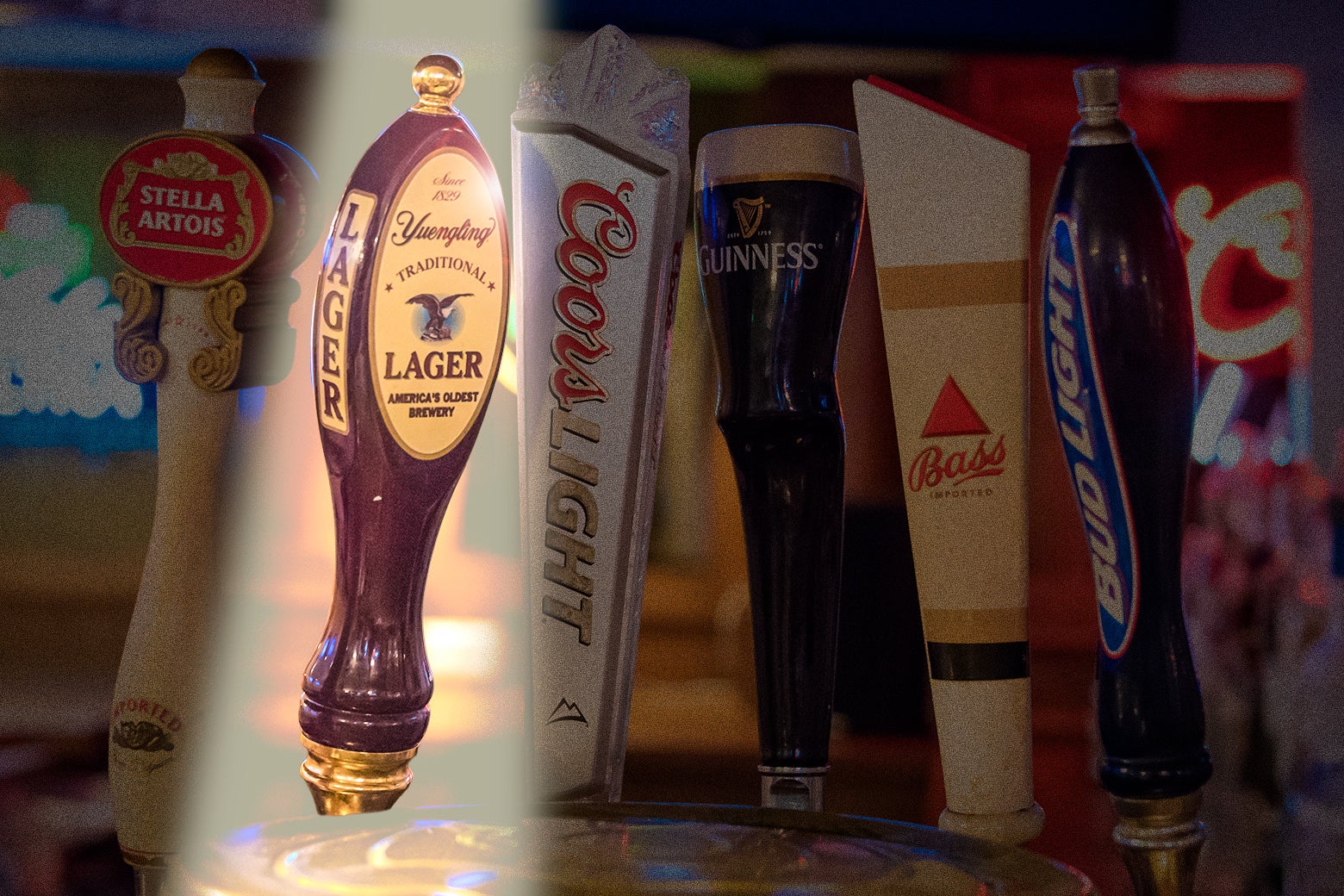
Drink Yuenglingheads Are Finally Getting What They’ve Begged For. It Could Come at a Price. For years, a fervent subculture has grown up around snagging the Pennsylvania brew. What will fans do now? Photo illustration by Slate. Photo by Roberto Machado Noa/LightRocket via Getty Images. Sign up for the Slatest to get the most insightful analysis, criticism, and advice out there, delivered to your inbox daily. In early March 2026, Greg Underwood took to the Facebook group he had created nearly seven years prior and asked his community of around 2,000 Michiganders if it was time for a name change. “Public poll,” he posted, “Should I change the name of this group to #BroughtYuenglingtoMichigan!” Underwood, who had tasted Pennsylvania’s Yuengling lager for the first time in Myrtle Beach, South Carolina, had become a sort of grassroots campaigner, evangelizing and agitating for the brewery to expand distribution of their beer to his home state. As taps in several counties in Michigan began pouring the beer for the first time in August of 2025, Underwood was wondering if his malty mission was finally ready for the past tense. His Facebook group had coalesced around a growing cohort of Midwesterners who enjoyed Yuengling, a lager produced by America’s oldest continuously operating brewery, located in Pennsylvania. The group mostly exchanged snapshots of Yuengling at bars (in other states), bought and sold “Bring Yuengling to Michigan” T-shirts, and tracked indications that the brewery might be taking notice of their shared quest. Underwood and his fellow Michiganders were in good company. Since at least the early 2000s, beer lovers in the Midwest and Northeast have driven across state lines to load up on cases of Yuengling’s signature lager beer because it wasn’t distributed in their states.Similar communities and social media pages asked to bring Yuengling to New England, Texas, and Illinois. The beer combines an accessible price point with a nutty, malty flavor, which positions it as a well-loved alternative to the usual adjunct lagers on draft in bars around the country. But the brewery has long been stuck in its mid-Atlantic market. The Yuengling brewery and its devoted fanbase stand at an interesting crux in American brewing. The brand falls short of the mega-production of mass-market light beers made by the likes of Anheuser-Busch, but far exceeds the local craft breweries that sell from taprooms and local grocers. We might try to shoehorn it into a group with nationally distributed Sierra Nevada Brewing Co. and Boston Beer Co., but Yuengling’s relative lack of distribution accentuates its regional identity. The cult of consumers devoted to its beers is more reminiscent of smaller, regional brands like Narragansett Lager or Genesee Cream Ale, though the Pennsylvania brewery produces much more beer than the makers of these niche Northeastern cans. On top of all this, after six generations, America’s oldest continuously operating brewery remains family-owned. But as the billionaire owner of the brewery passes it down to his four daughters, will its quickening expansion into new states convert the cult classic into a sellout? “Historically, we’ve considered ourselves a regional brewery,” explains Jennifer Yuengling, vice president of operations for D.G. Yuengling & Son, Inc. and a sixth-generation member of the brewing family’s legacy. “We were founded by my great-great-great-grandfather, David G. Yuengling, in 1829, in a small town in Pennsylvania called Pottsville, and we existed at the local level where lots of anthracite coal had been found in the mid-1800s.” Back in the 19th century, Pennsylvania was spotted with regional brewers who served the surging German and Irish immigrant enclaves that settled in the state. Virtually all of these local brewers have succumbed to the tests of time, but Yuengling, which weathered the years of Prohibition by selling ice cream and nonalcoholic “near beer,” remains standing. Part of their secret to success? At times, staying put, at others, marching forward. In actuality, the Yuengling family distributed beer outside of the mid-Atlantic in the past, but much of this is forgotten history. According to a recent German history of the Jüngling family (the German spelling of the anglicized name Yuengling), the current generation’s four-times great-grandfather, Johann Friedrich Jüngling, opened one of the first breweries in the area of the German city of Ludwigsburg at Aldingen Castle (which his father-in-law owned half of) in the early 1800s. His son, David Gottlob Jüngling (more commonly known as D.G.), would emigrate to the United States and launch his own brewery in the then-thriving coal-mining town of Pottsville. By the end of the 19th century, the business also operated breweries in Saratoga, New York; New York City; and in the city of Trail, in British Columbia, Canada, but operations would be pared back by the time it emerged from Prohibition. The brewery delivered a truckload of “Winner Beer” to President Franklin D. Roosevelt in December of 1933, the day Prohibition was repealed. The brewery’s modern upward-and-outward trajectory, though, kicked off when the current fifth-generation owner, Dick Yuengling, purchased the business from his father in 1985. “When he came back into the business in 1985, he had that really diverse background from the logistics and the trucking and the wholesaler relationship side,” Jennifer Yuengling says of her father, who operated a beer wholesaler and distributor in the 1970s. “And he was fortunate he came into the business where we had an amazing brewmaster who has been with us for well over 50 years and they were able to collaborate and formulate some very quality brands, with our traditional lager being the flagship of those.” This lager, for Yuengling, has been the hook that has sunk into the ruddy cheeks of so many of these Facebook-group drinkers. If you walk into a bar most anywhere in Pennsylvania and call for “a lager,” you will be served a Yuengling without delay. It is an uncanny level of loyalty that has begun to awaken the regional brewery from its parochial approach. Dan Holland, another longtime Michigan Yuengling fanatic and member of several Yuengling Facebook communities, recalls the era when he would buy the beer in Ohio, New York, or Pennsylvania on business trips: “If I had to travel for work, if I saw it somewhere, I would buy it.” He remembers, “I would just load it, you know, load a work van up, and just haul it back, seven, eight, nine, 10 cases of beer.” Underwood, too, engaged in this informal interstate commerce of the beer: “When I was buying kegs is when I was buying the most amount of beer. And I was buying full half-barrel kegs in Ohio. If there were specialty beers out there, I was searching for those. Back in the day when they had Chocolate Yuengling, you know—Oktoberfest is always a popular one.” The brewery and the Yuengling family have long been aware of the demand for the product outside of its legitimate distribution network. Press releases announcing new expansion into states often reference the smuggling era and acknowledge the fans who have spent a decade asking for it to arrive. “I would say it really kind of started as a grassroots campaign from the consumer level,” Jennifer Yuengling reflects. “You know, we’ve heard those stories, we’ve heard of them as ‘beer smugglers,’ where they find our products from a contiguous state and then they smuggle trunks full of product back into their own market.” When Dick Yuengling first launched the lager beer, it was available in New York and Boston, but demand outpaced supply so quickly that he had to pull back distribution until a new brewery in Pottsville could be constructed. The family now operates two breweries in Pottsville, Pennsylvania, and a brewery in Tampa, Florida. But expansion comes with its sacrifices. Yuengling’s Pennsylvanian identity becomes increasingly obscured by its pursuit of new markets. “It’s a challenge maintaining how our story and our authenticity resonates with consumers the further we get away from home, right?” Jennifer Yuengling says. “We were historically known as a local coal anthracite brewery, and you get to Michigan or Wisconsin or Texas and, you know, that doesn’t necessarily resonate.” On top of this, the sport in acquiring a rare beer disappears with each new state the brewery expands its distribution to. In 2023, the brewery announced its expansion into Kansas, Missouri, and Oklahoma. In 2025, its beers hit the shelves in Illinois. In 2026, Iowa and beer-loving Wisconsin are seeing Yuengling lager for the first time. All of this, though, has been made possible by a distribution joint venture the brewery entered with brewing giant Molson Coors Beverage Company in 2020. While Yuengling remains family-owned, the mechanism of its continued expansion into the thirsty Midwest states is dependent on a Canadian-American beer conglomerate. For the fans who are finally getting Yuengling lager on draft at their local pub, the wait has been long. But absence can sometimes make the heart grow fonder. “Now it’s lost a little bit of the hunt. But it’s still awesome to see,” Holland tells me of Yuengling’s entrance into the Michigan market. Underwood, for his part, is mostly satisfied: “I can go to the store that’s across the street from my house and buy Yuengling for the house. But some of the nostalgia is a little bit gone because it is here. But I like the accessibility a lot better, I’m not having to drive an hour and a half to get a Yuengling.” Where informal vanloads are being replaced by commercial truckloads, will America’s oldest brewery become a victim of its own success? For its most devout fans, the brewery’s business machinations are actually a manifestation of a decade of grassroots advocacy. “When it did arrive here, me and a few other people that were also supporters here in Michigan, we all met up at a bar and had a drink together, celebrated Yuengling being here in Michigan,” Underwood told me. “I asked people what I should do with the group and if I should disband it, because we basically achieved what we wanted. But people said no, they said just whenever you see a Yuengling or something new, post that, you know, because people are going to care.” Beer Food History Social Media Pennsylvania Drink Michigan
Yuengling Beer’s Devoted Fans Have Wanted One Thing for Years. It May Not Be Everything They Dreamed.
Full Article
Original Source
Read the full article at Slate →KhanList aggregates and links to publicly available news content. We do not host full articles from third-party sources. Always verify important information with original sources.