
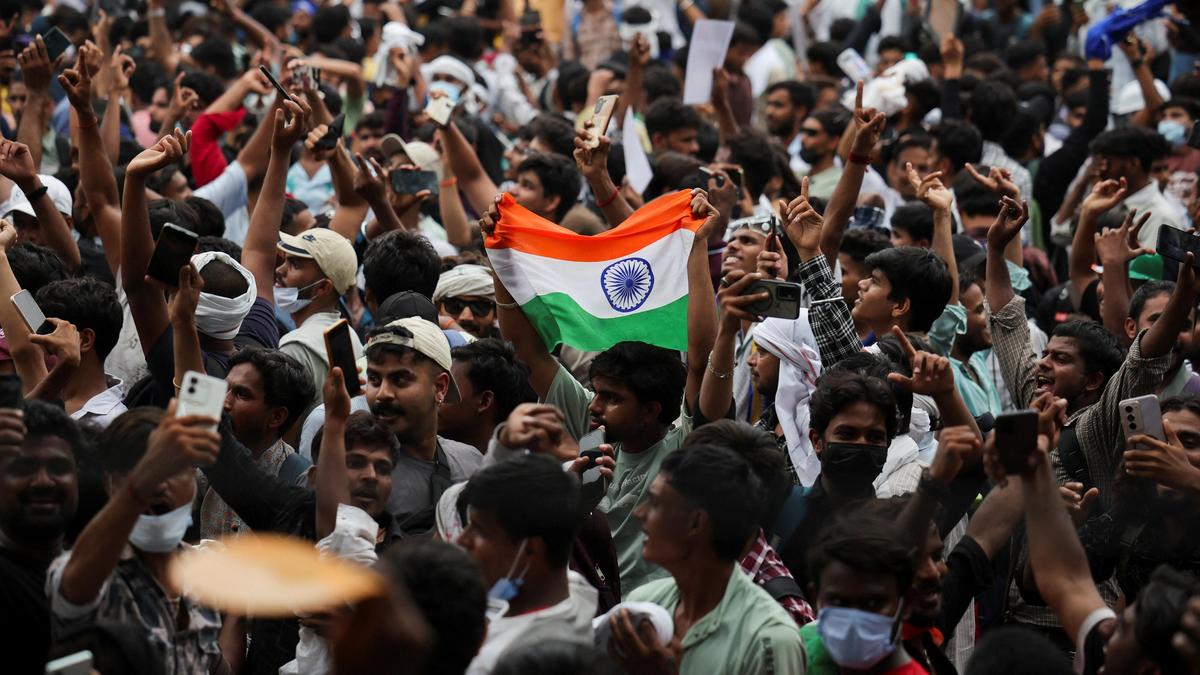
Across the world, India included, new forms of rebellion and revolt by the masses are emerging. Gen Z, in particular, is embracing new forms of protest, in the belief that disruption is essential to destroy an old order that is proving unequal to deal with newer kinds of problems. Anger is, however, the dominant impulse. History has witnessed many authoritarian regimes being overthrown through students’ protests and replaced by democratic forces, but this is not inevitable or necessarily true. There are many variations of Immanuel Kant’s “democratic peace theory” that are available.Nevertheless, safeguarding democracy is a common thread connecting many of today’s protests, some of which have taken on the character of a rebellion against the existing order. Not all protests., however, reach this point, though in India’s neighbourhood, student and youth upheavals in Nepal and Bangladesh resulted in the ouster of long-established regimes. The usual tactic — as seen in Nepal and Bangladesh — is to brand all those rebelling against existing regimes as “foreign agents” or worse, with a pliant media whipping up a frenzy against such elements and labelling them “anti-national” or “traitors”. It is imperative that those who believe in democracy, recognise the tell-tale signs (well in time) before matters get out of hand.Signal of growing discontentUnfortunately, warning signs are seldom heeded by those in authority. Even established democracies are not exempt from this malaise. Often enough, it is the impression rather than the reality that matters, leading to protests. Even as the media and other institutions — which normally act as checks and balances — fail to discharge their responsibilities, today’s Gen Z is beginning to take matters into its own hands to try and achieve results. This is true even of established democracies where recognised political parties and systems do exist. In this sense, unencumbered sovereignty tends to become the proverbial “poisoned chalice”.Recent agitations by the Cockroach Janta Party (CJP), and more specifically the Jantar Mantar “sit-in protest”, are pointers to what could well happen. Their agitation may not quite approach, in size or tenor, the kind of protests seen in Bangladesh and Nepal, but must not, nevertheless, be ignored. The CJP protest was, by far, more spontaneous and less structured than many others, but the pent-up fury among students over the mismanagement of examinations (such as the National Eligibility cum Entrance Test), and the perception of implicit collusion between those in charge and the authorities, was a signal of what could happen and should not be ignored. Protests by students in Jharkhand, Chhattisgarh and Bihar, and the tendency of those in authority to resort to mindless violence to contain such protests, do not augur well, either for the present or for the future.The need for understandingThere are few signs, however, that authorities across the nation have properly comprehended the true nature of recent agitations and the lessons to be learnt from them. What is worse is the tendency of State governments, by and large, to use indiscriminate force against students — force that is meant to be employed against unruly and violent mobs. This could not only prove self-defeating but also have far graver consequences, triggering a backlash against all forms of authority. Already, some individuals in Jharkhand are drawing comparisons between the students’ protests over recruitment irregularities and the “eponymous tribal uprising” led by the legendary Birsa Munda. Comparisons such as these could act as tinder for a serious conflagration when the occasion arises.Today, the availability of digital platforms and social media enhances the reach of protests of every kind, especially when they involve students and youth. The situation in Jharkhand certainly demands careful handling, more so since the agitators have a recognisable leader, Devendranath Mahato, who went on a hunger strike and was subsequently hospitalised. Jharkhand Chief Minister Hemant Soren’s response to the agitation — scrapping the examinations — almost seems like throwing the baby out with the bathwater, reflecting both the anguish and the inability of those in authority to understand the nature of the new kinds of protests.What is even less understood, however, is the true nature of the anger that pervades the minds of young people. Repeated assertions by those in authority that “Naxalism is dead”, for example, are a case in point. Most individuals miss the point that, from its small beginnings, Naxalism grew into a major thorn in India’s flesh. The movement, depicted as “spring thunder over India” in the late 1960s, was transformed from its very small beginnings in Naxalbari (North Bengal) into a grave threat, as Home Minister Amit Shah constantly points out. At one time, large parts of India’s landmass was convulsed by Naxalite violence. Worse, many of India’s best and brightest were inveigled into becoming part of the movement. Not only tribals, but also vast segments of the rural peasantry, the working class, and the intelligentsia were influenced by the malaise of Naxalism. The relevance of this here is that a “single spark” can cause a “prairie fire”. Keeping an eye on protests is, hence, vital, even as other threats, such as pandemics and cyber threats, may increasingly engage the minds of those in authority. Today, the CJP is hardly a political entity or party, but it does signify the anger among the youth, and the movement must not be brushed aside as irrelevant or insignificant. Leading political figures, hence, need to keep their eyes firmly on the ball and take note of the several protests being organised by students and young people across the nation. The recent arc of protests does not necessarily signify an erosion of public trust, for the middle ground of Indian politics remains relatively intact. Nevertheless, failing to recognise the simmering anger among large sections of the youth over aspects of public performance and the quality of governance could be dangerous. It behoves those in authority to ensure that these different forms of protest do not coalesce into a mighty river. The recent reference to “dimagi Naxals”, for example, has the potential to be exploited, leading to yet another round of protests with uncertain outcomes.What is most important at this stage is to prevent any rekindling of the atmosphere of protest that has convulsed the nation in recent months and to determine how best to bring down the surcharged atmosphere that has prevailed for some time. The lull following the CJP’s Delhi protest needs to be sustained and maintained, as there is little room for complacency. Additional protests could coalesce into a far more significant wave of unrest, given the residual anger among young people in different parts of the country. Another round of protests could well target not merely corruption in the educational sphere but develop into a broader movement against authority per se. The warning signs are already clear: the spokesperson for the ‘dimagi Naxals’ is already referring to the CJP as their sibling.The perception of institutional failureA final word. Ragtag parties or not, anger is writ large across the faces of the youth in different corners of the country. There is a widespread belief that deals are being struck at various levels, at the expense of the country’s youth, and that something needs to be done — but those in authority appear to have no answer to this poser. India’s political institutions today give the impression that they have reduced salience in dealing with situations of this kind. Hence, the baton has been taken over by the youth.The growing centralisation of power and authority is aggravating this situation. Rightly or wrongly, many segments of the youth are tending to believe that institutional safeguards are being systematically undermined. They feel there is a need to reset the compass. It behoves every political party, the Opposition, and those in authority to adopt measures that would help stem the sharp decline in faith in the political system among the youth. India’s domestic political scene is, to say the least, possibly entering an era of “variable geometry”, and it is vital that those in charge recognise the signs and deal with the many problems that have surfaced.M.K. Narayanan is a former Director, Intelligence Bureau, a former National Security Adviser, and a former Governor of West Bengal
Youth discontent and the changing face of protest
Full Article
Original Source
Read the full article at Thehindu →KhanList aggregates and links to publicly available news content. We do not host full articles from third-party sources. Always verify important information with original sources.