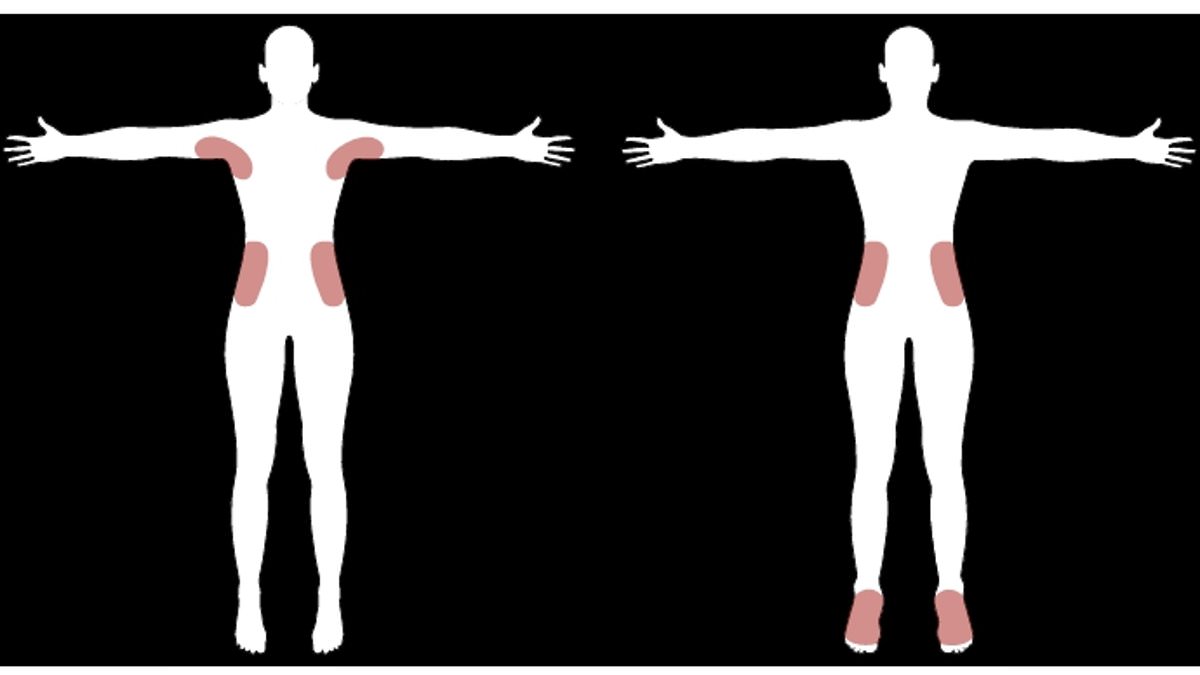
Some find it funny while others say it's torture – but scientists have now confirmed ticklish 'hotspots' are the same around the world.Researchers have discovered that across nations and cultures, people can't bear to be tickled on their necks, armpits, tummies and feet.The findings suggest that ticklishness is distinct from other bodily sensations, such as ordinary touch or pain.And it may be a fundamental aspect of human social interaction – as great apes, our closest living relatives – also take part in the behaviour.'Throughout human history, different theories have been proposed to explain why certain areas of the human body are more ticklish than others,' the team wrote in the journal Nature Human Behaviour.'Using multivariate machine learning techniques, our study revealed a high-resolution bodily map of human ticklishness.'This map was remarkably generalizable across cultures, and identified the armpits, sides of the trunk, and foot soles as the main ticklish 'hotspots' in humans.'The researchers pointed out that all these areas are not frequently touched in day-to-day life, which could explain why people elicit a stronger 'surprise' response to being tickled in these spots. Scientists created this body map showing the most ticklish areas - including the armpits, abdomen and soles of the feet The researchers pointed out that all these areas are not frequently touched in day-to-day life, which could explain why people elicit a stronger 'surprise' response to being tickled in these spotFor the study the scientists, from Radboud University in The Netherlands, recruited nearly 450 participants across three distinct cultural backgrounds – Chinese, Dutch and Greek.Across all groups, 71 per cent rated themselves as moderately to very ticklish, with laughter described as the most common reaction.They were asked to indicate where they were most sensitive, allowing the team to create a 'body map' of ticklishness.'The resulting maps revealed a highly bodily organised representation of ticklishness, with significant clusters emerging on the neck, armpits, abdomen/belly and foot soles for being tickled by family or friends,' they wrote.They discovered that when tickling is initiated by a romantic partner, the groin and inner thigh area is also a tickle hotspot.'The phenomenology of ticklishness as revealed in our study closely mirrors reports in great apes, across both captive and wild settings,' they added.'First, tickling is done using the hands and fingers, targeting areas such as the armpits, soles of the feet, belly and neck and eliciting laughter, just as great apes use their hands to tickle conspecifics (others from the same species) on the exact same areas.' Participants were asked to describe the experience of being tickled. The larger words in this chart indicates the words that were said most frequentlyThey explained that – in humans and great apes alike – tickling behaviours are more often among individuals who share a closer bond.Tickling is also most likely to be carried out by an older individual on a younger 'ticklee'. And finally, the frequency of being tickled decreases from childhood to adulthood.'Taken together, these patterns strongly suggest that tickling behaviours are an evolutionarily rooted trait shared across hominids,' they said.However, they explained the precise function of tickling still remains unclear.A previous study, published in 2024, found that the shrieks induced by tickling really do sound recognisably different to other types of giggles.During a listening experiment, around 200 people were able to identify tickling-induced laughter – with around 60 per cent accuracy – from laughter at a joke, seeing something funny or a humorous mishap befalling someone else.A second listening experiment and AI analysis of 887 YouTube clips revealed ticklish laughter exhibits less vocal control than other types. Participants also rated ticklish laughter as being more involuntary.The researchers, from the University of Amsterdam, said their findings highlight tickling as an evolutionarily ancient play behaviour.
You're having a laugh! Map reveals the tickle HOTSPOTS across the human body that are guaranteed to get you giggling
Full Article
Original Source
Read the full article at Dailymail →KhanList aggregates and links to publicly available news content. We do not host full articles from third-party sources. Always verify important information with original sources.