
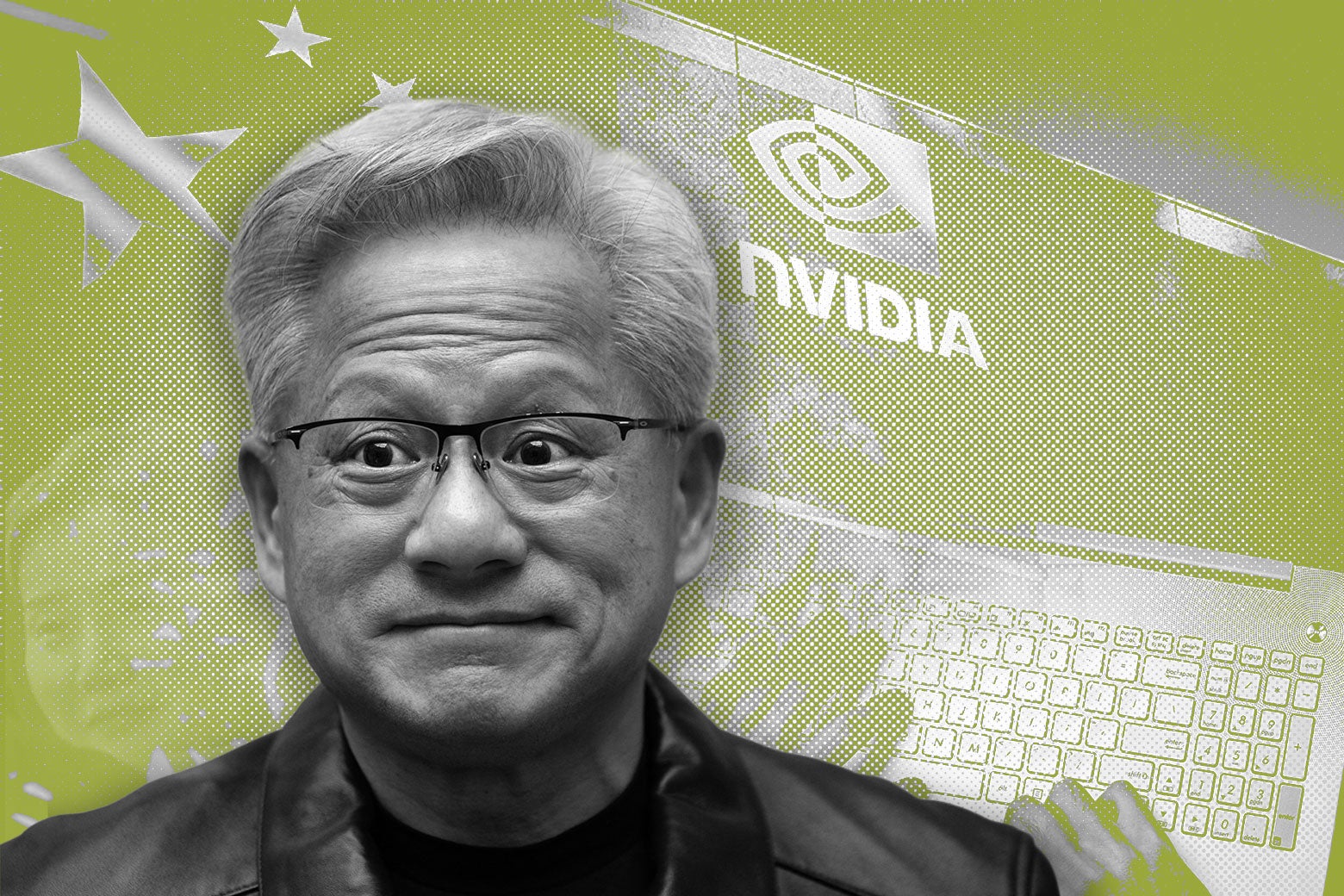
The Industry The Ugly Truth Behind Jensen Huang’s Cheating Scandal Americans were told to accept an A.I. boom at any cost to beat China. Now, the world economy hangs in the balance of one man’s affairs. By Enter your email to receive alerts for this author. Sign in or create an account to better manage your email preferences. Unsubscribe from email alerts Are you sure you want to unsubscribe from email alerts for Nitish Pahwa? Nov 12, 20262:36 PM Photo illustration by Slate. Photos by Joel Saget/AFP via Getty Images, Benjamin Fanjoy/Getty Images, Reuters, and Getty Images Plus. Sign up for the Slatest to get the most insightful analysis, criticism, and advice out there, delivered to your inbox daily. Things went downhill very quickly this week for Nvidia CEO Jensen Huang, one of the eminent figureheads of the global artificial intelligence boom. Not long after his extramarital relationship with a Chinese spy—and the Trump administration’s active cover-up—was publicly revealed, the New York Times reported that Huang had had another affair with one of his direct reports. Mere hours after the news broke, Nvidia’s board of directors convened to figure out what to do about their philanderer in chief; Huang then stepped down Thursday morning, with the board appointing CFO Colette Kress as his interim replacement. Shortly after that switcheroo was made official, Reuters reported that had engaged in yet another tryst with a second Nvidia employee. “Jensen’s contributions to NVIDIA are profound,” the board wrote in its press release. “NVIDIA is one of the most consequential technology companies in the world.” Somehow, those are both remarkable understatements. Jen-Hsun “Jensen” Huang is a Taiwanese immigrant who trained as a microchip engineer during the 1980s personal-computer revolution, then launched Nvidia in 1993 to produce more of the intricate semiconductors that gave Silicon Valley its name; he’s thus inextricable from the highly valued company that’s come to be the most essential hardware vendor of an A.I. age that demands more and better chips by the day. The leather-jacketed Huang has been CEO of Nvidia since the beginning, and he savvily pivoted the corporation’s focus once the generative A.I. boom sped off. His business deals are key for keeping the stock market roaring. His products are so treasured that Huang is now something of a geopolitical kingpin, earning an upfront view of the trade negotiations purportedly intended to maintain the United States’ technological lead over China—and to help his home country, Taiwan, expand the foothold of its all-important Semiconductor Manufacturing Company. It’s nigh impossible to succinctly convey how vital this man has been to the new global arms race, how singularly intertwined his cult of personality is with one of the most powerful corporations of the modern age. (As Huang biographer Stephen Witt put it in a recent Hard Fork interview: “Nvidia is Jensen, to a degree that I’ve almost never seen in any other corporation.”) His misdeeds and resignation aren’t merely alarms as to the fragility of the A.I. bubble. (Look at my plummeting tech stock market, dog.) They’re set to influence the future trajectories of the largest global economies and trade routes. The memes pointing out how an entire sector has relied on one man’s libido are thus closer to the truth—and far more troubling—than they may otherwise appear. Unless you’re an especially nerdy gamer, you may not have known much about Nvidia prior to 2023, when it rode a wave of ChatGPT-era hype to become the ninth publicly traded trillion-dollar corporation in American history (and, subsequently, a bit of a meme stock). Nvidia was first and best known for developing video cards that helped the burgeoning gaming industry incorporate increasingly lifelike, sophisticated graphics that once rudimentary consoles and PCs couldn’t otherwise handle. That positioned Nvidia perfectly for the A.I. wave, as major steps forward in visual autogenerations and rapid-pace text outputs were enabled by the very chips that could keep intensive video games running without overheating. But the A.I. boom proved to be a more formidable beast. The demand for Nvidia’s graphic processing units in particular escalated so quickly that it became an all-around market leader for the broader semiconductor industry, its shortages and production rollbacks and order pileups and supply restrictions becoming indicative of market health as a whole. There was also the China factor. Almost everything about the American A.I. agenda, under Presidents Joe Biden and Donald Trump, has been positioned in opposition to our great-power rival—maintaining competitive advantages in computing power, research, and real-world deployment. Yet Huang, in spite of his Taiwanese origins and business ties with TSMC, never sounded as China-hawkish as his fellow A.I. executives. He’s publicly hedged on the matter of his home state’s sovereignty, he personally traveled to China amid the peak of Trump’s tariff-based trade-warring, and he repeatedly objected to the trade restrictions that both China and the U.S. imposed on the former’s access to Nvidia’s most premium chips. Certainly, Nvidia has long had exposure to the Chinese market, with the People’s Republic accounting for nearly a quarter of the company’s data center revenue as of 2023. There was sheer business interest here, despite Nvidia’s ballooning income from several other countries. But what the spy scandal astoundingly demonstrated is that the Trump administration is not as China-hawkish in practice as in rhetoric. As my colleague Ian Prasad Philbrick noted, the U.S. government already agreed last year to roll back some of the Biden administration’s export controls as Huang lobbied the new president (and donated handsomely to the ballroom). More alarmingly, Trump’s circle knew that Jensen’s paramour Alice Huang (no relation) had connections to Chinese intelligence, yet allowed Nvidia’s CEO to sell chips to her Singaporean company, Megaspeed International. Notably, Nvidia reported early last year that about one-fifth of its all-around revenue hailed from Singapore, then erased those numbers from follow-up statements after the Commerce Department began a probe into Megaspeed—which it wound down after Nvidia asked the feds to lay off. “Once Congress started asking whether a suspected Chinese intelligence asset had access to the CEO, Huang could no longer walk into a meeting with regulators or contracting officers without that question walking in with him,” wrote tech lawyer Eugene Rome in a statement to Slate. “Every license application and contract renewal would have become about him and his relationship with the spy—and any other compromising personal relationships—instead of the company.” What we have here isn’t limited to the matter of an American CEO who let the glory get to his head and began comporting himself as a Casanova. (Many such cases.) The geopolitical deceptions here frankly amount to nothing less than a major rethink of how the global A.I. industry has been operating. The sector-centric saber-rattling with China, sold to the American public as the basis for aggressive data center buildouts and increasingly unwelcome A.I. applications, is revealed to have been kayfabe at best (at least, under the easily flattered Trump). The people of Taiwan, who once had such pride in their countryman’s global success, feel betrayed that even he sold them and their key industry out to the Chinese forces that persistently threaten their autonomy. The nature of our tech trades with an entire region, Southeast Asia, will have to be probed. And, most saliently for you and me: The man who birthed the company that’s made the A.I. rush possible is no longer there, and there’s no clear successor with the same levels of internal knowledge, ability to inspire employees, willingness to flatter Trump, and get Wall Street hyped the heck up. What l’affaire Huang ultimately portends, then, is nothing less than an overhaul of the wholesale A.I. business as we know it, further muddying the future of this economy-propping, job-market-disrupting, politics-exploding realm. No one quite knows where we go from here. The only thing we know: Jensen Huang, the man who once defined this tech revolution as we know it, will no longer be leading that charge. This article has been updated with a mention of Jensen Huang’s alleged third affair with another Nvidia employee. Artificial Intelligence China Economy Foreign Policy Silicon Valley Stock Market Taiwan
You’re Going to Miss Jensen Huang More Than You Think
Full Article
Original Source
Read the full article at Slate →KhanList aggregates and links to publicly available news content. We do not host full articles from third-party sources. Always verify important information with original sources.