
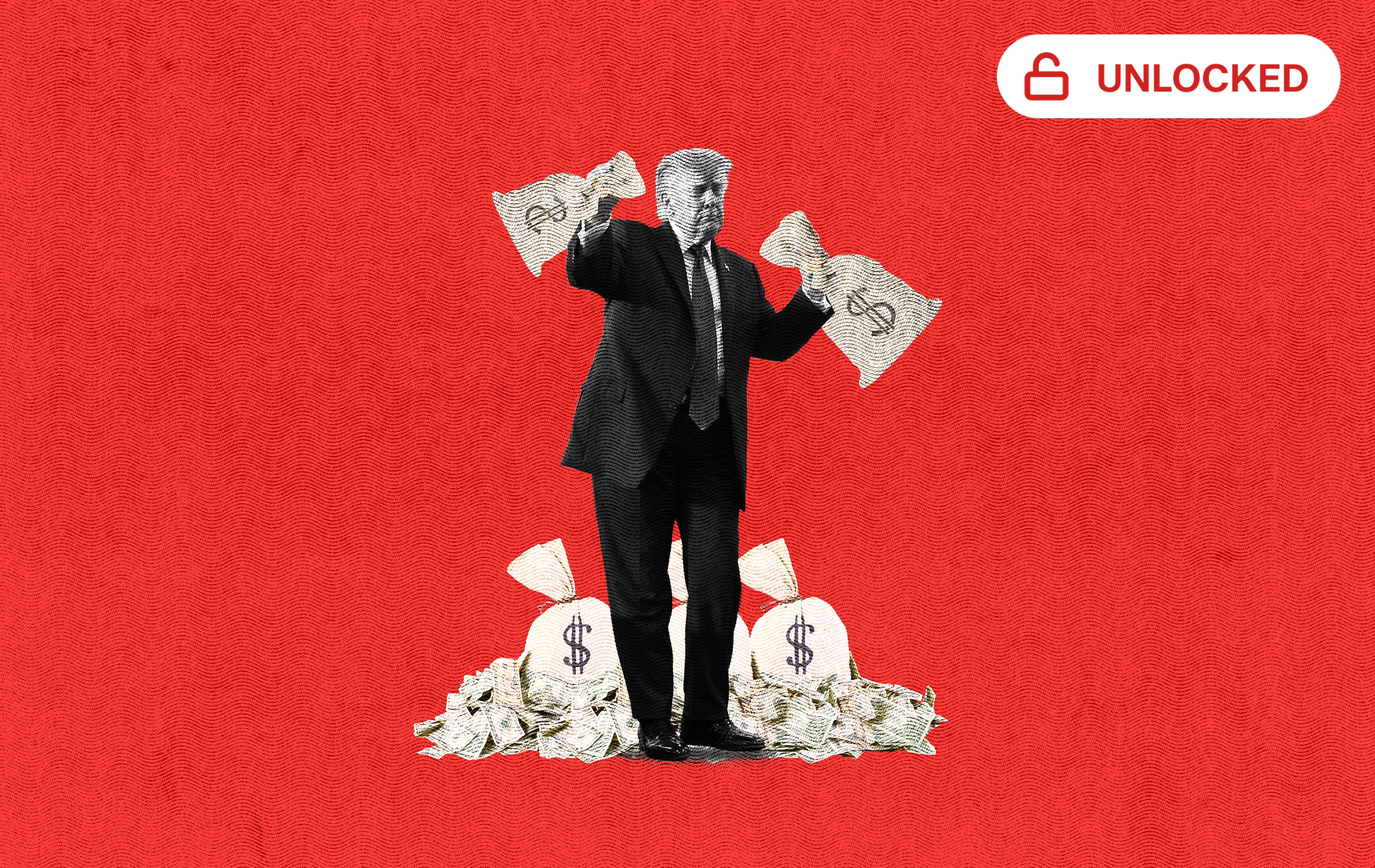
Turn any article into a podcast. Upgrade now to start listening. Members can share articles with friends & family to bypass the paywall. You’re reading Dispatch Markets, a weekly dive into the forces driving economic growth—and those holding it back—featuring Scott Lincicome, Kyla Scanlon, Karl Smith, Marian Tupy, and Adam Ozimek. With the midterms mercifully just a few days away, a spate of bad polls has panicked farm-state Republicans. An October New York Times/Siena survey has President Donald Trump deeply underwater (38 percent approval versus 57 percent disapproval), and Senate races in Trump-voting states with large rural populations (Iowa, Kansas, Nebraska, and more) are suddenly competitive. Among the chief panickers is Trump himself, who’s responded to the numbers in typical fashion—not by reversing the policies that demonstrably hurt these farming communities but by throwing even more taxpayer dollars at them. In just the last two weeks, Trump went to Kansas to announce $8 billion in “Harvest Fuel Relief” to offset record diesel prices, caused in large part by Trump’s ill-fated Iran adventure. Three days later, Vice President J.D. Vance went to Nebraska and unveiled a plan to subsidize U.S. fertilizer production and (somehow) lower fertilizer prices, which both the Iran war and Trump’s tariffs inflated. Both ploys are the latest in a long line of monetary and nonmonetary payoffs to American farmers hurt by Trump’s policies—tens of billions of dollars that haven’t been authorized by Congress, aren’t going to less politically important groups also hurt by these policies, and come atop billions in “normal” government support for U.S. agriculture. “We just got thrown some more election candy,” grumbled Nebraska Farmers Union President John Hansen after hearing Vance’s fertilizer sop. The candy’s costs—fiscal, economic, and political—just keep climbing. Billions and Billions Illustration by Noah Hickey/The Dispatch (Photos via Getty Images). Adding It Up Before we get to the tally, let’s first recall why American farmers are hurting. As I wrote last September, most of this “farmer crisis” was government-grown: Tariffs on inputs and machinery, as well as immigration restrictions and deportation raids, raised their costs; foreign retaliation and closed overseas markets depressed their sales prices; and subsidies and other policies discouraged adjustment. Throw in bad weather and high interest rates, and the result was a predictable mess: costs exceeding sales prices, widespread bankruptcies, and worse. The Iran war exacerbated these problems. Prices of diesel and fertilizer—two inputs of farmers can’t do without—spiked after hostilities began in late February, adding thousands of dollars to their already high monthly expenses. According to the USDA’s September forecast, farmers will spend $5 billion more on fertilizer and $5 billion more on fuel this year, and median farm income is projected to be negative $467 for 2026. As several experts just told the Washington Examiner, the Trump administration never would’ve needed to bail out farmers last week if the tariffs and the war hadn’t started. But here we are, again. Since 2018, the Trump administration has unilaterally directed roughly $46 billion in “emergency” aid to farmers hurt by the president’s own policies. Almost all of it comes via the Commodity Credit Corporation (CCC), which allows the president to spend billions on farm “emergencies” without congressional oversight, and it excludes similarly dubious nonmonetary support for American farmers, pandemic relief, and other farm aid—both emergency and not—appropriated by Congress. Before we get to that other stuff, let’s first document the direct payments: During Trump’s first term, farmers received $23 billion in ad hoc “Market Facilitation Program” funds, plus about $2.3 billion in government food purchases and $0.3 billion in export promotion. All of it was intended to compensate farmers for lower prices and lost export sales caused by foreign retaliation to Trump’s tariffs—especially by the Chinese government. And, just like this time around, the money had a clear electoral motive: The first trade war aid arrived in summer 2018, just a few months before that year’s midterms, and Trump announced roughly $13 billion in CCC aid at a Wisconsin campaign rally in September 2020. Trump’s second term has already added about $20 billion more to the “emergency” tab: $11 billion in “Farmer Bridge Assistance” announced last December, another $1.6 billion for specialty crops, and now the $8 billion for diesel. In each case, the political motivation was again clear—and championed by the administration at midterm campaign rallies across U.S. farm country. In the grand scheme of the federal budget, $46 billion is (unfortunately) little more than a rounding error, but it’s still quite big. The annual budget of NASA, for example, was $24.4 billion this fiscal year, and the CHIP S Act spread out $39 billion in manufacturing incentives over five years. Both were approved by Congress, and each is smaller than Trump’s farm payouts. The $46 billion is also large in terms of who’s paying and who gets paid. Spread out evenly, it’s akin to the government taking $290 from each American taxpayer and then handing about $25,000 to each farm—all financed through borrowing at increasingly high interest rates. In reality, of course, the redistribution is probably even more distasteful, given that farm subsidies are usually concentrated among the largest producers, not struggling family farms. It’s also important to remember that this $46 billion is only what’s been promised so far. Another year of tariff and war pain could increase the totals, and if farmers are still struggling in 2028, there’s no telling how much cash they could see (sigh). Finally, the cash comes atop plenty of other special government support for U.S. agriculture. For starters, the Trump administration has used other unilateral levers to line American farmers’ pockets: The aforementioned fertilizer plant grants, for example, will cost taxpayers more than $573 million to (supposedly) cut farmers’ fertilizer bills. In March, the EPA mandated record biofuel volumes for 2026 and 2027 under the Renewable Fuel Standard, adding an estimated $3 billion to $4 billion a year to U.S. farm income—paid by U.S. refiners and drivers. (Trump just promised Kansas voters even more if they vote Republican next week.) The administration lowered minimum wages that farmers can offer guest workers on H-2A visas, saving them $2.5 billion a year in labor costs. And the White House has exempted various farm inputs—fertilizers, machinery and equipment, packaging materials, etc.—from Trump’s tariffs, while also suspending trade remedy duties on Moroccan phosphate, translating into hundreds of millions of dollars in direct tax savings plus billions more via lower U.S. prices. There’s even more—a Great American Cotton Plan, a USDA/Federal Trade Commission inquiry into farm-equipment competition on October 7, apparel tariff preferences tied to U.S. cotton purchases, etc.—that we can’t quantify. Some of this stuff (e.g., tariff relief) would be good and defensible if applied broadly and offered to everyone, but it isn’t. Instead, it’s a targeted government transfer to U.S. farmers, with clear political strings attached. And, of course, it supplements the usual federal farm subsidies, which have also been rising. As we discussed last year, Republicans’ One Big Beautiful Bill Act gave farmers billions in “disaster” aid and trade promotion subsidies, while also augmenting traditional subsidy programs. The Congressional Budget Office projects that the latter will add roughly $59 billion to the farm subsidy tab over 10 years, and the USDA earlier this month announced record payouts for the 2025 crop year. Put it all together, and government payments to farmers will hit $55.4 billion in 2026—a nominal subsidy record that represents more than 30 percent of net farm income (up from around 8 percent in 2023 and 2024). And well over half of the 2026 government payments will come from “emergency” aid and other ad hoc funds—$20.6 billion from Trump and $13.9 billion more from Congress—instead of standard subsidy and conservation programs. Government checks aren’t topping up a healthy farm sector, so much as propping up a weaker one—made that way by U.S. government policy. The costs and consequences. None of this means that some American farmers aren’t struggling. Market income is down (see chart below). Bankruptcy filings are rising, and farm debt has topped $600 billion. Many of the people receiving “emergency” government support have legitimate gripes with that same government—one that raised their costs and cut their exports by billions of dollars each way. Yet the $46 billion remains a terrible idea for a host of reasons. At the most basic level, the payments aren’t calibrated to match actual losses incurred. (They’re instead tied to acres and production, which is why the biggest operations collect the most.) And, of course, they ignore the millions of other Americans—businesses and consumers—who generate far more economic output than farming and are also suffering from higher costs, lost jobs, and other pains caused by the very same White House policies the farm payments offset. The only difference is that they (we) don’t matter as much politically. Yet the problems here run much deeper. First, this is a textbook case of the “policy quicksand” I warned about earlier this month—and likely to encourage more bad policy in the future. Instead of fixing the first-term trade policies that caused American farmers’ pain in 2018-19, the administration bought farmers off. That papered over the damage from the trade policies and removed the political pressure to reverse them, thus encouraging Trump to go even further on tariffs this time around (and add in a war for good measure). Any accounting of Trump’s tariffs must consider these costs and risks along with the more visible ones (new taxes, higher prices, etc.). The ad hoc support also helped entrench new demands for even more government sugar this time around. Farm groups are already lobbying to make expanded ethanol (E15) waivers permanent after five straight years of “temporary” ones, and we’re now on to round three of the supposedly temporary “bridge payments” the trade wars started eight years ago. Since Trump has shown little interest in ending the harmful policies that got us into this mess, we should expect the next round of “temporary” relief to already be in the works. Second, this situation is yet another indictment of congressional inaction, especially by Republicans. The main vehicle for Trump’s farmer payoffs is the CCC, which today functions as an open-ended slush fund for presidential farm supports. As the American Enterprise Institute’s Joshua Sewell documents, abuse of the CCC certainly didn’t start with Trump 1.0, and Biden abused it too. Trump, in typical fashion, has used the law more aggressively and expansively than any other president. Yet Congress has done nothing to stop him, despite several Republican bills proposed to do that very thing. (Sens. Chuck Grassley, Roger Marshall, and Mike Braun, for example, introduced a bill in 2023 to curb the account, but the proposals died with the 2024 farm bill.) Once Trump returned to the White House, revised farm bill text dropped the CCC limit Senate Republicans once backed, and now—naturally—they’re eyeing a different statute to let more farm aid flow. Sheesh. Third, these government supports should raise serious questions about the long-term stability of the U.S. farm economy and its increasing dependence on government rather than markets. Federal payments are now more than 30 percent of net farm income, and this troubling figure excludes billions more in other, non-cash government supports like biofuels blending mandates. Yet this imbalance makes no good sense: American agriculture is among the most productive in the world, and, as we’ve discussed before, subsidies distort business decisions and markets in numerous harmful ways, while encouraging more dependency (and payoffs). Subsidies inflate land and equipment prices, encourage certain crops and unsustainable planting, favor the biggest operators over smaller ones, and teach every farmer to focus on the next government payment instead of the next harvest. Political payoffs only add to the problem. Finally, there’s a bigger, broader red flag here for fans of the Senate and the Electoral College (a group to which I belong). Critics of this system have long argued that it gives small, mostly rural states disproportionate influence over presidential elections and federal policy. There are solid counterarguments to these claims, but they’re weakened when a single president can quickly and unilaterally direct tens of billions of taxpayer dollars toward those states (about $25,000 per farm!) and billions more in indirect support, to paper over his own policy failings and sway a national election (and maybe control of the legislative branch). The Senate and the Electoral College are defensible as constraints on majority rule and regional power imbalances. They’re much harder to defend when, thanks to unbridled taxpayer cash and small populations, they become a delivery system for partisan rule. Next week we’ll learn if they have. Chart of the Week Worth Your Time Disclaimer: The opinions expressed above do not necessarily reflect those of the presenting sponsor. Want to see more of The Dispatch in Google search? Add Us as a Preferred Source Scott Lincicome is an author of the Dispatch Markets newsletter, vice president of general economics and trade at the Cato Institute, and a visiting lecturer at Duke University Law School. He wrote the Capitolism newsletter at The Dispatch from 2020 through 2026.
You’re Buying American Farmers a LOT of ‘Election Candy’
Full Article
Original Source
Read the full article at Thedispatch →KhanList aggregates and links to publicly available news content. We do not host full articles from third-party sources. Always verify important information with original sources.