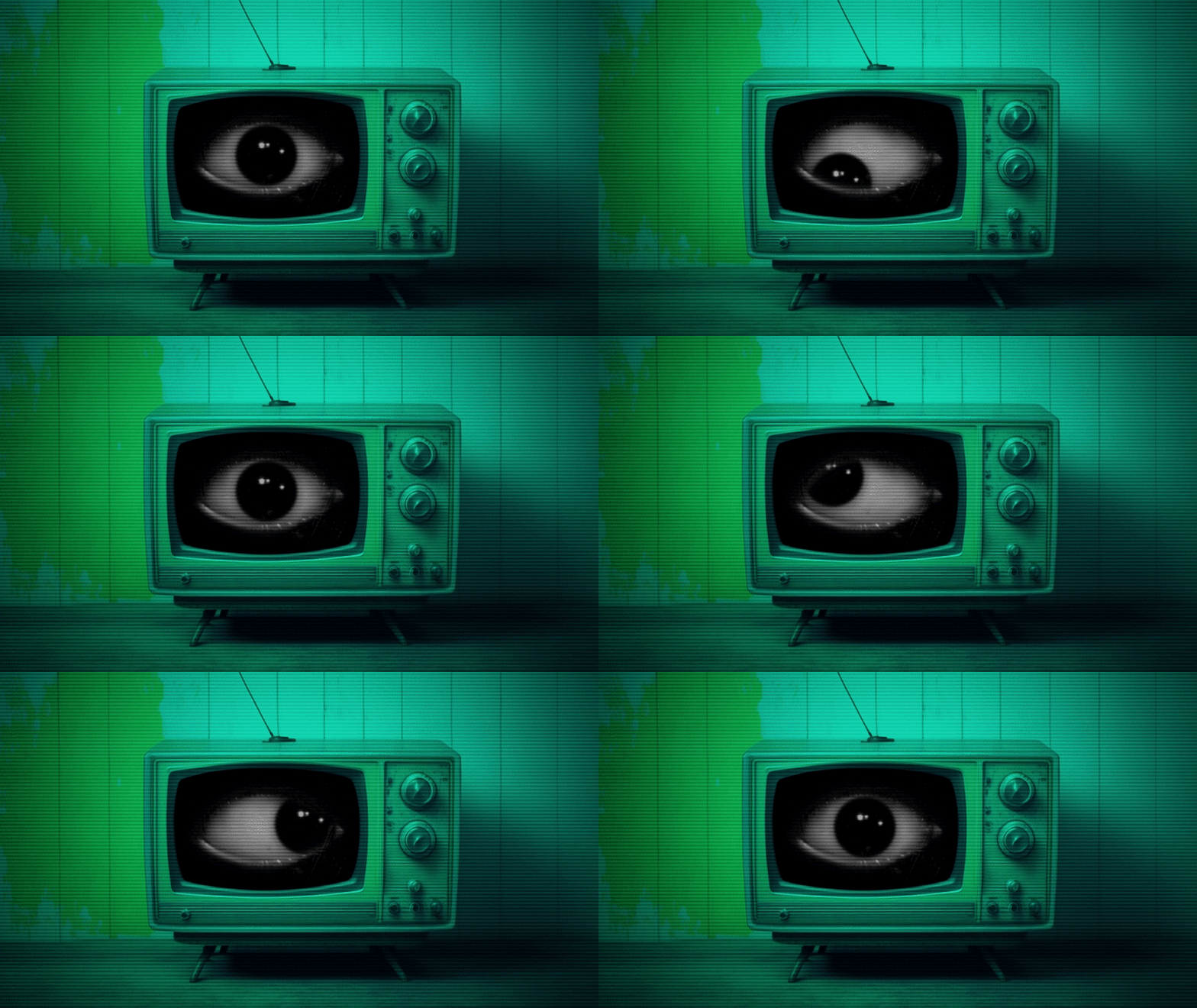
Television prices have plummeted due to hidden tech that harvests lucrative user data by analysing everything watched onscreen, privacy experts warn, with some models now sold at a loss by manufacturers pivoting to make money from customers’ data.Once a significant purchase of up to $10,000, flat-screen prices have dropped dramatically. Most brands now offer a 50-inch 4K set within the $500-$700 range, while even cutting-edge models nearing 100-inches are more affordable.TVs have become far cheaper in recent decades, but experts say that’s come at a cost – our privacyStephen KiprillisAccording to Australian Bureau of Statistics (ABS) data prepared for this masthead, TV prices have dropped steeply over the past decade, down 73 per cent between June 2016 and June 2026 - interrupted only by a 2022 Covid supply-chain blip – despite steady economy-wide inflation of 32 per cent over the same period.This means a $2000 TV in 2016 now costs just $537, despite $2000 in 2016 terms having a purchasing power of about $2632 in today’s money. Some of that is due to advances in manufacturing.However, this affordability relies on secret operating system technology that Swinburne University digital media professor Ramon Lobato calls “basically a form of spyware.”“We expect our viewing to be private, but TV is now becoming part of a larger digital ad-tech system,” Lobato said.‘Basically a form of spyware’Initial price drops began roughly 20 years ago stemming from manufacturing advancements in things like LCD screen manufacturing driving strong price competition, but the mid-2010s arrival of internet-connected smart TVs accelerated the deflation.That allowed manufacturers to insert ads within menus and on ad-supported streaming channels preinstalled on TVs. Paid ads also appear as recommended content banners within TV operating systems such as VIDAA, majority owned by Hisense. A 2023 RMIT study – authored by Lobato – surveying smart TV owners found just 45 per cent were able to identify such banners as paid advertisements.Beyond disguised ads, TVs now come equipped with Automated Content Recognition (ACR) technology to harvest and sell user data. Enabled by default during set-up, ACR takes a screenshot every second of whatever is displayed – including web browsing, streaming apps, gaming, DVDs or mirrored laptops – matching it to content databases.“The major manufacturers have invested significantly in ACR tech over the last decade,” Lobato said of the technology that can recognise specific series, live sports and gaming titles being played.“ACR is basically a form of spyware – consumers should opt out wherever possible,” said Lobato, who has authored an upcoming book, Smart TV, on the technology and economics of the medium.Loss leadersACR’s constant surveillance, which packages users into very specific “segments” and records their IP addresses, allowing for highly lucrative ad targeting.“Users who watch travel shows and boomer-era sitcoms might be assumed to be high net worth retirees – a great market for cruise line ads,” Lobato said. People who watch Bloomberg’s financial programming might be targeted with ads for stock brokerages or luxury cars; heavy viewing of Bluey followed by the evening news could indicate parents in the market for children’s products and toys.Financial disclosures lay bare this new industry reality. US brand Vizio, a major player in the country’s TV market, lost $US7 million ($9.9 million) from its device sales division in the third quarter of 2024, but posted a $US116 million gross profit from its advertising, software and ACR data sales division.In 2019, Bill Baxter, Vizio’s then chief technology officer, said: “I really don’t need to make money off of the TV”. Vizio was acquired by Walmart at the end of 2024, for $US2.3 billion, in a strategic move to boost the retailer’s burgeoning advertising sales business, Walmart Connect.Samsung, LG and TCL are other TV manufacturers who have grown significant advertising sales offshoots in recent years.Roku, which manufactures TVs for the US market but also sells plug-in sticks that make TVs smart and licenses its operating software to brands including Kogan locally, earns its money similarly. Its chief executive and founder Anthony Wood has said: “we don’t really make money [from TV sales]“. Roku’s service is “paid for by our ad and content business”.By the end of 2024, Roku was posting an average earning per TV user of $US41 per year from selling their ACR data and serving them ads. Fox Corporation has since announced plan to acquire Roku for $US22 billion.As a result of the revenue opportunities, manufacturers have moved away from relying on hardware sales to instead “reinvent themselves as advertising platforms”, Lobato said. The harvested data is even relied upon by ratings agencies like Nielsen as a reliable viewership metric.Big TVs have got much cheaper over the years. Manufacturing advances aren’t the only reason.Bloomberg“Most consumers are unaware of how extensive this data collection is, and how much advertisers can learn about them from their viewing choices, especially when viewing data is combined with other information available through data brokers,” Lobato said.Tom Sulston, head of policy for Digital Rights Watch, said most Australians would be unaware that ACR surveillance technology was activated on their televisions and did not know how to turn it off. Additionally, different brands use different names for ACR, or package it in within broader smart TV features they may not want to turn off, he said.“We should be able to relax and watch a show without worrying that our TV is surveilling our viewing habits,” Sulston said. “It’s not okay for TV manufacturers to hide their creepy invasive behaviour behind verbose terms of use documents that no-one has time to read”.He advised privacy-conscious users to research disabling settings or use a disconnected TV with a set-top box.“They can’t just assume our consent like that. Given the option, I can’t imagine anyone actively choosing to have their viewing habits recorded and used to create an advertising profile,” Sulston said, urging the government to progress reforms to restrict how companies collect such data.In the US, Texas has taken isolated legal action against several manufacturers, leading to settlements - including Samsung agreeing to get explicit opt-in consent for ACR in the state - Australian privacy laws remain relaxed.Just as the smart TV revolution has been a boon for manufacturers at the forefront of data collection, it has reshaped legacy brands’ focus.Earlier this year, premium TV maker Sony confirmed it had sold a 51 per cent stake in its Bravia television division to Chinese competitor TCL, which has been at the forefront of manufacturing efficiencies and post-purchase monetisation.A Hisense spokesman said its data collection policies “abide by Australian regulations”. Sony, Samsung, LG and TCL did not respond to questions.Ultimately, while cheap sets can be enticing, “we need to bear in mind that the TV will generate extra revenue through advertising and data collection once it’s in your home”, he said.“Not all consumers will be comfortable with that value exchange,” Lobato said. “It’s a buy now, pay later scenario – we’re paying with our privacy.”The Business Briefing newsletter delivers major stories, exclusive coverage and expert opinion. Sign up to get it every weekday morning.From our partners
Your TV is watching you every second. Here’s how
Full Article
Original Source
Read the full article at Smh →KhanList aggregates and links to publicly available news content. We do not host full articles from third-party sources. Always verify important information with original sources.