
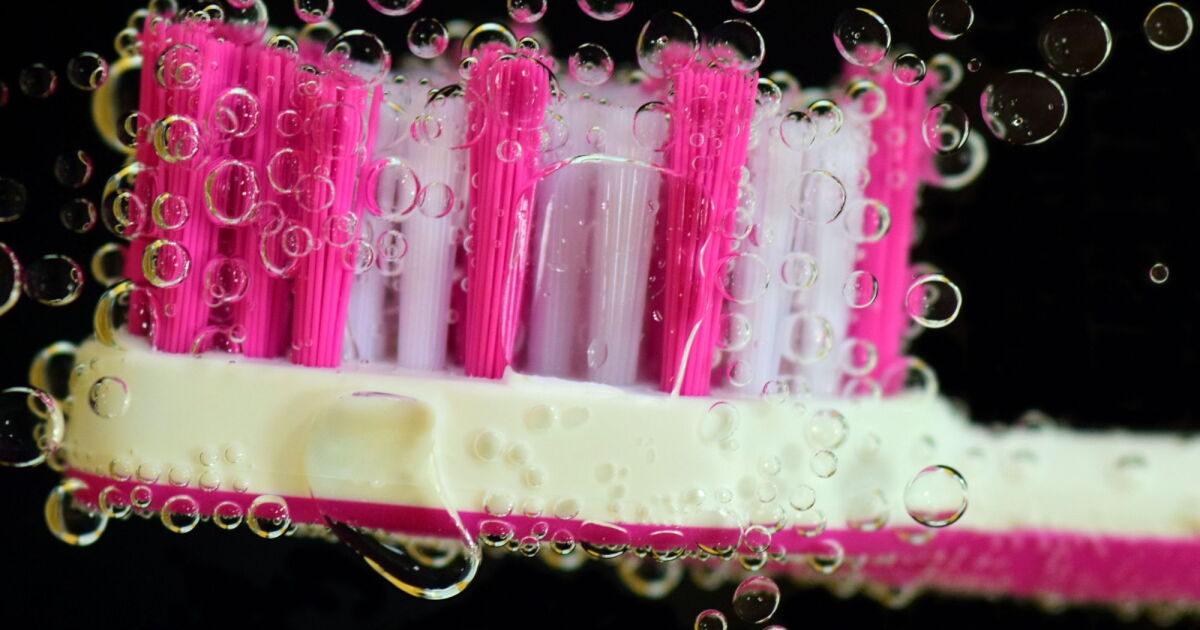
For all the engineering packed into modern electric toothbrushes, cleaning your teeth still largely amounts to little more than sweeping a miniature broom around your mouth to inconvenience your tiny squatters.A new experimental brush developed by researchers in China gives those bristles a bit of a zap, using piezoelectric filaments to produce an electrical charge that drives a sterilizing chemical reaction to expose and damage the bacteria responsible for plaque and cavities.Keeping your pearly whites clean essentially amounts to a fight against the acid-producing bacteria that call our teeth and gums home. Unfortunately for us, those tenants have evolved a sticky knack for evading eviction, creating a webbing known as biofilm that prevents them from being easily licked or swallowed away.Toothbrushing does a suitable job of tearing into this matrix and clearing away residual food, forcing the bacteria to waste time and energy bouncing back each day. Swishing some mouthwash around your gob after brushing delays their return, but can be brutal for healthy microflora.People have tried to improve this age-old practice of regularly disrupting biofilm. Ion-generating toothbrushes release charged particles to induce a polarity that helps repel plaque, for example. Other toothbrushes have aimed to kill bacteria in a more direct, localized fashion by weaving antibacterial agents into their bristles.Both have their drawbacks, either in a need for power or questionable long-term stability.This new approach ditches the need for a battery and aims to facilitate chemical reactions right at the source of the problem.Those reactions generate reactive oxygen species: chemically eager substances capable of making life hard for bacteria.There’s precedent for putting this kind of physics to work in dentistry. A study published in 2024 explored a toothbrush design using an electrically polarized form of polytetrafluoroethylene, better known as PTFE. Ultrasound activated the material to generate reactive oxygen species, producing antibacterial effects in laboratory experiments alongside tooth whitening.This new design weaves the electricity-generating action of polyvinylidene fluoride (PVDF) into the bristles themselves.In laboratory tests using PVDF filaments of two different diameters, the method reduced populations of key oral pathogens Streptococcus mutans and Porphyromonas gingivalis by between 45 and 78%, compared with less than 10% when it came to standard nylon brushing. The PVDF filaments also successfully disrupted biofilms, with lab tests on cow teeth demonstrating a removal efficiency of more than 99%.The researchers also investigated what happened in human mouths. Their three-month evaluation involved more than 100 volunteers given the same brushing instructions, with genetic sequencing used to track changes in oral microbes.Tests on 115 of the volunteers revealed reductions in the relative abundance of several pathogens, alongside better plaque and gum-health measures compared with conventional brushing.Encouraging, certainly. But a smaller proportion of potentially harmful bacteria doesn’t automatically mean fewer bacteria overall. Nor does improved plaque or reduced bleeding mean users will develop fewer cavities or avoid periodontitis in the coming years.Those are separate questions requiring a longer follow-up. Still, testing the concept in people gives it a foothold beyond the laboratory demonstrations characterizing earlier approaches.A self-recharging, bacteria-killing addition to the usual brush, swish, and swipe is easy to appreciate. Throw in a healthy diet, and it’s one more way to ensure you keep your teeth and gums just as your dentist likes them.This research was published in Science Advances.Source: EurekAlert
Your teeth could soon be protected by a futuristic force field
Full Article
Original Source
Read the full article at Newatlas →KhanList aggregates and links to publicly available news content. We do not host full articles from third-party sources. Always verify important information with original sources.