
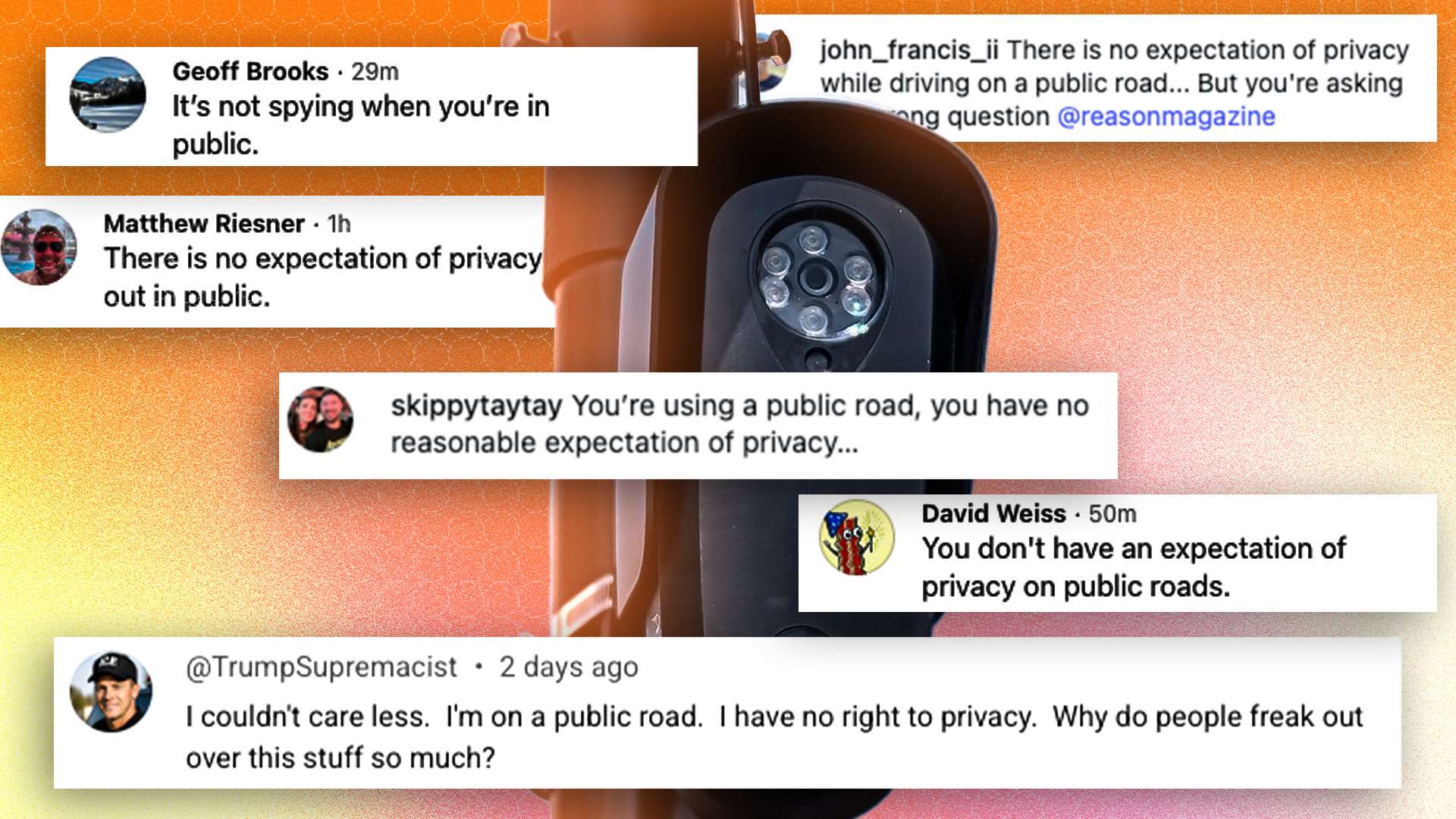
Do Americans have a reasonable expectation of privacy in public? Reason has published extensively on the problems associated with law enforcement's current use of automatic license plate readers and the ongoing nationwide backlash to mass government surveillance. In response, proponents of the technology commonly argue that concerns over privacy violations are unfounded. Besides, the argument goes that Americans "have no reasonable expectation of privacy in public" or while "using public roads." But is that true? And where does this argument come from? First of all, such a statement is far too broad a claim. Police officers are not allowed to randomly stop someone in the street and demand to know where they're going or where they've been unless the officer has reasonable suspicion that the individual is involved in criminal activity or has committed a traffic violation. Even then, these stops are meant to be brief, and Americans are free to invoke their right to remain silent and refuse to speak with police or answer any questions. If Americans had no reasonable expectation of privacy while in public, police officers wouldn't have these restrictions on their authority. However, this argument is most likely referring to a more nuanced Supreme Court ruling from a 1983 case called United States v. Knotts. In that case, a man was suspected of stealing chloroform to aid in the manufacture of illicit drugs. To catch him, officers placed a radio transmitter in a 5-gallon container of chloroform. Once the suspect picked up the container, officers tracked it to a drug lab a few hours away. When asked whether the warrantless planting and use of the transmitter by police violated the Fourth Amendment, the Court answered that it did not, in part because "a person traveling in an automobile on public thoroughfares has no reasonable expectation of privacy in his movements from one place to another." The Court also noted that the transmitter didn't convey any additional information the officers couldn't simply see with their own eyes. Although this ruling was straightforward at the time, a lot has changed since 1983. And in 2012, the Court took up a similar case called United States v. Jones, which involved the warrantless use of a GPS device to track the vehicle of a suspected drug trafficker. But despite police similarly using a device to track a suspect's vehicle on public roads like in Knotts, the Court ruled differently and unanimously held that police need a warrant before using a GPS device to track someone's vehicle. But why the different outcome? First, the Court's majority opinion held that installing a GPS tracker on the suspect's car required police to intrude on private property. All nine justices agreed that the Fourth Amendment definitely protects against that, and rejected the argument that the Knotts ruling meant people have no reasonable expectation of privacy while using public roads. And second, in Jones, the cops used the GPS device to track the car everywhere it went for 28 days. Compared to the transmitter in Knotts, which police used to track a single container for only a few hours, using a GPS device for nearly a month can reveal a lot of private details about someone's life. And five justices joined in concurring opinions to express their uneasiness with that fact. So in 2018, when the Court took up the question of whether the warrantless search and seizure of cellphone location data violates the Fourth Amendment in Carpenter v. United States, the majority held that, actually, Americans do "have a reasonable expectation of privacy in the whole of physical movements." This holds even when people are out in public or using public roads. And in June, the Court doubled down on this ruling in a case called Chatrie v. United States, holding that police using location history collected by Google constitutes a search under the Fourth Amendment. But where do ALPR cameras come in? According to the Court's most recent rulings in Carpenter and Chatrie, police surveillance could violate the right to privacy if the technology reveals intimate details of someone's life, is cheap and easy to use compared to traditional policing methods, and allows cops to retrace someone's movements from before they were ever suspected of a crime. It's no coincidence that the criteria for an unconstitutional invasion of privacy echo the same concerns people have expressed regarding ALPR surveillance systems. And it's why there have been multiple lawsuits arguing the Fourth Amendment protects against cops who invade Americans' privacy by using ALPR cameras provided by Flock Safety and others without proper oversight. For now, the courts are still figuring out how the Fourth Amendment might apply to ALPRs and other surveillance technology. But one thing is clear: Americans' Fourth Amendment rights don't disappear just because they're out in public.
Your Right to Privacy Doesn't Disappear When You're in Public
Full Article
Original Source
Read the full article at Reason →KhanList aggregates and links to publicly available news content. We do not host full articles from third-party sources. Always verify important information with original sources.