
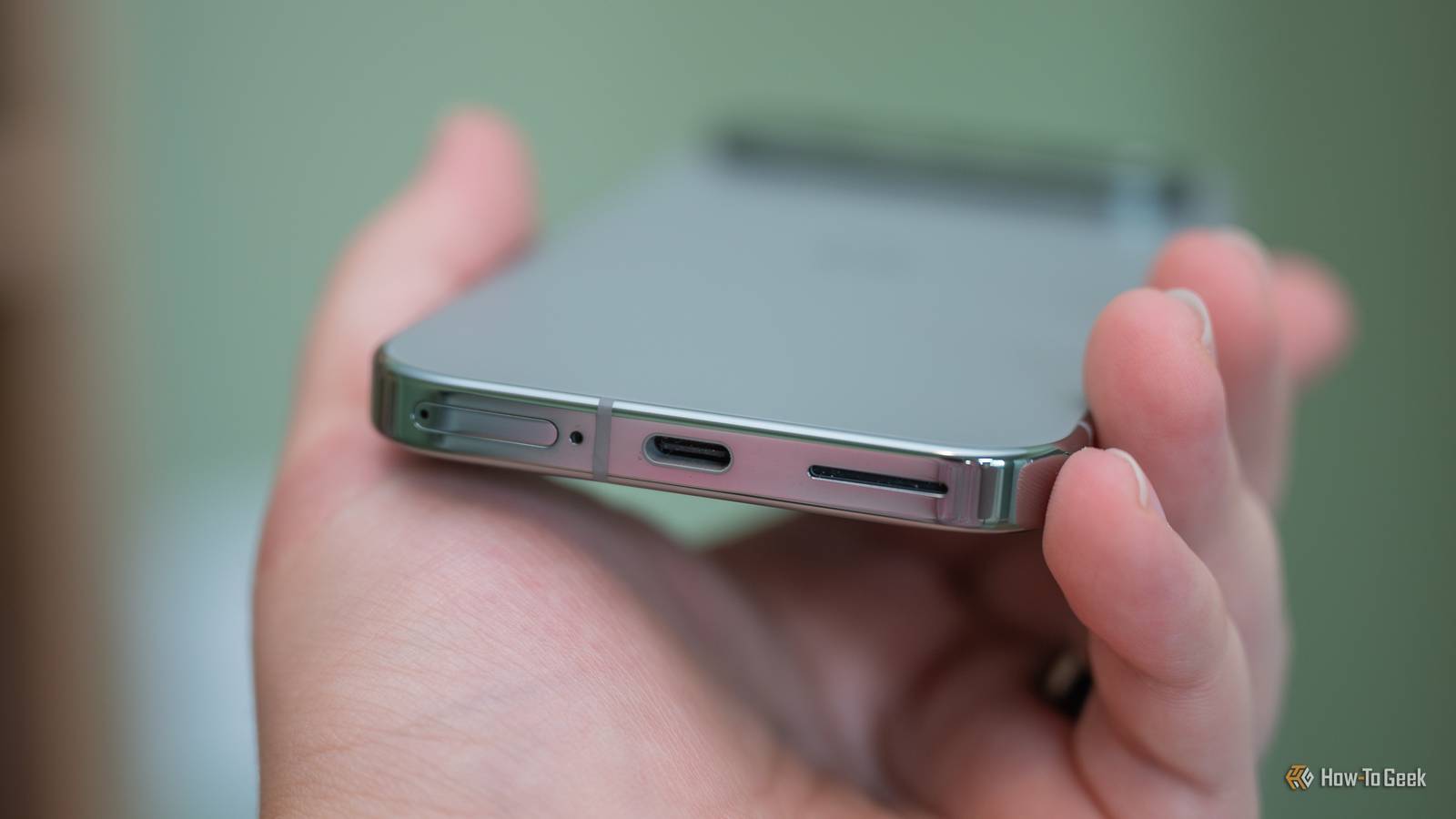
Published Oct 21, 2026, 1:01 PM EDT Andrew Heinzman is a seasoned tech writer with over half a decade of experience. He specializes in delivering insightful tech news and detailed product reviews, particularly focusing on audio and video technology, as well as computers and smartphones. His journey in tech writing includes a two-year stint as the News Editor at Review Geek, the former sister site of How-To Geek. Throughout his career, Andrew has consistently provided readers with valuable insights and up-to-date information on the latest developments in the tech world, earning recognition for his clarity, depth, and relevance. In his free time, Andrew likes to explore music and read books, just as he did when earning his bachelor's degree in English literature. Your Pixel phone came with a nice USB-C cable, but Google didn't include a power adapter in the box. So, you resorted to using one that happened to be sitting around your house, and your expensive Pixel phone is charging half as fast as it should. Thankfully, there's an easy solution: buy a new power brick that's capable of charging your Pixel phone at full speed. Your phone will thank you, as will the other USB-powered devices you own. Get a new power adapter Cheap power bricks rarely exceed 20 watts Credit: Justin Duino / How-To Geek All standard Pixel smartphones since the Pixel 7, as well as the Pixel Fold, require a USB-PD PPS charger rated 30 watts or higher to achieve peak charging speeds. So, whether you're using a Pixel 8 or a Pixel 11 Pro, any power adapter with a minimum 30-watt output and PPS compatibility will get the job done. Such chargers are available for under $20 at just about any retailer. Google's Pro XL smartphones offer fast charging up to 45 watts, but they can't hit full speed with a standard 45-watt power adapter. You actually need a power adapter with an unusual 21V PPS profile (usually listed as "3.3V–21V" or "5V–21V" in the fine print of online product listings). Google's official Pixel power adapter fits the bill, although it's somewhat expensive. Pixel A-series smartphones will charge at their maximum speed so long as you have a USB-PD power adapter with an appropriate wattage. The only exception is the Pixel 10a, which requires the same PPS compatibility as standard Pixel models. Phone Model Maximum charging speed Pixel 7 Up to 20W Pixel 7 Pro Up to 23W Pixel 7a Up to 18W Pixel 8 Up to 27W Pixel 8 Pro Up to 30W Pixel 8a Up to 18W Pixel 9 & 9 Pro Up to 27W Pixel 9 Pro XL Up to 37W Pixel 9 Pro Fold Up to 21W Pixel 9a Up to 23W Pixel 10 & 10 Pro Up to 30W Pixel 10 Pro XL Up to 45W Pixel 10 Pro Fold Up to 30W Pixel 10a Up to 30W Pixel 11 & 11 Pro Up to 30W Pixel 11 Pro XL Up to 45W Pixel 11 Pro Fold Up to 30W Power adapters usually have their charging specs printed on them. If you've bought a power brick recently and aren't sure what speeds it's capable of, just examine it. Alternatively, you can look up the charger on a storefront like Amazon to see what the listing says. Just be sure to remember that multi-port chargers have to divvy up their available power when charging multiple devices simultaneously. If you need to charge several devices at a time without sacrificing speed, then a 100-watt PD charger with PPS is a good option. I should also point out that the Pixel 11 series supports "Extreme Charging Mode," which extends a compatible charger's peak output in order to rapidly recharge a battery that's below 50%. You can enable this feature from your Quick Settings, but it requires a USB-C PPS adapter rated 30 watts or higher (or a 21V PPS adapter capable of hitting 45 watts if you're using a Pixel 11 Pro). UGREEN 3-Port 30W USB-C Charger Block Brand UGREEN Output 30W Color Gray Type GAN Cable included No Charging Ports 2x USB-C, 1x USB-A This inexpensive UGREEN charger supports 30-watt USB-PD charging with PPS. It's a great option for Pixel owners who want to charge at top speed using the cable that came with their phone, provided that you don't own a Pro XL model. Wireless chargers benefit from a good power brick, too Those Qi2.2 speeds aren't free Unlike USB-C cables, which are fairly efficient, Qi wireless chargers tend to be fairly wasteful. Old-fashioned non-magnetic wireless chargers can waste up to 40% of the energy that's passed through them, while newer Qi2 and Qi2.2 chargers may waste up to 20%, depending on how well they're connected to your phone. Some people cite this wastefulness as an environmental concern, or as something that'll impact your power bill. But phones consume so little energy that it doesn't really matter. For context, your clothes dryer can consume more electricity in an hour than your phone does in an entire year. So why am I even bringing this up? Well, I'm trying to make it easier to explain why wireless chargers need a good power brick. A standard Qi2 wireless charger may only hit a maximum speed of 15 watts, but because so much energy is wasted, you need an adapter that's rated for 20 watts or more in order to hit that top speed. The Pixel 10 family supports Qi2 charging at 15 watts, while Pixel 11 devices utilize Qi2.2 for 25-watt wireless charging (the Pixel 10 Pro XL also offers Qi2.2 25-watt wireless charging). Thankfully, any inexpensive USB-C PD power brick will get the job done here (no need to fret over PPS profiles), so long as you have a Qi2 or Qi2.2 magnetic charging pad. Wireless charging is improving at a snail's pace, so spending extra for a 60-watt adapter just to "future-proof" your wireless charging setup doesn't make much sense. Don't neglect your car charger Your car's USB port probably can't charge your phone at top speed In-car USB ports tend to have a low amperage and can only charge smartphones at 5-watt speeds. That's good enough to keep your Pixel phone from dying while you use Google Maps, but it's not enough to proactively charge the phone. A power adapter that plugs into your car's 12V outlet (the cigarette lighter) is an essential upgrade for charging on the go. I suggest buying one that features both USB-A and USB-C PD ports (plus PPS compatibility) so you've got lots of options for all of your devices—there are 200-watt options on Amazon for roughly $30. Just be sure to use a good USB-C cable so that you actually get the speed you're paying for. Though I should point out that a lot of newer cars feature 2.1A ports that can charge smartphones at 15 watts. Built-in USB-C PD ports are also becoming somewhat common, at least in high-end EVs. UGREEN 130W Car Charger $23 $35 Save $12 Brand UGREEN Output 24 Volts Color Black Cable included Yes Charging Ports 1 USB-A and 2 USB-C With 100W power delivery via one of its USB-C ports, the UGREEN 130W Car Charger can juice up most mobile devices, including laptops, at their top speed. A note about battery health By default, Pixel phones utilize adaptive charging and battery-saving features that can lead to inconsistent real-world charging speeds. This is a big part of why you need a compatible PPS charger to hit the Pixel's top speed; PPS lets your phone control input current and voltage to a much finer degree than the basic USB-PD standard. Your Pixel phone may charge at top speed when its battery is low, but charging speed will fluctuate and slow as the device reaches capacity. It will also pause charging at 80% if it believes that you're asleep. You can change or disable some of this behavior, but I suggest that you leave it alone. It'll extend the lifespan of your phone's battery in the long term.
Your Pixel is charging at half speed because of the wrong power brick
Full Article
Original Source
Read the full article at Howtogeek →KhanList aggregates and links to publicly available news content. We do not host full articles from third-party sources. Always verify important information with original sources.