
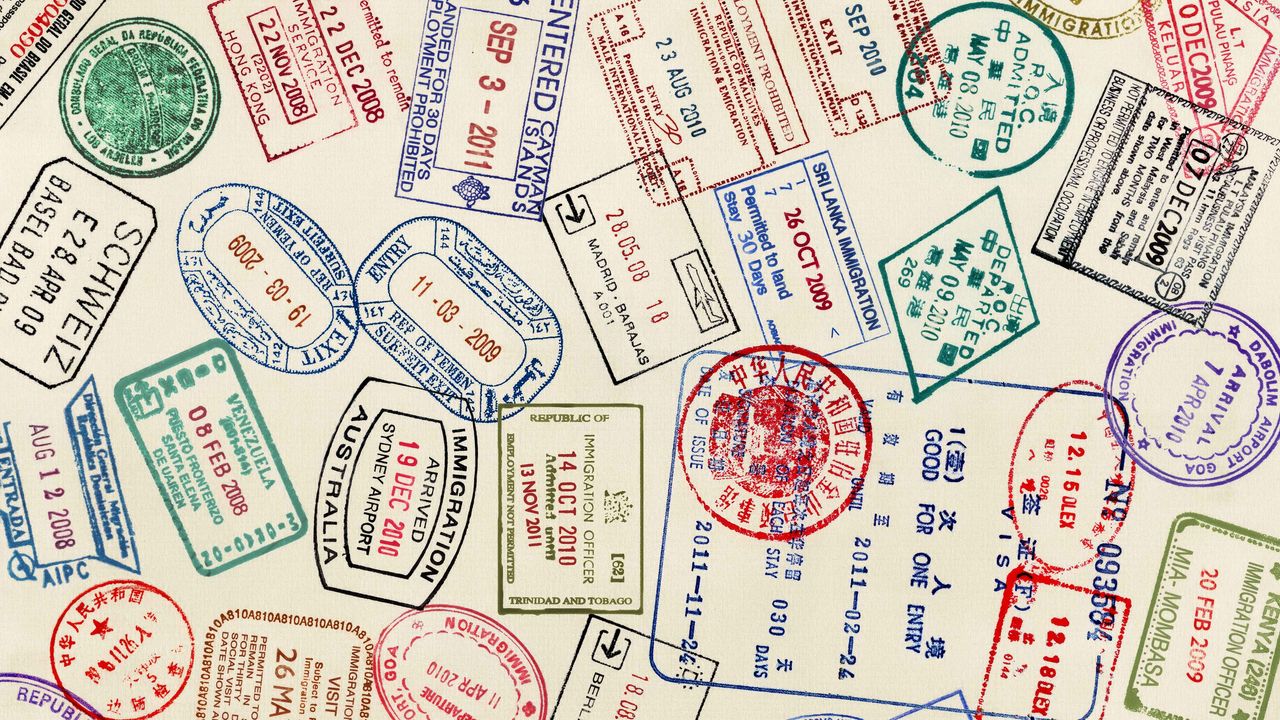
For travelers who treat their passports as unofficial scrapbooks, few souvenirs are as satisfying as a fresh immigration stamp. But visitors entering the United States are increasingly likely to leave passport control without one.On October 1, US Customs and Border Protection (CBP) said it would “cease the routine use of admission stamps during primary processing. According to CBP, removing this step should “further streamline primary inspection and reduce operating costs."The change doesn’t alter the rules governing who is admitted to the United States or how long they’re allowed to stay. But it does mean that travelers will no longer be able to rely on their passport as a reliable travel log, says Sébastien Couix, founder and CEO of Visamundi, a French travel-tech company specializing in entry requirements.“Until now you left the counter with two records, the ink stamp and the electronic I-94,” Couix says. “Now, in most cases, you leave with one.”Previously, if an international visitor to the US needed to confirm how long they were permitted to stay in the country, they could check their physical passport stamp. But now, you’ll need to pull up your electronic I-94 record to confirm immigration details like how long you’re allowed to stay and the immigration category you were admitted under (such as B-1/B-2 for business or tourism and F-1 for students).Why are some countries getting rid of passport stamps?Can I still ask for a US passport stamp?Why you should check your I-94 after entering the USWhat to do if there's an error on your I-94Why are some countries getting rid of passport stamps?In the US, CBP began replacing paper I-94 cards with electronic records for most air and sea arrivals in 2013 and has since rolled out mobile tools and facial-biometric identity checks at ports of entry. In many ways, doing away with passport stamps is the natural next step in digitizing the border process.Kathleen Walker, a Denver-based immigration attorney, describes the October bulletin as less a dramatic policy change than the formalization of a practice that has become more and more common. Joseph Kwon, a Nashville-based immigration attorney adds, “Think of the stamp as a receipt. The official record has always been the I-94.”The United States isn’t alone in moving away from physical travel records. Europe’s Entry/Exit System replaced routine stamps with digital entry and exit records across 29 countries have also largely moved to electronic border records. Currently, at least 35 countries, including Australia, New Zealand, Singapore, and South Korea, have started to phase out passport stamping, a trend that’s only expected to continue.Can I still ask for a US passport stamp?For travelers who like collecting stamps, it’s still worth asking politely at the inspection booth. But even though you can still ask for a passport stamp in the US, it’s no longer a guarantee that you’ll get one. CBP’s new guidance says officers may still stamp passports in certain situations, including when a traveler requests it, but only “when appropriate.”“You can ask,” Couix says. “My advice is to treat a stamp as a favor, not a right.”But for some travelers, a passport stamp is more than just a momento. It serves as a physical record of important travel information. According to Couix, entry stamps often come in handy as supporting proof for visa and residency applications, and certain application paperwork for banks or schools. They are also helpful for Green card holders, who generally can’t use the I-94 system to look back at their trips, and temporary workers who need to keep track of time spent outside the United States.“Your passport used to be the archive,” Couix says. “It isn't anymore.”That was one of the stamp’s biggest advantages, Walker says: It gave travelers an immediate, visible record of when and how they were admitted, and it gave immigration attorneys another paper trail when reconstructing travel history or sorting out an incorrect electronic record.Now, immigration experts say travelers should keep their own digital paper trail instead: Save a copy of your I-94 after each arrival, along with any other travel records you may need later.As the Trump Administration makes it more difficult for people to visit the US, other nations are starting to respond in kind.Why you should check your I-94 after entering the USThe I-94 is essentially the government’s digital record of your arrival in the United States, and for most international visitors, it’s now the place to confirm how long you’re allowed to stay. CBP generally creates a digital I-94 for travelers admitted on a temporary basis, including tourists, students, and temporary workers; US citizens and green card holders don’t receive one. You can pull up your most recent record on CBP’s I-94 website or through the CBP Link app.If you don't receive a passport stamp, Kwon recommends checking your I-94 immediately after entering the US to make sure the details are right, and saving a copy somewhere you can easily find it again. First, make sure your name and passport number are correct, then look closely at the entry category listed and, most importantly, the date you’re expected to leave. Visa Waiver Program travelers are generally allowed to stay for up to 90 days, while visitors traveling on a tourist or business visa may be given as long as six months.Walker says one drawback of losing the physical stamp is that travelers may no longer catch mistakes while they’re still standing at immigration. “With a stamp, a traveler could spot a wrong date or visa class before leaving the airport,” she says. With an electronic record, a mistake may not become apparent until after the traveler has already completed inspection and entered the country.That date can also be different from the expiration date printed on your visa, which is where things can get confusing. A visa tells you how long you can use it to travel to the United States; it doesn’t necessarily determine how long you can stay once you’re here. Someone with a visa valid for several more years, for example, might still be admitted for only a few months on a particular trip.What to do if there's an error on your I-94If something on your I-94 looks wrong, don’t panic—but don’t ignore it either. Most errors can be fixed, and the sooner you catch them, the easier that usually is.“If CBP made the mistake, CBP's Deferred Inspection office fixes it,” Kwon says. Travelers should find the nearest CBP Deferred Inspection Site and contact the office to ask for a correction. These offices can fix mistakes made when you entered the country, including a misspelled name or incorrect passport information, the wrong entry category, or the wrong departure date. Depending on the location, you may be able to handle at least part of the process by phone or email rather than returning to the airport where you arrived.You also don’t necessarily have to contact the port where the mistake happened: CBP says a designated Deferred Inspection Site or CBP office at an international airport can generally review an entry-related correction regardless of where you entered the country.There are a couple of exceptions. If the I-94 was issued by US Citizenship and Immigration Services as part of an approval notice, the correction generally needs to go through USCIS instead. And a shorter-than-expected stay isn’t always a mistake: In some cases, CBP may limit your admission to the date your passport expires.The important thing is to deal with any discrepancy before the date on your I-94 passes. As Kwon puts it, “Waiting is what turns a typo into an overstay.”
Your Next US Passport Stamp Might Be Your Last
Full Article
Original Source
Read the full article at Cntraveler →KhanList aggregates and links to publicly available news content. We do not host full articles from third-party sources. Always verify important information with original sources.