
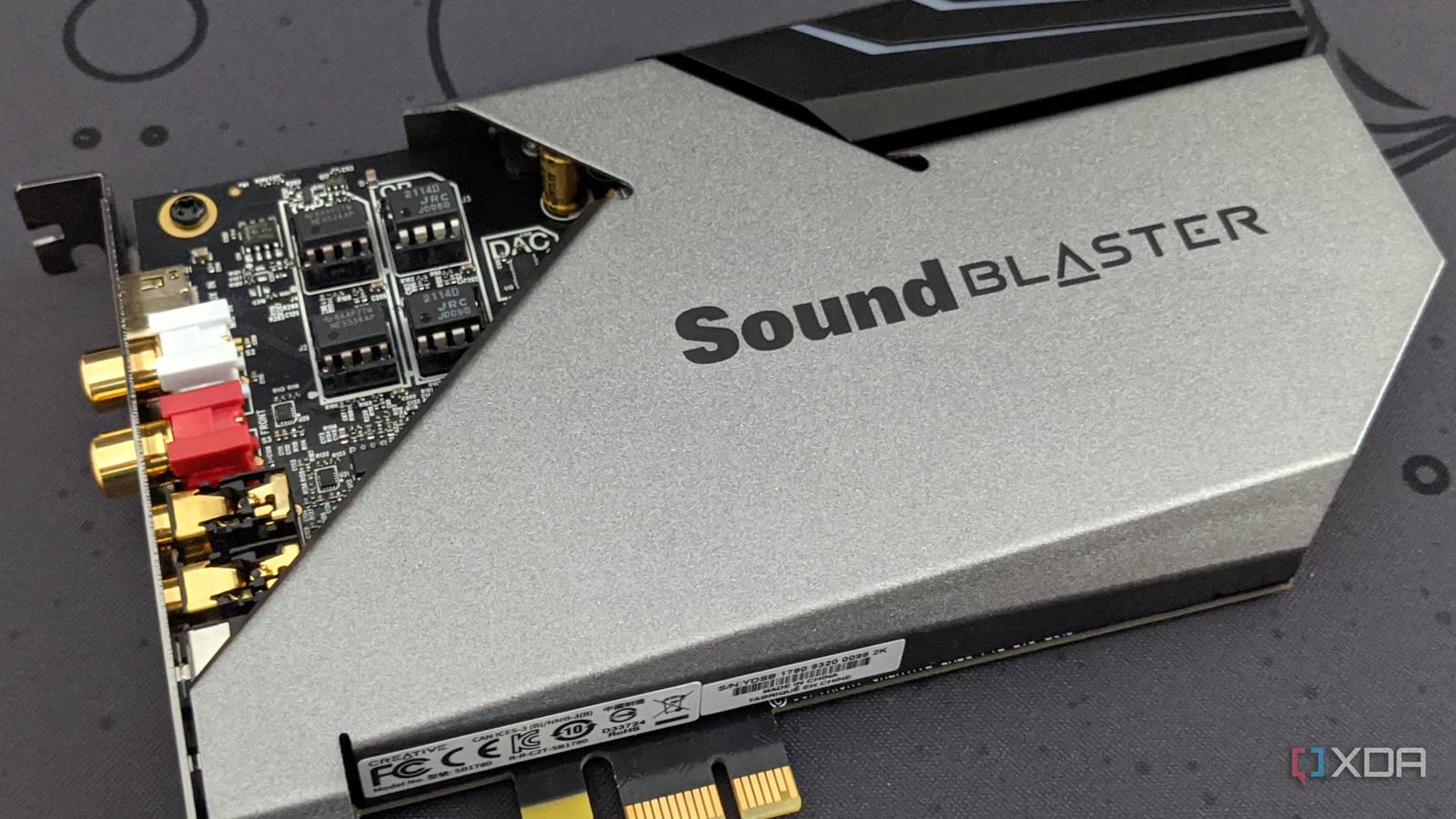
Published Sep 21, 2026, 7:00 AM EDT Shivansh began his tech journey as an avid reader of tech publications, which inspired him to launch his career in video media at Sillycorns. He has led content across multiple tech YouTube channels and Instagram accounts, crafted go-to-market (GTM) strategies for Vivo, and consulted on digital growth. Coming full circle to his roots in written media, he now delivers deep-dive tech journalism. Outside of his professional work, Shivansh loves watching movies, riding bikes, and playing cricket. If you played the original BioShock on an ordinary PC, there's a setting you probably never got to use. It makes each room in Rapture sound like the room it is, with all the sound effects. However, on today's motherboard audio, that setting is normally grayed out because the game expects the EAX audio support found on cards like Creative's Sound Blaster X-Fi from about 20 years ago. Now I have always been in favor of sound cards fading away because the onboard audio kept getting better. Yet when I see brand-new gaming motherboards fail to support settings that older sound cards handled with ease, I’m just left asking, 'Why?' A new motherboard sounds cleaner than a 2005 sound card The hiss argument ended years ago Let's start with the analog side, because modern onboard audio no longer has the obvious noise-floor disadvantage that once helped justify a discrete sound card. We at XDA have spent plenty of time with PC audio already, and one colleague found that even a budget USB audio interface sounded better than their motherboard audio. So I didn't go hunting for a 20-year-old card to plug in and listen to. I read what the companies involved actually published. Creative's own datasheet for the Sound Blaster X-Fi XtremeMusic, launched in 2005, lists a 109 dB signal-to-noise ratio. That number describes the ratio between the reference signal level and the measured noise floor. ASUS lists 120 dB for the Realtek chip on its current ROG Strix X870E-E Gaming WiFi. Every 10 dB is a tenfold drop in noise power. The ASUS page also mentions audio shielding and a separate headphone amp, which tells you board makers stopped treating audio as leftover space. Picture your PC's audio as a restaurant kitchen. The last step, turning digital sound into something your headphones can play, is the plate the food arrives on. Onboard audio has the nicer plates now. Plates don't cook, though, and cooking is where the old card still had a trick. What an old sound card does that onboard audio can't One of the X-Fi's big jobs was running EAX, Creative's Environmental Audio Extensions, on its own processor. A game tells the chip what kind of room you're standing in, and the chip works out the echo and muffling as you move. A gunshot should ring off tile, go dull behind a closed door, and fade differently outdoors. EAX let developers describe that for every sound, and the card did the math. Creative was proud of that chip. Its datasheet compared it to a Pentium 4 running at 3.6 GHz, which sounded like a lot of computer in 2005. The newest version, EAX 5.0, launched alongside the X-Fi, and Creative advertised support for 128 hardware-accelerated voices. BioShock uses OpenAL for its EAX 5.0 path, and the game still expects an EAX-capable implementation before it enables the setting. The image above shows it: the Use Creative EAX Audio option grays out when EAX-capable hardware isn't present. Without an implementation that exposes the EAX functionality BioShock expects, the game simply grays the option out. I'll be honest, I assumed this was a compatibility problem someone had brute-forced years ago. That is true for plenty of older EAX games, but BioShock is a slightly different case. Windows Vista bricked up the door to the oven Games still knock on a door that isn't there So that 109 dB spec was never the old card's real problem. Windows was. Plenty of 2000s games talk to sound hardware through DirectSound3D, Microsoft's old 3D audio system, and they can ask for a sound to be mixed on the card or on the processor. Then Vista arrived. Microsoft's DirectSound changes removed hardware acceleration from the old DirectSound3D path that many earlier games used. Many games that depended on hardware DirectSound3D lost their hardware 3D audio and EAX path, often falling back to simpler software or stereo output. You might never know anything was missing. Only the DirectSound3D path was affected in this way. Games using OpenAL, including BioShock for its EAX path, could still talk to compatible audio hardware. Creative's fix, a small tool called ALchemy, translates DirectSound3D calls into OpenAL so older games can regain hardware-accelerated 3D audio and EAX on newer versions of Windows. The open-source crowd went a step further. DSOAL replaces the old DirectSound3D path and presents hardware-style 3D audio and EAX support to compatible games, while OpenAL Soft performs the processing in software on your CPU. It's the regular oven learning the house specials. DSOAL and ALchemy only matter for games that use DirectSound3D. BioShock's EAX path already uses OpenAL, so its compatibility problem is separate. They don't change how music, movies, or modern games sound on your PC. If a free download can cook the dish, it's fair to ask why anyone would still want the old oven. Is an old Sound Blaster worth buying for a modern PC? Only if one grayed-out switch bugs you For most people, no. DSOAL's EAX support stops at version 4, which covers many DirectSound3D-era games but not BioShock's EAX 5.0 path. A modern processor has vastly more than enough performance to handle these effects in software, so the problem today is compatibility rather than raw processing power. Getting an X-Fi running is its own little project, too. Go back to that ASUS page from earlier and check the expansion slots: three PCIe slots, and nowhere to put the original PCI X-Fi. The old oven needs a gas line your new kitchen was built without. The same page lists Windows 11 as its only supported system, while Creative's last software pack for these cards targets Windows 10. In case the data is overwhelming, I am writing a summary for you in the table below. Have a look. Modern onboard audio Onboard + software compatibility Creative Sound Blaster X-Fi Signal-to-noise ratio 120 dB (ASUS X870E-E) Same as onboard 109 dB (XtremeMusic) DirectSound3D games (EAX 1-4) Often lose hardware 3D audio/EAX Restored in software Restored with Creative ALchemy BioShock's EAX 5 toggle Grayed out Still problematic with OpenAL Soft (bug report) Supported by compatible X-Fi hardware Fits a current motherboard Built in Built in Needs a PCI slot Official Windows support Windows 11 Community-maintained Windows 10 The plates got better, and the oven got left behind So no, there's little reason to expect the old Sound Blaster to sound better on the analog side. Modern motherboard audio has caught up enormously, and it cooks most of the recipes the old card used to own. So, unless you already have one sitting in a drawer and a PCI slot on your board, that money is much better spent on a solid pair of headphones.
Your motherboard still can't do one thing a 20-year-old sound card could, and BioShock proves it
Full Article
Original Source
Read the full article at Xda-developers →KhanList aggregates and links to publicly available news content. We do not host full articles from third-party sources. Always verify important information with original sources.