
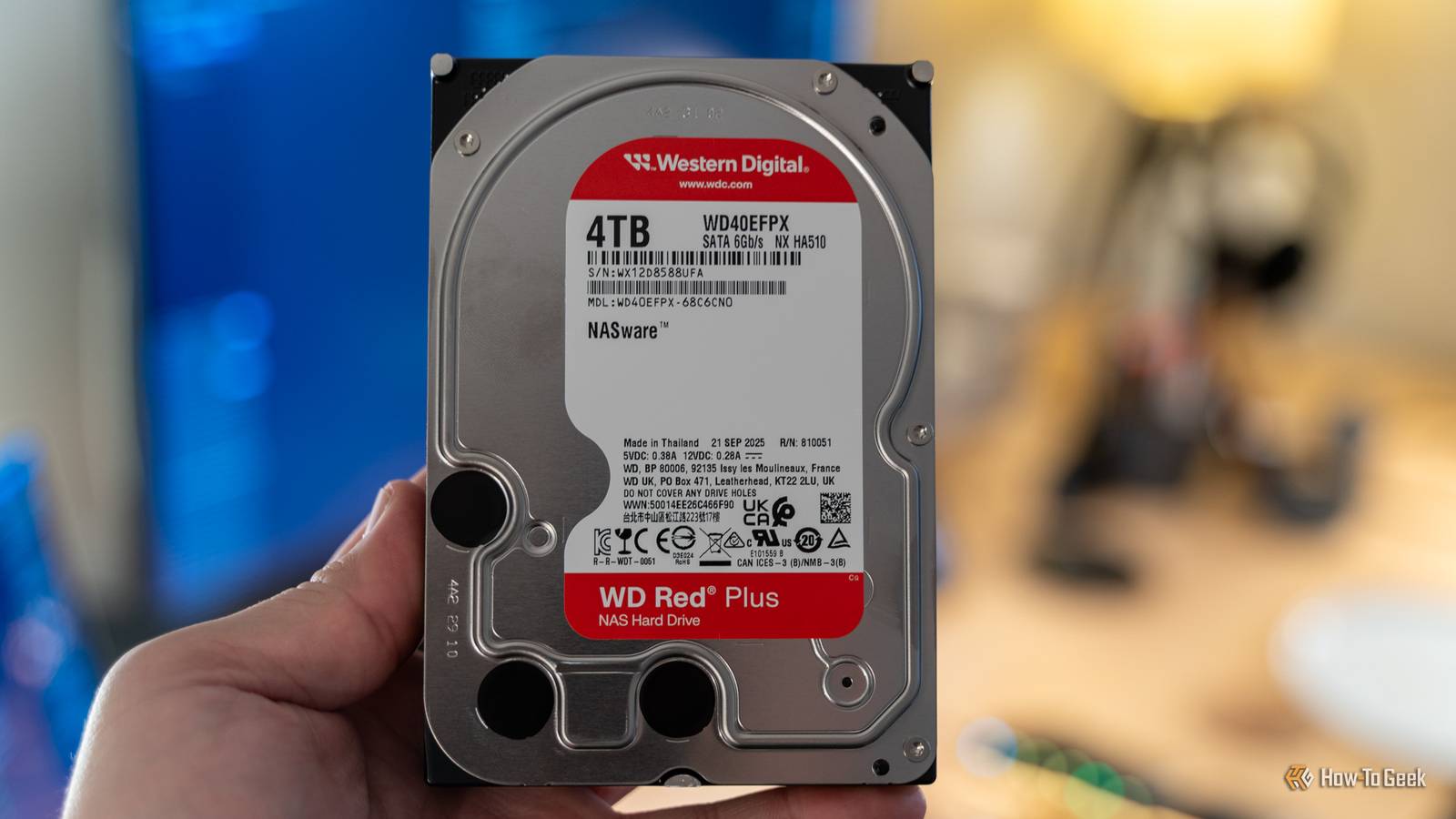
Published Jul 24, 2026, 9:30 AM EDT Monica J. White is a journalist with over a decade of experience in covering technology. She built her first PC nearly 20 years ago, and she has since built and tested dozens of PCs. PC hardware is her main beat, and graphics cards and the GPU market at large are her main area of interest, but she has written thousands of articles covering everything related to PCs, laptops, handhelds, and peripherals. From GPUs and CPUs to headsets and software, Monica's always willing to geek out over all things related to computing. Outside of her work with How-To Geek, Monica contributes to TechRadar, PC Gamer, Tom's Guide, Laptop Mag, SlashGear, Whop, and Digital Trends, among others. Her ultimate goal is to make PC gaming and computing approachable and fun to any audience. Monica spends a lot of time elbow-deep in her PC case, as she's always making upgrades, testing something, or plotting out her next build. She's the go-to tech support person in her immediate circle, so she's never out of things to do. Whenever she has spare time, you'll find her gaming until the early hours and hanging out with her dog. Considering that half of failed hard drives die in their first year of operation, can we truly trust the 1-million-hour reliability figure that's been floating around for a long time now? One million hours works out to more than 114 years, which makes HDDs sound immortal. But no mechanical hard drive is being promised a century of service, and manufacturers know that this number cannot predict the lifespan of the drive you actually end up buying. A million-hour HDD is not expected to last 114 years Don't expect your great-great-grandkids to inherit your HDDs MTBF stands for mean time between failures, but the name makes the spec sound far more personal than it really is. The figure doesn't estimate how long your HDD will run before breaking (even though many people assume it does). Instead, MTBF is used by manufacturers, and it's calculated across a large population of drives, dividing their combined operating time by the number of failures observed or predicted during testing. As a simplified example, 1,000 drives running for 1,000 hours with one failure between them would produce a one-million-hour MTBF, even though no individual drive had operated for longer than 1,000 hours. The calculation also assumes that the drives are being used under particular conditions and during the relatively stable portion of their service lives. It doesn't neatly account for every drive that dies early because of a defect or every aging drive that eventually wears out (and that Secure Data Recovery study I mentioned above found that nearly half of them failed in year one). Seagate's own documentation warns that interpreting a one-million-hour MTBF as a century-long lifespan is incorrect, while describing the metric as a statistical indicator of reliability rather than a practical estimate of how long one HDD will remain operational. Real-world research shows just how far actual results can stray from those "one million" figures. A Carnegie Mellon University study examined replacement records covering around 100,000 drives whose published MTTF ratings ranged from one million to 1.5 million hours. Those ratings suggested an annual failure rate no higher than 0.88%, yet the researchers found that annual replacement rates of 2% to 4% were common, with rates as high as 13% in some systems. The one-million-hour figure is a legitimate engineering statistic, but it provides no assurance that the particular HDD you buy will survive a week, much less a hundred years. WD Elements Portable HDD - 2TB $149 $165 Save $16 This portable HDD may not last you for over 100 years, but it's as reliable as can be. AFR turns the giant number into something useful One million hours becomes roughly 0.88% per year Credit: Dibakar Ghosh | How-To Geek / Google Gemini (Nano Banana Pro) A much easier way to understand MTBF is to convert it into an annualized failure rate, or AFR. A drive rated for one million hours works out to an AFR of roughly 0.88%, meaning that, under the manufacturer's assumed operating conditions, around nine drives in a fleet of 1,000 might be expected to fail over the course of a year. That sounds far less spectacular than 114 years, but it gives you a much clearer idea of what the reliability claim actually means. So, no, HDDs aren't likely to become family heirlooms the way your grandmother's china set might have done. That 0.88% figure looks more believable, but it still doesn't match every real-world fleet. The fine print decides whether MTBF applies at all Temperature, workload, and duty cycle all count here Credit: Nick Lewis / How-To Geek Well, here's a catch: Even that 0.88% AFR only applies under the conditions used to calculate it, and those details tend to vary. Western Digital, for example, rates current WD Red Plus drives for a workload of up to 180TB per year, but bases its one-million-hour MTBF estimate on a sample population running at 40 degrees Celsius and transferring 90TB per year. Do something slightly different? You might get different results. Going beyond those assumptions doesn't mean your HDD will immediately collapse, wither, and then die. It does mean, however, that the headline reliability figure doesn't apply ... or rather, it doesn't have to apply. For every HDD that fails, there are some that never do and just get replaced, and not a single HDD has even had the chance to run for 114 years non-stop so far. Real-world drive fleets expose the limits of the spec Model, age, and environment come into play Credit: Patrick Campanale / How-To Geek Backblaze's latest Drive Stats report shows how messy HDD reliability becomes outside of a manufacturer's calculations. In its latest Drive Stats report, Backblaze analyzed 341,263 HDDs and recorded an AFR of 1.24% for the first quarter of 2026, while its lifetime AFR sat at 1.39%. Results also vary dramatically between models. But individual models ranged from zero failures to an AFR of 4.9% during the quarter, so there's a lot of wiggle room there. Even Backblaze's enormous dataset can't tell you exactly how long your next HDD will last. Its drives operate in managed data centers, undergo qualification before deployment, and sit behind systems designed to tolerate hardware failures. Backblaze also admitted that its statistics probably underreport day-one failures because a drive generally needs to survive until the end of its first day on the job for it to make it into the dataset. Always assume the drive's gonna fail No MTBF, AFR, or any other acronym can protect the only copy of an important file, which is why I just generally tend to assume every drive will fail one day. I've only had it happen a couple of times in my 20+ years of building PCs, but it does happen, and you'd rather be safe than sorry. The solution to a good night's sleep without worrying about your data is simple, of course. Follow the 3-2-1 rule for secure storage and never trust one single HDD too much. It can backfire massively. Seagate Exos 22TB $649 $2713 Save $2064 If you need heaps upon heaps of HDD storage, a recertified drive like the Seagate Exos can be a good pick.
Your hard drive's 1-million-hour rating means nothing—here's what actually matters
Full Article
Original Source
Read the full article at Howtogeek →KhanList aggregates and links to publicly available news content. We do not host full articles from third-party sources. Always verify important information with original sources.