
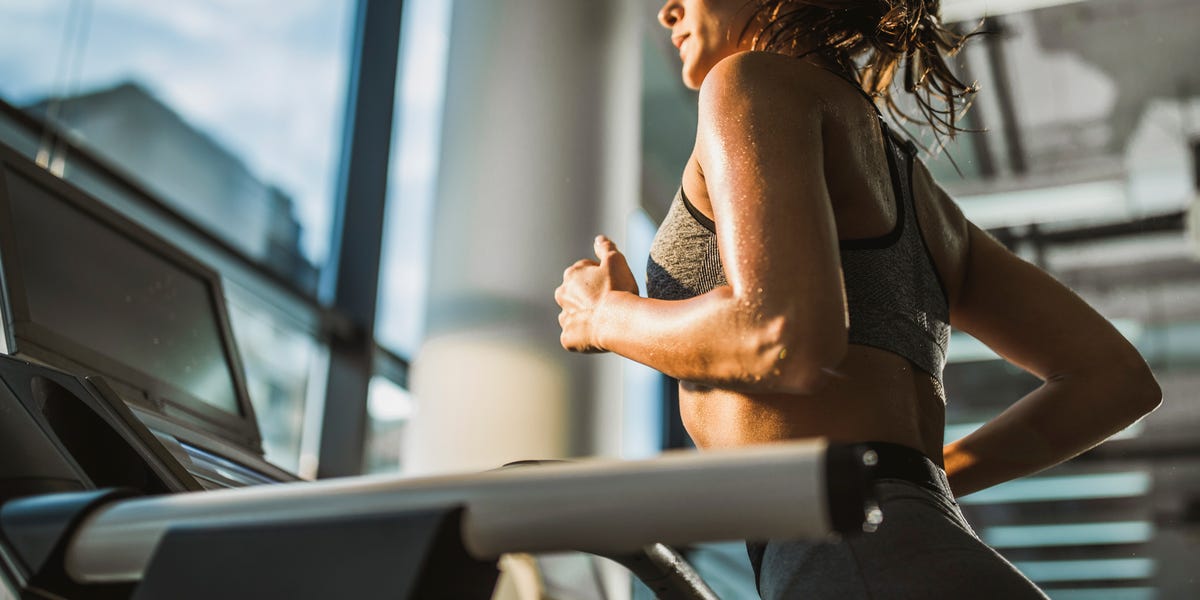
9 min readThere’s almost no other cardio machine that brings up as many feelings as the treadmill. For the first few years of my running career, I’d do just about everything I could to avoid hopping on one, even if that meant running in freezing temps or heavy rain.Then, last winter happened. There was more snow and ice on the ground in New York City than I had seen in a long time, but I had a half-marathon to train for. It left me no choice: I had to move my workouts to the treadmill unless I wanted to end up like that meme where the woman says snow is the perfect texture for running just to wipe out on live television a few seconds later.But, as any treadmill hater knows, moving a run indoors isn’t as simple as it sounds. A lot changes on a tread—form, mental stimulation, pace—and it can totally mess with your head. Once you understand why, though, it’s a lot easier to work with the treadmill instead of against it; here’s how.Because it is! For starters, your form changes. “Many people shorten their stride on the treadmill—me included,” says Amy Woods, a USAT-certified run coach and ISSA-certified strength and conditioning coach. “We also tend to run a little more upright.”There’s a simple reason behind it. When you’re running outside, your legs have all the space they need for each stride, but on a treadmill, you’re contained to the length and width of the belt. Plus, most people tend to stick too close to the front of the tread, making their space even smaller, says Morgan Mowers, PT, DPT, a physical therapist and V.02-certified run coach.Between a shortened stride and the fact that it’s a bit easier to propel yourself forward when you’ve got the help of the moving belt, you end up using different muscles on a treadmill compared to outdoors. “We see a decrease in activation of hamstrings and glutes, those bigger propellers that push you forward,” Mowers says. Instead, you’re seeing more activation in your hip flexors, quads, calves, and knees.On paper, a lot of these differences should actually make treadmill running easier than running outside. Another example? A treadmill provides a consistent surface. Outside, terrain and incline can vary with each step, so you call on more stabilizing muscles in your ankles and calves, Mowers says. “With every step, there's a little bit of a change when you're running outside versus on a treadmill,” she says. “Even if you are changing up the incline, it's the same exact surface over and over again.” You also don’t have to deal with the same environmental challenges—like heat and wind resistance—that come with running outside. There’s even a famous 1996 study that claims runners should set their incline to 1 percent to accommodate for the difference.Even with all these easier-sounding differences, running on a treadmill often feels anything but. For many people, myself included, slowing down on a treadmill is the norm. One possible reason: You may just not be used to it, Woods says. Running safely on a treadmill, especially at higher speeds, takes practice. “It's definitely a different feeling when you're running on a treadmill,” Woods says. “You have to be more aware of your foot placement, your arm swing, and where your eyes are looking.” Even if you’re not consciously aware of it, your proprioception (your ability to sense your body’s position in space) could be affected.Plus, when you’re on the treadmill, you’re stuck at one pace unless you change it, Mowers points out. “That consistency that your body is feeling on a treadmill can make it feel harder, and also may result in you going at an overall slower pace,” she says. When you hop on a treadmill, you start yourself at a pace and settle in until you physically change it. Over the course of a mile outdoors, in comparison, you may start at an 11:00 pace, then speed up to a 10:45 pace for most of it, and end up cruising at a 10:30 pace—all without really noticing. Even though your effort feels the same, your outdoor mile ends up faster.Then there’s the mental side of things. Outside, you’ve got much more stimulation, says Rachelle Reed, PhD, an exercise physiologist. Your surroundings can offer the perfect distraction, and the natural variations in scenery, incline, terrain, and pace can help keep your brain more engaged too. This can have an impact on your rate of perceived exertion (RPE), Reed says. In fact, a 2019 meta-analysis found that at faster speeds, runners rated their effort as harder on a treadmill compared to outdoors. Basically, it’s harder to go hard on the tread. And because running on a treadmill is technically easier than running outdoors because you have less variation, wind resistance, and environmental factors to navigate at any given moment, that higher RPE really speaks to the mental effects of being inside, Reed says.The good news? All these differences between treadmill and outdoor running only really matter if you’re training for a race. That’s because come race day, you’ll want your muscles fully prepped to accommodate your outdoor stride, along with the ability to run across inconsistent terrain and in various elements, Mowers says. Meanwhile, if you’re just looking to do cardio, you can take your pick between the two.When You Should Stick to the TreadmillIf you are in fact training for a race, how should a treadmill fit into your training? In this case, going outside tends to be superior to staying in, our experts agree. Don’t move your run to the tread at just any sign of inconvenience—running in the rain, cold, and (reasonable) heat all make you a better runner, and you never know if those conditions will pop up on race day, so you’ll be glad to have the practice.Still, there are definitely situations where it’s not a good idea to go outside. Mowers draws the line when it comes to safety: If the ground is icy, snowy, or slippery in any way, she’ll stay inside to avoid potential injury. If temps are dangerously hot, she’ll run on the treadmill. If there’s risk from serious weather, like thunder and lightning or flooding, she’ll also stay safe indoors. And, she’ll stick to her tread in the event of poor air quality (anything that’s an air quality index over 101).It’s always worth considering personal safety, too. If your only window to run is late at night and you feel more comfortable staying indoors, do that.How hot is too hot? This is going to vary down to the person and place. Anything above 85 degrees can be dangerous, Woods says, and you also need to factor in dew point, humidity, and the effort of your run. (Harder efforts are more risky than easier ones.) If temps are higher and you decide to run outdoors, make sure you bring plenty of hydration and fuel, go slower than normal, and pay attention to signs of overheating.There’s also the convenience factor. You may need to do a run on the treadmill because it’s more accommodating to your schedule or childcare needs. That’s totally okay too. Ideally, the majority of your runs (we’re talking about 80 percent, and especially your long runs) will be outside, but if you’re someone who finds themselves needing to do the bulk of their running indoors, a run coach can help you make sure you’re prepped for race day. (Woods works with athletes who do the bulk of their training on treads—it’s possible!) The treadmill exists for a reason, and your training will not be affected by the occasional indoor run.How to Adapt Your Workout for the TreadmillFirst and foremost, don’t be too hard on yourself about pace. “I always disconnect from pace on the treadmill,” Woods says. Instead, she focuses on her time and RPE. It’s really about thinking about the “spirit of the workout,” she says. For example, you can pay attention to what heart rate zone or effort level you’re supposed to get to and match that—even if that looks slower and feels harder indoors.And, no, you don’t need to set your incline to 1 percent to compensate for bringing your workout indoors, our experts agree. The biggest reason? The study that established the idea was very small (it had just nine participants) and done only in men. That said, the incline buttons will become useful depending on the kind of run you have on deck for the day.Finally, give yourself a good warm-up on the treadmill, Mowers says. “Just the act of getting on a treadmill is going to increase our heart rate a little bit because we're a hamster on a wheel; we're trying not to fall off of this thing, and we're so aware of the fact that we're running,” she says. You may need at least 10 to 15 minutes to settle in before getting started with the rest of your workout.Here’s how to approach different kinds of runs indoors.If you’re doing a short, easy run…Nothing really has to change, Woods says. It may take you a little longer to run a 5K on your treadmill, but try to stick to the appropriate lower heart rate zones and RPE that you’d normally achieve on these kinds of runs outdoors.You can play with incline if you’d like—but it’s not a requirement if this is a one-off run you’re doing inside. Running for one day on a completely flat surface won’t affect your training. One reason you may want to try changing the incline may simply be because it adds some variety and stimulation, Woods says. If you’re someone who struggles because the treadmill feels boring, try increasing the incline anywhere from 1 to 4 percent for anywhere from 30 seconds to a few minutes every so often.Another hack: Every 10 minutes, increase your speed slightly. That should give you enough time to warm up a little each time and settle into the pace, so you shouldn’t see much of a jump in demand on your heart rate or effort.If you have speed work…This one gets a bit trickier, Woods says. Going at all-out speeds on a treadmill can be much tougher—and not feel super safe. This is a time when you’ll want to think about the spirit of the workout. If you have intervals where you’re supposed to get to max heart rate efforts, instead of turning up the speed super high, you can increase the incline in addition to adjusting the speed slightly, Woods says. That should still get you to your zone 4 or 5, all while allowing you to stay slower and feel more in control. This is much easier to accomplish in a tempo run (where you’re holding the pace for longer chunks of time) compared to intervals, so you could also swap an interval run for tempo too.You also have the option to skip a speed workout, Woods says. Missing one session won’t have an impact on your training, and if you’d rather not do it on the treadmill, you also have the option to switch it with another run for the week.If you have a hill workout…Now, here’s a workout that translates pretty well to the treadmill: All you have to do is up your incline for the duration marked in your workout. Woods recommends sticking between 1 and 4 percent as a good rule of thumb, but you can always bump up to 5 to 8 as long as you can keep good run form.If you have a long run…Ideally, you can move your long run to another day when you can run outside. But, if not, go by time—not mileage. Woods doesn’t recommend running on a treadmill for longer than two hours unless you are very experienced on one because of how it affects your form.You also have the option to break up your run and do 90 minutes in the morning and 90 minutes in the afternoon. “This will help with form deterioration which is more noticeable and can be more dangerous on a tread,” Woods says.While you’re on your long run, you’ll also want to incorporate moments of incline running and even some pace variation—both for improving your running and also giving yourself a mental reset. Woods also loves to sprinkle in 15- to 30-second walking breaks every mile or so to reset her form and hydrate.If you’re not training for anything…Then the world is really your oyster on the treadmill, but all the same ideas apply: Focus on time and effort, not pace. And, feel free to sprinkle in different inclines and speeds to work different heart rate zones and find moments of mental reset.Olivia Luppino is an associate editor at Women’s Health. She reports, writes, and edits content ranging from service stories to in-depth features and awards packages across all verticals, including health, fitness, sports, and beauty. While at WH, she’s traveled to Paris, France to watch Faith Kipyegon attempt a sub-4-minute mile and covered major races like Ultra Trail du Mont Blanc in Chamonix. Olivia is a RRCA-certified running coach who is especially passionate about helping people start their running journey and is training for her second marathon. Her works also appears in New York Magazine’s The Cut, PS (formerly Popsugar), and Salon, where she also did on-camera interviews with celebrity guests.
Your Guide to Running on the Treadmill This Winter
Full Article
Original Source
Read the full article at Womenshealthmag →KhanList aggregates and links to publicly available news content. We do not host full articles from third-party sources. Always verify important information with original sources.