
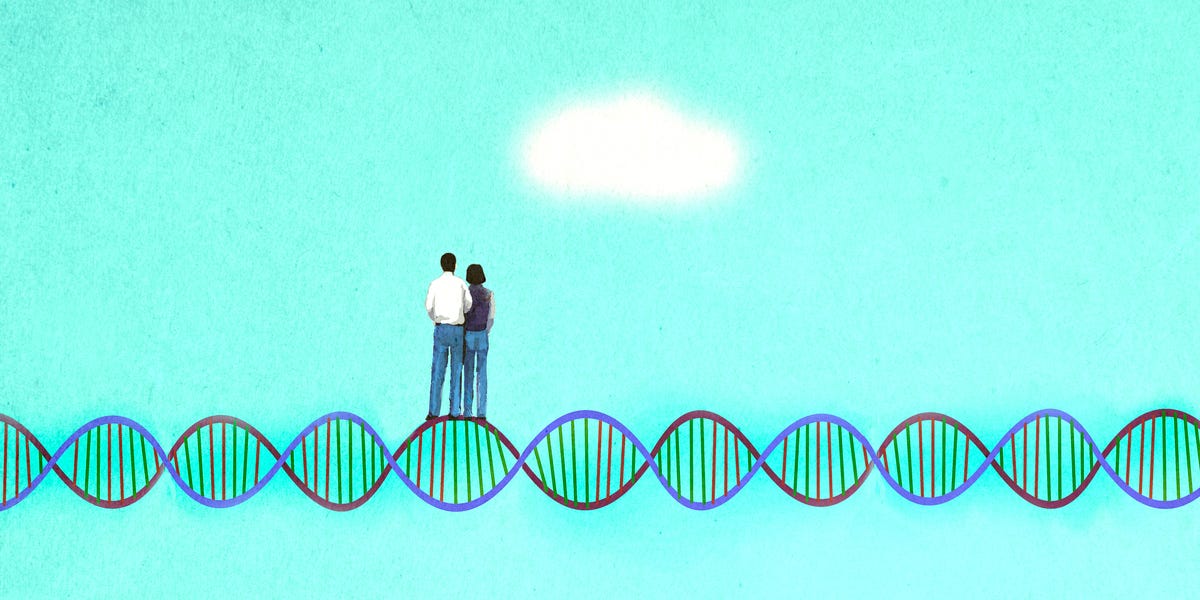
3 min readBesides the clichéd “must love dogs” and “likes long walks on the beach at sunset,” what do people actually look for when seeking a partner? Dating profiles barely touch on the qualities someone might imagine in their ideal match, and bathroom selfies aren’t doing us any favors. Sometimes the answer is so subconscious, it can only be found in our genes.Trying to find the person who’s right for us is less random than we might think. When individuals with similar traits find each other, it’s known as assortative mating, which continues shaping the genetic makeup of human populations and is intentional—in a way—whether those couples realize it or not. In the back of our minds are criteria, such as education or certain behaviors, that potential matches have to meet. This can partly explain why some families have been known for certain traits for generations. Researcher Gretchen Saunders of the University of Minnesota decided to find out just how prevalent this phenomenon is by comparing genetic signatures in couples and across generations.“Understanding mate choice, including how it is changing over time, is critical for both social science and genetics research, as it informs patterns of social homogamy and inequality while also affecting key assumptions in quantitative genetic and genetic epidemiological models,” Saunders, who specializes in statistical genetics and psychology, said in a study recently published in Behavior Genetics. When partners carry similar traits that can be inherited, their children are also highly likely to be born with them, which can affect how those traits end up being distributed throughout a population. This doesn’t necessarily mean people explicitly choose each other based on those traits alone. It’s more likely that they already associate with groups that share the traits, and through those social and professional connections, they may eventually find a partner in such a group. Saunders based her research on eight specific traits ranging from physical features to education to habits that affect health. These included the visible factors of height and body mass index along with education level. She added five more having to do with drinking and smoking, such as frequency and the start or end of these habits.Each subject who provided information for the study was given a polygenic score. These are numbers that merge the effects of different DNA variants in the genome to gauge a person’s genetic predisposition to a phenotypic, or observable, trait. Polygenic scores can also predict the likelihood of inherited diseases, which was not a factor in Saunders’ research. She was especially looking for similarities in polygenic scores between spouses and siblings. The phenotypic factor that was most similar between married couples was education level, which wasn’t surprising given that sociocultural variables have been observed in couples with phenotypic similarities for decades. Education was followed closely by alcoholic drinks per week. Less obvious links were body mass index, smoking initiation, and smoking cessation.Seemingly unrelated traits were often found together. Those who had completed a higher level of education were often found to prefer partners who were taller, had a lower body mass index, and lower likelihood of smoking. Heavy smokers and drinkers tended to be attracted to those with similar habits and a higher body mass index. Polygenic scores based on this data revealed that while spousal genetic correlations were not as strong, they were still substantial. Traits already determined before these subjects became couples, such as height and body mass index, were the most correlated, while traits that were subject to change over time, such as cigarettes or drinks per day and smoking cessation, showed less of a connection. Comparing siblings showed evidence for partner matching based on these traits in earlier generations.“Apparent differences in genetic architecture across cohorts may reflect not only temporal changes in assortative mating within populations, but also cross-cohort differences in underlying social structure, opportunity, and behavioral norms that shape mating patterns and phenotype distributions,” Saunders said.So while DNA isn’t necessarily destiny, it may be, at the very least, pointing you in the right direction.Elizabeth Rayne is a creature who writes. Her work has appeared in Popular Mechanics, Ars Technica, SYFY WIRE, Space.com, Live Science, Den of Geek, Forbidden Futures and Collective Tales. She lurks right outside New York City with her parrot, Lestat. When not writing, she can be found drawing, playing the piano or shapeshifting.
Your Genes May Already Know Who You’ll Fall in Love With
Full Article
Original Source
Read the full article at Popularmechanics →KhanList aggregates and links to publicly available news content. We do not host full articles from third-party sources. Always verify important information with original sources.