
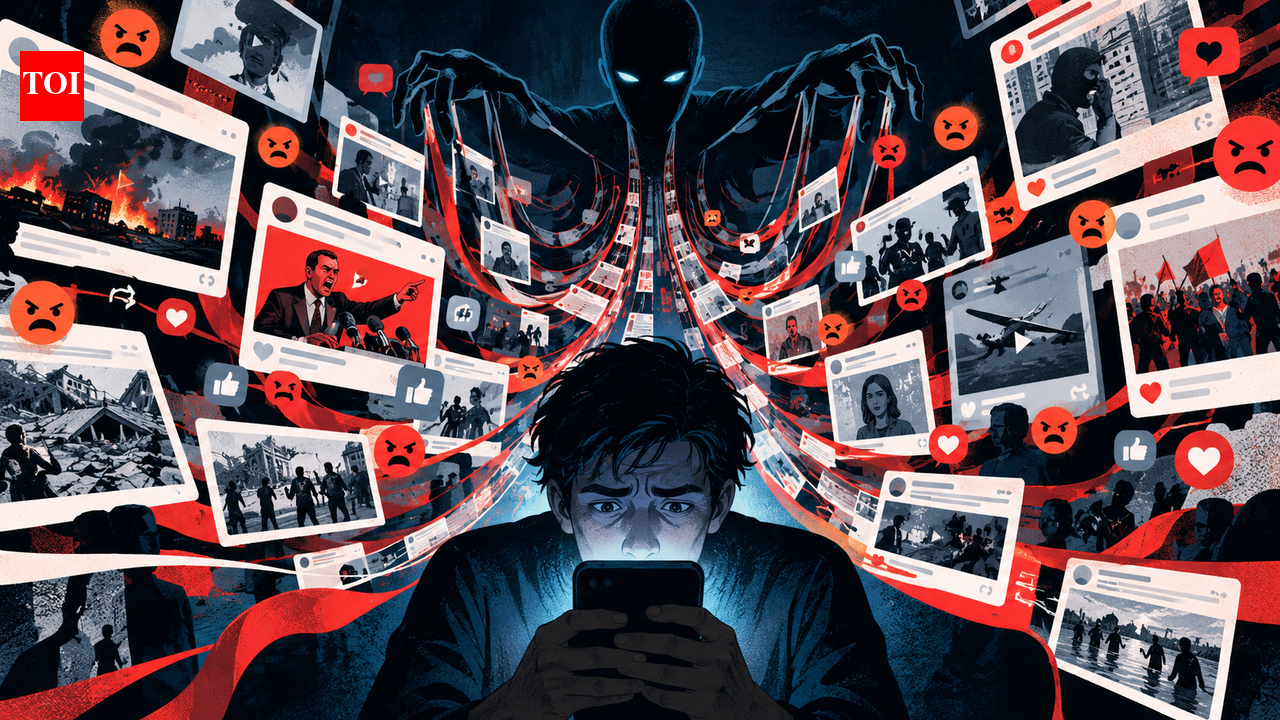
Your social media algorithm is designed to keep your enraged 24X7 (AI generated)In most Indian homes there used to be one person who read the newspaper properly, front to back, in order, and woe betide anyone who pulled out the sports page before he was done. The front page came first, with its riots and rail accidents and ministers saying things they would deny in the evening.Then came the edit page, where someone calmer explained what all that noise actually meant. Then the letters section, where a retired schoolteacher from Medinipur would disagree, very politely, with a retired bank manager from Pune.At the very end there was the crossword, filled in slowly with a blunt pencil while the tea went cold. When the last clue was cracked, the paper was folded, tucked under a cushion, and the reader got up to shave. The world had been terrible that morning, as it usually is, but the paper knew when to stop, and so did he.We wake up to a war zone every dayNow look at how most of us begin the day. We wake up, reach for the phone before our eyes are fully open, and start scrolling. Within a few minutes we have seen a video from a war zone, a scandal from some state capital, a clash inside a lift in Noida filmed on someone’s phone, and a post written with the sole aim of making us disgusted. Before our feet have touched the floor, the heart is beating faster, the mind is running ahead, and a vague sense of dread has settled in for the day.Nothing has happened to us, yet we feel as if a lot has. This is not because the world suddenly became worse. It is the result of a change in design, a change in how news reaches us, and to understand why the phone leaves us so tired and so angry, we have to understand what the old newspaper did and what the feed took away.The newspaper was a bundle. The front page gave you the problem, the edit page gave you an argument about it, the letters page gave you a fight over it, and the crossword gave you permission to put it all down. Each part had a job, and together they walked you through the bad news and then out of it.You were upset, then you understood a little, then you heard other people argue, and then you were done. Psychologists would call that closure. Your father simply called it finishing the paper.Moral indignation drives rapid user interaction.The feed kept only the front page. It threw away the edit page, the letters and the crossword, and then it did something cleverer and crueller: it put the front page on loop. There is no last page anymore. A newspaper came every morning and ended on Page 16.The feed comes in an endless scroll that never ends, and that ending was removed on purpose. Aza Raskin, the designer who invented infinite scrolling in 2006, has since said publicly that he regrets it. His point was simple. When you remove the natural places where a person would pause, you also remove the moments when they might decide to stop. Your thumb keeps going because nothing ever tells it to rest.Your feed wants you enraged, not informedThe next thing to understand is what the feed wants from you. It does not want you informed; and it certainly does not want you calm. It wants your attention, for as long as possible, because your attention is what it sells.The quickest way to grab attention is to excite or upset you, so the feed is built for arousal, not resolution. A calm, satisfied person closes the app and goes to make breakfast. An agitated person keeps scrolling. The machine learns this very quickly and serves more of whatever agitates.So you get every city’s crime, every flood, every atrocity, every outrage, everything that has gone wrong anywhere, all of it, all day, and none of it comes with a way to do anything about it. You get the pain of the entire world with no path out of it.Angry you is good business for social media companies.Your body takes all this personally. Deep inside the brain is a small almond-shaped part called the amygdala, which works like a smoke alarm. When it senses danger, it rings loudly, and it does not check whether the danger is in your room or on a screen 2,000 kilometres away.It sends the alarm to the body, which releases stress hormones, cortisol and adrenaline, the same chemicals our ancestors needed when a tiger stepped out of the forest. Those chemicals prepare you to fight or to run. But you are sitting on your bed, holding a phone. There is no tiger and nowhere to run, so the chemicals have nowhere to go. They stay in your system, and you go on scrolling, and the alarm rings again and again.Complete mental breakdown is where we are at…Done once, this is harmless. Done every day for years, it wears you down. Sleep gets worse. Small things start to irritate you. You feel tired without having done anything tiring.The part of the brain right behind your forehead, the prefrontal cortex, which acts like the sensible elder in the family who tells you to think before you speak, gets pushed aside whenever you are in that heated state.Over time it becomes harder to concentrate, harder to control impulses, and easier to snap. People who live like this start reading ordinary things as threats, a neighbour's look, a colleague's message, a stranger's tone.This is not only a matter of morals or manners. It is a matter of health, and a lot of us are quietly unwell. There is a deeper injury too, and psychologists call it “learned helplessness”. It describes what happens when a person, or even an animal, faces something painful again and again and finds that nothing they do can stop it or escape it.After enough of this, the brain draws a conclusion. It decides that action is pointless, and it stops trying, even when a way out later appears. Human beings can handle a great deal of bad news as long as they can do something about it. Tell a village that the river is rising and they will build a wall. Tell them every day that rivers are rising in 40 countries, and that they can do nothing about any of them, and eventually they stop listening, or worse, they stop caring.That is our condition now. We are fully informed and completely stuck. We have become spectators at a fire that never goes out.Spectators get restless, and restless people get angry, and this is where we need to be careful with words.Misinformation is having a field day!Outrage isn’t anger. One ends, the other doesn’tAnger and outrage are not the same thing. Anger, at its best, is useful. It tells you that a line has been crossed, and it gives you the energy to go and fix a specific problem. The parent who is angry about a broken streetlight writes to the municipality and gets it fixed. Outrage is anger with a loudspeaker, directed towards no one in particular. It is loud, and it asks you to do nothing except react.The platforms love outrage, and they have good reason to. A team of researchers led by William Brady, publishing in the journal PNAS, found that adding just one moral and emotional word to a post, words such as shame, hate or corrupt, made it roughly 20% more likely to be shared.The researchers explained why with a simple idea. Human beings are wired to show which side they are on, to signal to their group that they are good and the other lot are bad. Emotional, moral words catch our eye faster than plain facts do. And the platform's system notices which posts grab eyes fastest and pushes them to even more people.Outrage makes us want to believe in liesSo the most heated language gets the biggest reward, and everyone learns to speak a little more heatedly tomorrow. It is a loop.It gets worse. Further research by psychologists Brady, Molly Crockett and colleagues found that sources of misinformation tend to stir up more outrage than trustworthy news outlets do.Outrage also makes people less likely to check whether something is true. So the angriest stories are often the least reliable ones, and they are precisely the stories people share without even opening them. The lie travels in a jet plane while the truth is still looking for e-rickshaw.Then there is the strangest trick of all, which is that sharing feels like doing. When you repost an angry video or add a furious comment to someone's post, you get a small feeling of having acted, of having stood up for something. It costs you nothing and changes nothing, but for a moment it feels like a duty performed. Call it fake catharsis.A quote-tweet is action without the action. Ten years ago we laughed at this and called it slacktivism. Today, for millions of people, it is the only activism they do.And here is the part we rarely talk about. Rage with nowhere to go does not evaporate. Psychologists who study what they call displaced aggression have shown that when tension builds up and finds no outlet, it gets stored and later spent on whoever happens to be nearest and weakest.The delivery boy who is ten minutes late. The stranger in the comments. The cousin in the family WhatsApp group who forwarded the wrong thing. The minority of the week, whoever the feed has decided that is. The algorithm manufactures the rage, and our near and dear ones pay the price.There are people who are very happy with this arrangement. A population that feels angry and helpless is a population looking for an explanation, and grievance always goes looking for an ideology.The most heated language gets the biggest reward.Societal frustration turned into big businessPolitical and commercial players who have one to sell find willing buyers. They take that vague, floating anger and give it a shape, a target and a slogan, and in doing so they turn a society's frustration into a business that grows with every scroll. A country can survive a lot of bad news. It struggles to survive a population that has been trained to hate on schedule.If all this is hard on adults, it is much harder on children. A teenager's brain is still under construction. They are working out who they are, how to read faces, how to make up after a fight, how to sit with a difficult feeling until it passes.Social psychologist Jonathan Haidt, in his book, The Anxious Generation, argues that between 2010 and 2012 childhood itself changed shape. It moved from a play-based childhood, spent outdoors with friends, to a phone-based childhood, spent alone with a screen. He points to four kinds of damage.It's all manufactured and not for your benefit.Time spent with friends in person dropped by roughly half from 2012 onwards, so children got less practice at the messy, real business of getting along. Sleep suffered, because notifications and late-night scrolling cut into the hours a growing brain needs most. Attention broke into little pieces, so sitting with one hard problem for a long time became harder. And the endless comparison, with perfect faces and public counts of likes and views, made a whole generation feel permanently not good enough.The numbers from the United States, where this has been studied most closely, are frightening. Suicide rates among children aged 10 to 14 more than doubled between 2010 and 2020, and hospital admissions for self-harm rose sharply from the early 2010s.Researchers still argue over how much of this the phone alone explains, but the timing has made a lot of parents and governments sit up. We are showing children a world on fire before they have even learnt to cross the road alone. Anxiety mixed with powerlessness, at the very age when a person is deciding who they are, is a cocktail nobody should be pouring for a child.Why governments are intervening globallyThis is why the world is changing its mind about tech companies. For about two decades, roughly from 2000 to 2019, governments let platforms police themselves, with community guidelines and an age box that any ten-year-old could tick.From around 2020, Europe began asking for transparency, and its Digital Services Act now requires the biggest platforms to offer users a feed that is not built on profiling them, with fines of up to 6% of a company's global turnover for failing.Algorithm designed to alter human behaviour.Now a third phase has begun, in which governments are no longer only asking platforms to explain their design. They are starting to change it.Australia has gone furthest. Its Social Media Minimum Age law came into force on 10 December 2025 and requires platforms to take reasonable steps to keep children under 16 off their services.It is aimed squarely at platforms that use the features we have been talking about, recommendation systems, infinite scrolling, likes and disappearing stories. In the first few weeks, platforms removed about 47 lakh underage Australian accounts. Companies that fail to comply can be fined up to A$109.2 million, roughly ₹600 crore.In September this year Australia went a step further with a Digital Duty of Care bill. The idea is borrowed from workplace safety law: just as a factory owner must keep the shop floor safe for workers, a platform must keep its space safe for users.The bill targets the risky design features directly, the recommending algorithms, the endless feeds, the counts of likes, and the content that disappears. Under what the government calls: “My Feed, My Way”, platforms must let people switch off algorithmic recommendations entirely and choose a simple feed, in time order, showing only the accounts they have chosen to follow.Prime Minister Anthony Albanese summed it up neatly: “It’s not about giving government control. It’s about giving people control.” That is the key. Australia is not asking for less content. It is asking for a feed with an ending.Others are following. Britain is considering a ban on social media for those under 16, and for 16 and 17 year olds, a default curfew that would switch off feeds between midnight and 6 in the morning. And in India, parliamentary panels have begun discussing platform accountability, algorithmic transparency and user safety, though no firm law has yet taken shape.That homogeneous echo chamber isn't random.The 'diversity' powder kegWe cannot afford to take our time. India has hundreds of millions of people who came online through cheap mobile data, many of them for the first time, and many of them in a phone-first world without ever having had a newspaper habit to compare it with.We are also among the most diverse countries on earth, and diversity is exactly the kind of soil in which outrage grows fastest. We have already seen forwarded rumours turn into mobs, and online fury turn into real fights on real streets.An engine built to reward rage, running unchecked in a crowded and plural country, is not just a mental health problem. It is a question of whether neighbours can keep living next to each other.The good news is that the fix does not need censorship. Nobody needs to decide which opinions are allowed. What India needs is what Australia is attempting: make platforms explain how their algorithms choose what we see, give every user the right to switch to a plain feed of the people they actually follow, and bring back the stopping points that were removed on purpose. These are design rules, not speech rules.It is tempting to say all of this comes down to willpower, that people should simply use their phones less. But we did not tell factory workers to breathe less when the air was toxic. We made laws about the chimneys. We did not ask labourers to be braver about falling from scaffolding. We made safety rules for construction sites.A feed designed by some of the cleverest engineers in the world to keep you from stopping is not a fair fight for a tired adult, let alone a 13-year-old. The problem is in the design, so the solution has to be in the design too.The old newspaper was not perfect. It was often biased, sometimes boring, and occasionally wrong. But it did one thing that we have forgotten to value. It showed you the troubles of the world, helped you think about them, let you argue about them, and then gave you a crossword and sent you on your way.Somewhere tonight, someone will fold a paper and put it under a cushion. The news inside it is just as bad as the news on your phone. The difference is that it ends.
Your feed isn't random. The algorithm is built to keep you angry, anxious & scrolling
Full Article
Original Source
Read the full article at Timesofindia →KhanList aggregates and links to publicly available news content. We do not host full articles from third-party sources. Always verify important information with original sources.